Comparison
of "Viceroy" Autavias --
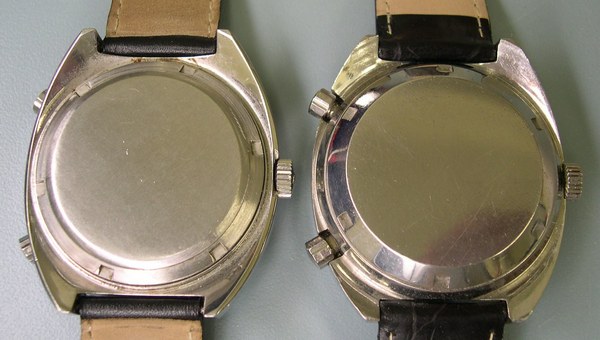
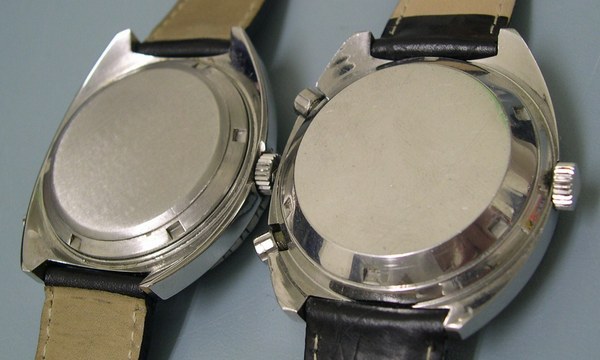
Reference 1163V (left) and Reference 11630
(right)
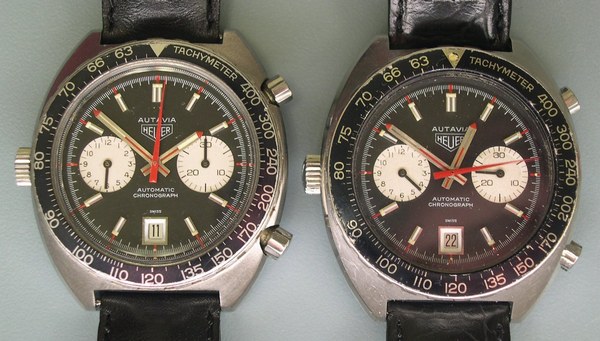
From May through December 1972, Heuer produced a series of
Autavia chronographs that were offered by the Brown & Willaimson Tobacco Company as a promotion for Viceroy cigarettes. Customers could send proofs of purchase for a carton of Viceroy cigarettes (10 packs) and receive an Autavia chronograph (Reference 1163) for $88. At the time, these "Viceroy" Autavias were being offered, Heuer dealers were
offering comparable automatic Autavias (black
dial with white registers) for a list price of $200.
It
is difficult to present a comprehensive
description of all the variations of the Viceroy
Autavias. At $88 per watch, the Viceroy
promotion was very successful, and Heuer was
hardly able to produce the watches fast enough
to meet the demand. After beginning with cases
made by Piquarez, Heuer had to add a second
supplier (Schmitz), and cases from both
suppliers were used throughout the production of
the Viceroys. So over the relatively brief period of the promotion, Heuer used
cases of varying thicknesses; two different
styles of case-backs; cut-outs for the pushers
that opened to either the front or the back (or
both); and two different styles of bezels. Cataloging and
describing the various "Viceroys" is made more
difficult because many of these elements were
interchangeable (for example, either style
case-back -- shallow or deep -- could be used
with either of the cases -- 1163V or
11630).
Accordingly,
the following table is not an exhaustive attempt
to describe each variation of the Viceroy
Autavia that was produced. Rather, it describes
certain elements that should be found together
in a "genuine" Viceroy Autavia. (For example, if
the pushers are visible from both the front and
the back of the case, then the case was made by
Schmitz, and the case-back should be the deeper
variety, also made by Schmitz.) By describing
certain of these combinations, this table covers
the more common variations of the Viceroy
Autavia.
In
reviewing the "Viceroys", it is important to
keep in mind the distinguishing features of all
the "Viceroy" chronographs -- they had (a) an
"economy" dial (with all 12 numeral on the hour recorder, (b) brushed steel hands with red inserts and red triangular tips, and (c) a tachymeter (T) bezel. These chronographs were sold by Viceroy
for $88, during the period from May through December 1972. During this period, Heuer continued to market
its regular (non-Viceroy) Automatic Autavias
through its customary channels, however, these
had the "standard" (non-economy) dial, polished
steel hands, minute / hour (MH) bezels, and a
selling price of either $200 (for the Reference 1163 model, with plastic crystal) or $275 (for the Reference 1163 model, with a mineral crystal). All this becomes more complicated when we realize that chronographs physically identical to the Viceroys may have been offered by dealers for some period shortly before the Viceroy promotion and were certainly offered by dealers after the Viceroy promotion had ended.
|
|
Reference
1163V
|
Reference
11630
|
- Outer
Rotating Bezel
|
narrower
(3.3 mm across surface);
no luminous dot
|
wider
(4.2 mm across surface);
luminous dot in
triangle
|
- Inner
Bezel
(between dial and
crystal)
|
polished
steel (shiny) tension
ring
|
matte
black support ring
(flange)
|
- Crystal
|
plastic
(domed)
|
mineral
(flat)
|
- Case-Back
|
- shallow
(if case made by Piquerez)
or
- deep,
with sides at 45 degrees (if case
made by Schmitz)
|
- shallow
(if case made by Piquerez) (less common) or
- deep,
with sides at 45 degrees
(if case made by
Schmitz)
|
- Pushers
|
- fully
visible from front, and
partially obstructed from back (if
case made by Schmitz)
or
- fully
visible from both front and back
(if case made by
Schmitz)
|
- fully
visible from back, and partially
obstructed from front (all versions,
whether made by Piquerez or
Schmitz)
|
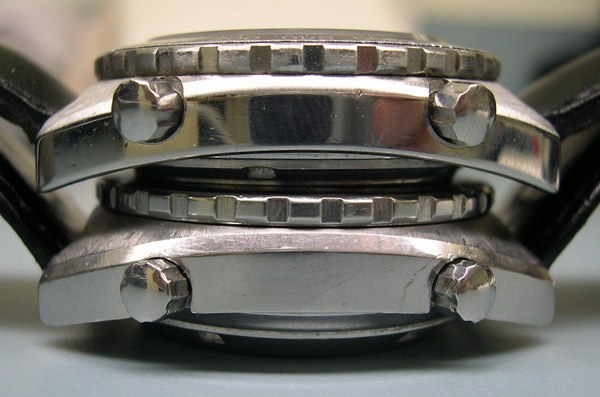
- Thickness
(top of bezel to back of
case)
|
13.0
mm
|
14.6
mm
|
- Price
When New
|
$88
(through Viceroy
promotion)
|
$88
(through Viceroy
promotion)
|
Standard
Features of all Viceroy Autavias
--
- economy
dial -- polished markers, with white
inserts
- brushed
steel hands, with red tips and red inserts,
and thin luminous material
- bi-directional,
ratcheting Tachymeter (T) bezel
- Cal
12 movement
- measurements
across case (42mm), lug-to-lug (47.2mm) and
between lugs (20mm)
|
|
Some
Additional Notes regarding the Viceroy Autavias
--
- The
hands on the Viceroys were brushed steel,
with red inserts and a
narrow
(thin) insert of luminous
material
;
the brushed steel hands on the Monacos
had
wider
(thicker) luminous
inserts;
over time, many of the Viceroy-style hands
were replaced with the Monaco-style hands, as
either a part of routine servicing or because
the customer requested the change (to
increase the visibility at night); in the
photo of the Viceroys (above), three of the
main hands are Viceroy-style hands, with the
hour hand on the 1163V being the Monaco-style
hand (wider, thicker insert).
- In
terms of the
visibility
of the
pushers,
there were actually three variations
--
- on
the earlier 1163Vs (manufactured by
Piquerez), the pushers were
fully-visible
from the
front
and partially obstructed from the back (as
on the sample shown on the left); this was
problematic, as dirt would get into the
cut-outs, become compacted, and "gun-up"
the pushers (requiring a major
servicing).
- on
some of the later 1163Vs (manufactured by
Schmitz), the pushers were
fully-visible
from both the front and the
back
of the case; these cases were manufactured
by Schmitz, to supplement the production
by Piquerez; these cases will always have
the deeper Schmitz back.
Click
here
to see samples of these
cases.
- on
the 11630, the pushers were
fully
visible from the
back
and
partially obstructed from the front (as on
the sample shown on the right).
- The 11630
cases were made by both Piquerez and Schmitz --
those made by Piquerez had the shallower
case-backs and those made by Schmitz had the
deeper case-backs. The Schmitz version of the
11630 seems to be more common.
|