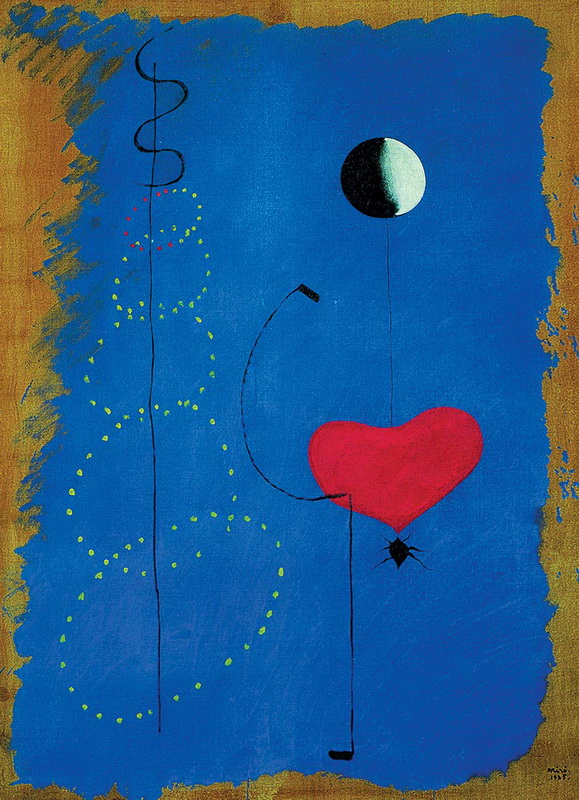
In his book, How Banksy Saved Art History, Kelly Grovier presents 43 works by the street artist, Banksy, and for each of the Banksy works Grovier presents a “classic” work that the Banksy work references, re-interprets or reimagines. For example, we see Girl with Balloon (Banksy, 2002) paired with Joan Miro’s Dancer II (1925) and Love is in the Air (Banksy, 2003) paired with a bronze figurine of Malqart, a Phoenician god, from the seventh century BC. In each instance, Grovier explains the relationship between the Banksy work and its antecedent.

In his introduction to the book, Grovier observes, “Time is a myth. The most formidable art alters the past every bit as much as it shapes the future. However mystical it may seem, the work of every great artist leaves palpable traces on the great works that preceded it.” I continue to reread and think about this passage. Sometimes I substitute the words “watch design” for “art” and the word “designer” for “artist”. If Grovier’s observation is accurate for great art and artists, wouldn’t it also be true for the great watches and watch designers?
But what does it mean to say that a new piece of art (or watch) alters the past? The Carrera Reference 2447 chronographs produced in 1963 were physical objects that followed the design created by Jack Heuer. As physical objects, each watch remains unchanged from the time that it was produced, subject only to changes caused by use or aging. Of course, a new design can alter the way we view previous designs and objects, but can a new design (or a new watch) actually alter the past? How can today’s art (or today’s TAG Heuer Carrera) leave palpable traces on the works that preceded it?
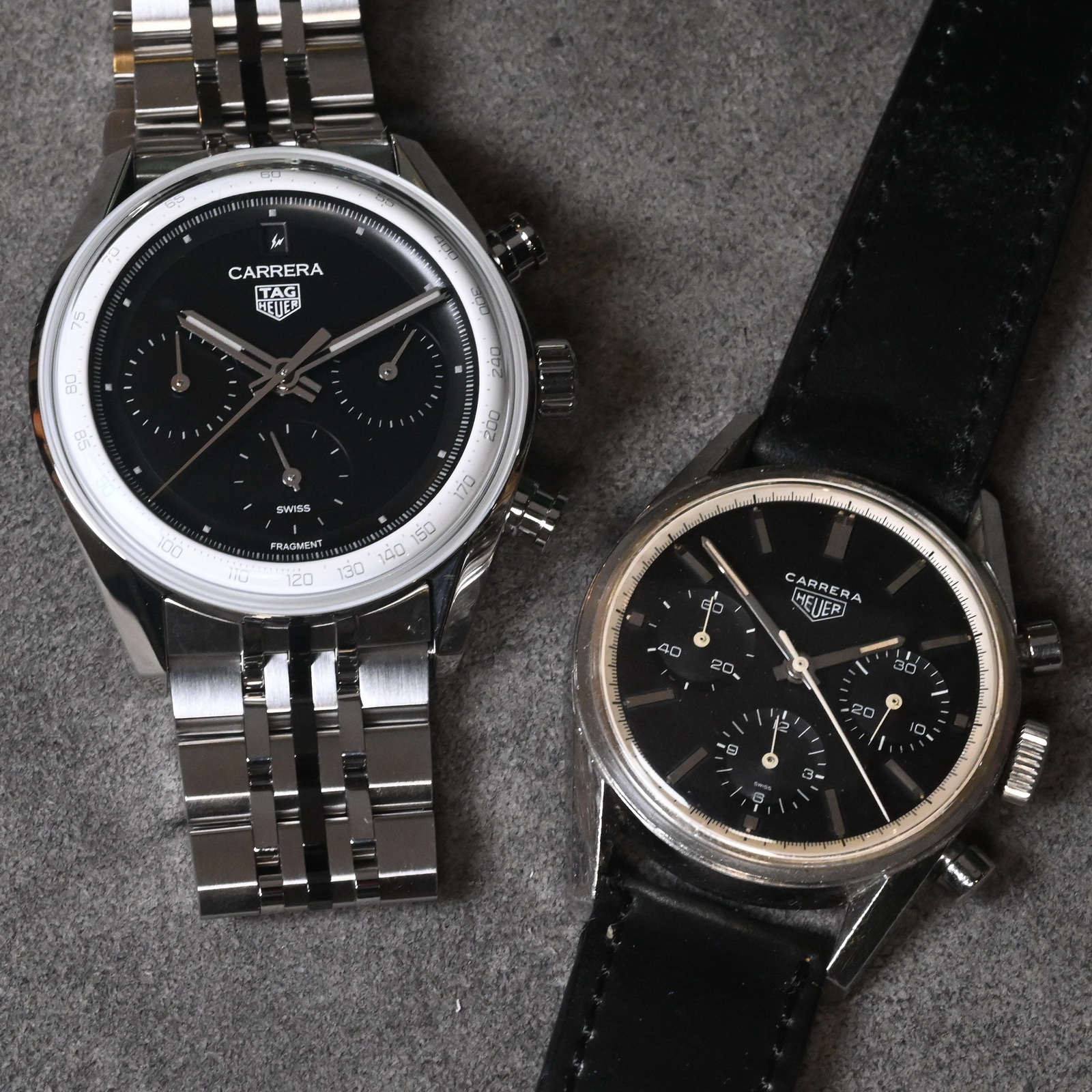
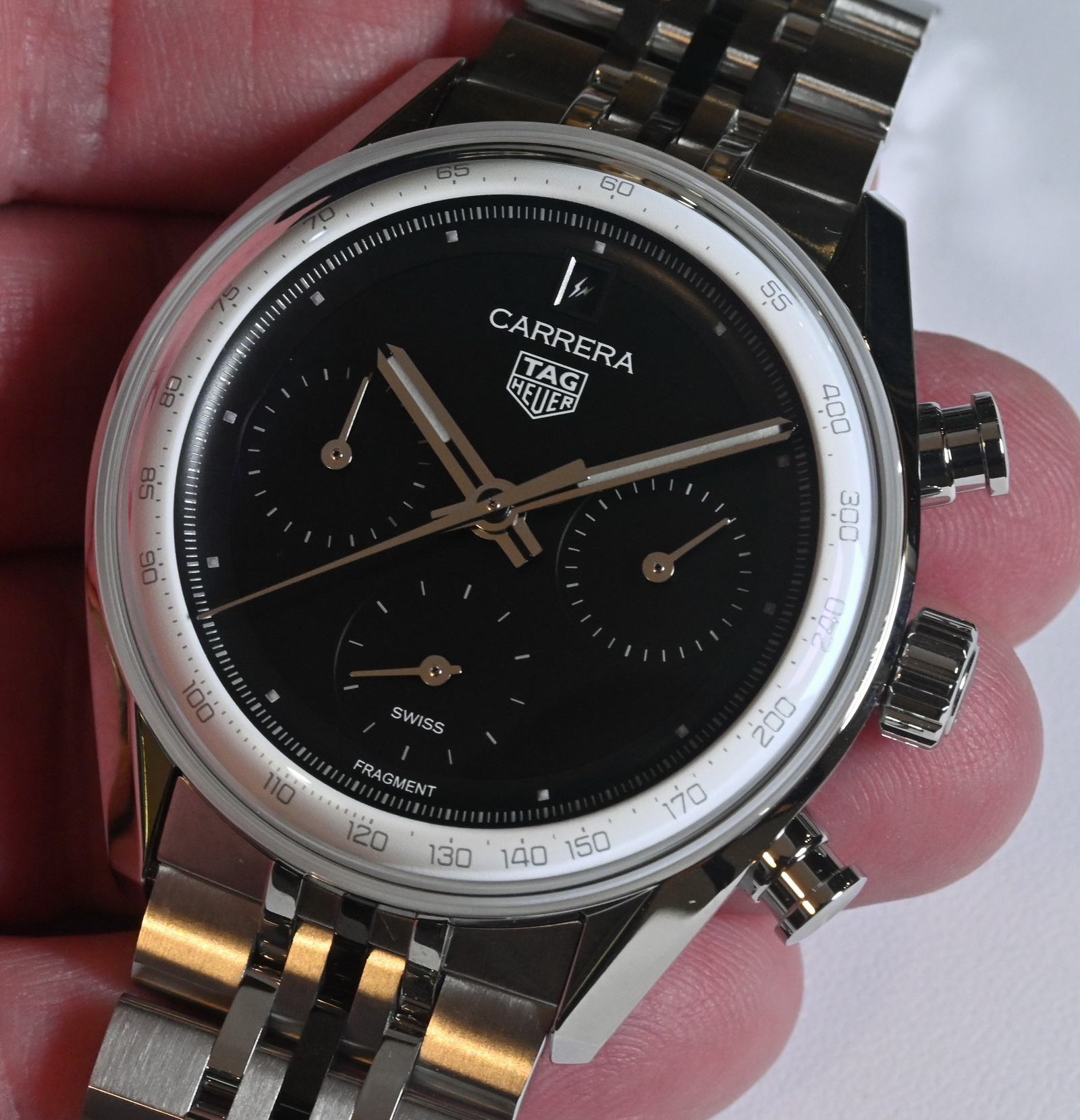
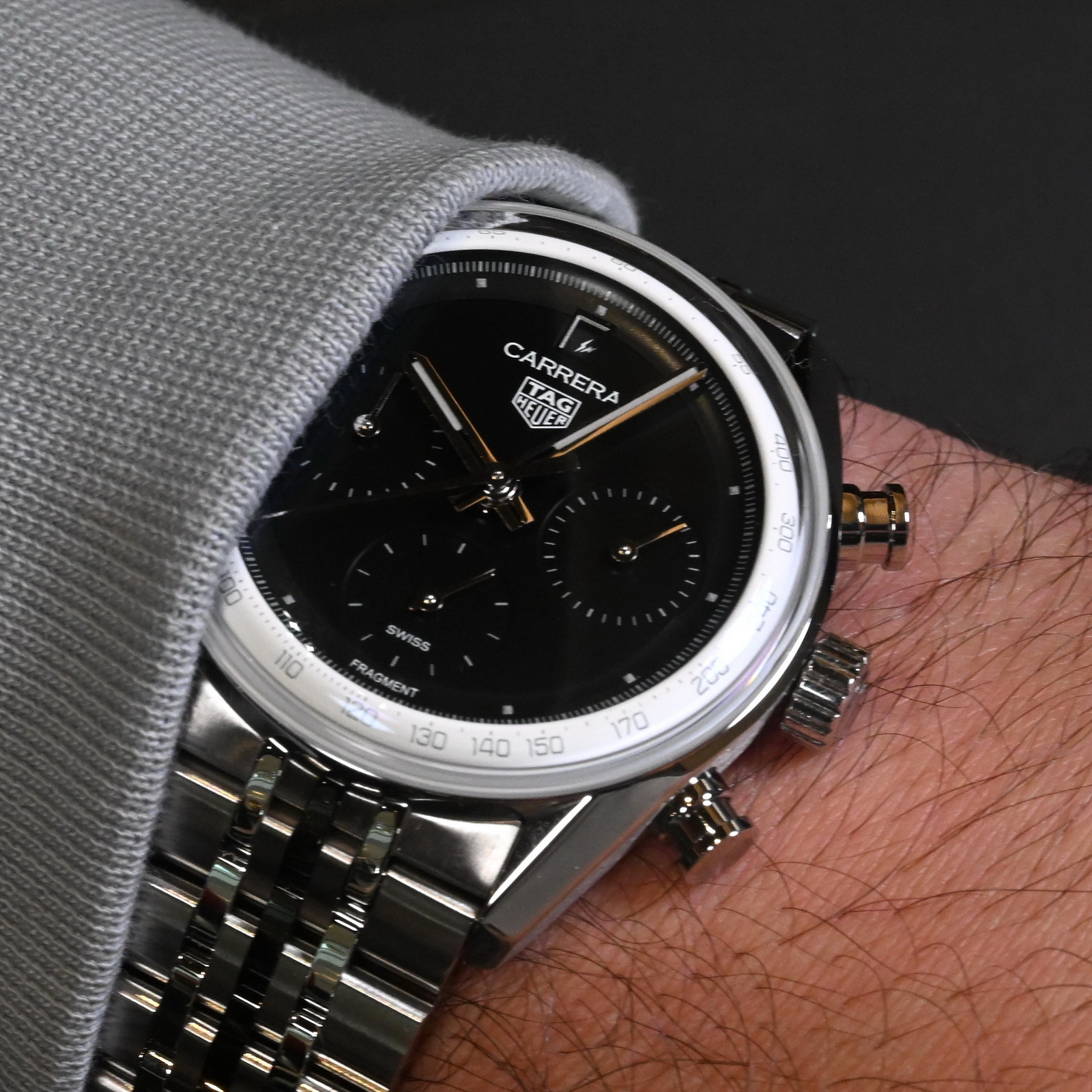
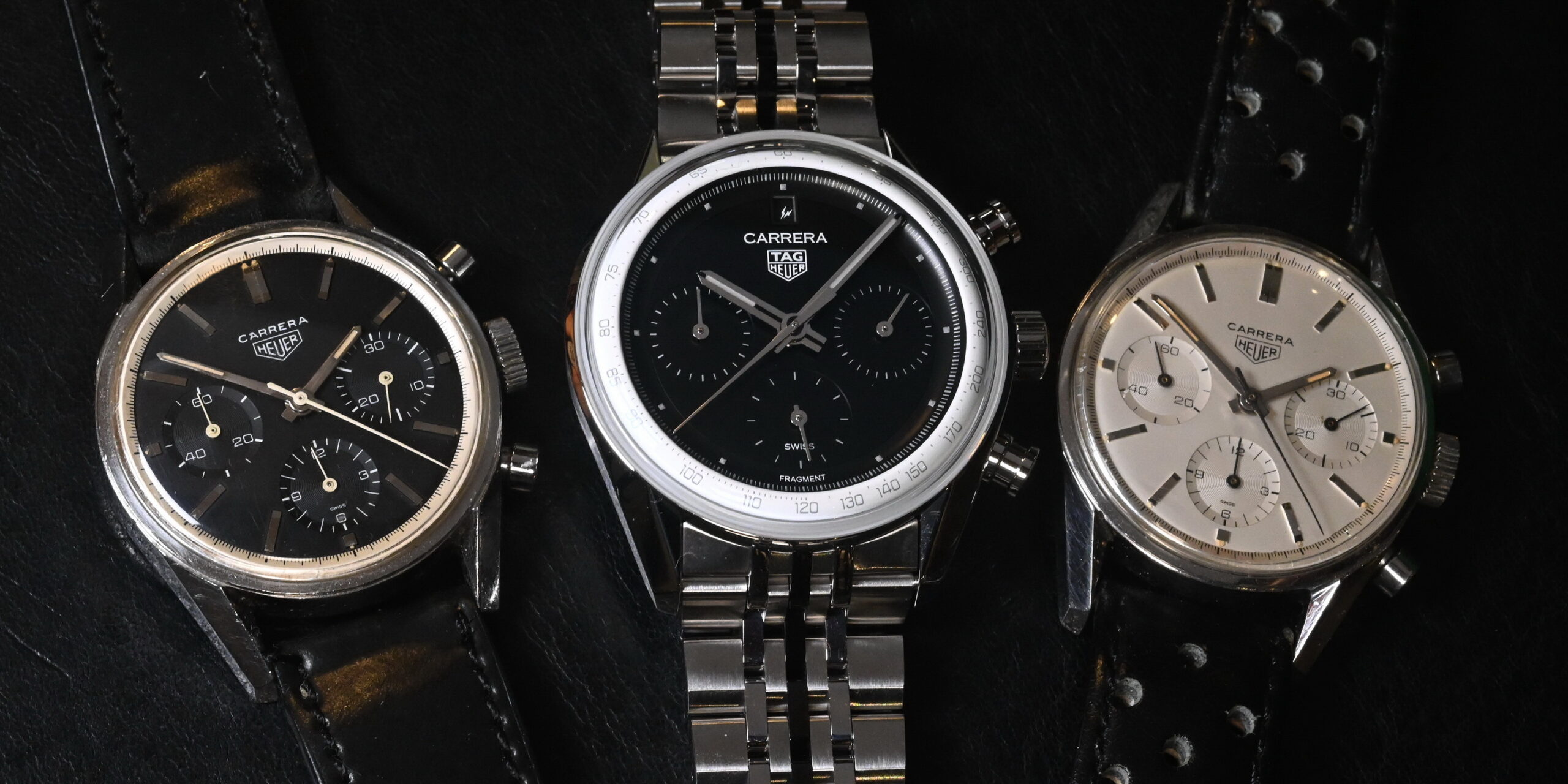
Today, TAG Heuer and Fragment Design have introduced the new Carrera Chronograph x Fragment Limited Edition, designed by Hiroshi Fujiwara, head of Fragment. Clearly, Fujiwara was inspired by the first Carrera chronographs from 1963 (specifically, the Reference 2447 N). I believe that Fujiwara is a great artist / designer, whether operating in the realm of streetwear or watches. So I go back to Grovier’s words and ask myself whether and how the new Fragment Carrera alters the past. I study the vintage Carrera chronographs in my collection looking for the palpable traces of Fujiwara’s work. I ask myself how the experience of seeing and wearing the newest Carrera has changed my vintage models, or at least my perception of these models.

Having spent some time with the new Fragment Carrera, I can report that while the new watch may not have actually altered the “classic” Carrera chronographs in my collection, on a physical level, this watch has changed the way that I view and understand these predecessor objects. I see the approach that Fujiwara has taken in designing his Fragment version of the TAG Heuer Carrera, and must compare it to the approach that Jack Heuer employed in designing the very first Carreras, back in 1963. What was Jack Heuer trying to create with the original Carrera? How was the new Carrera different from the chronographs that preceded it? What constraints did Heuer face, in terms of suppliers and available materials, as well as commercial realities? Can the factors that explain the design of the original Heuer Carrera help us understand the new TAG Heuer Fragment Carrera?
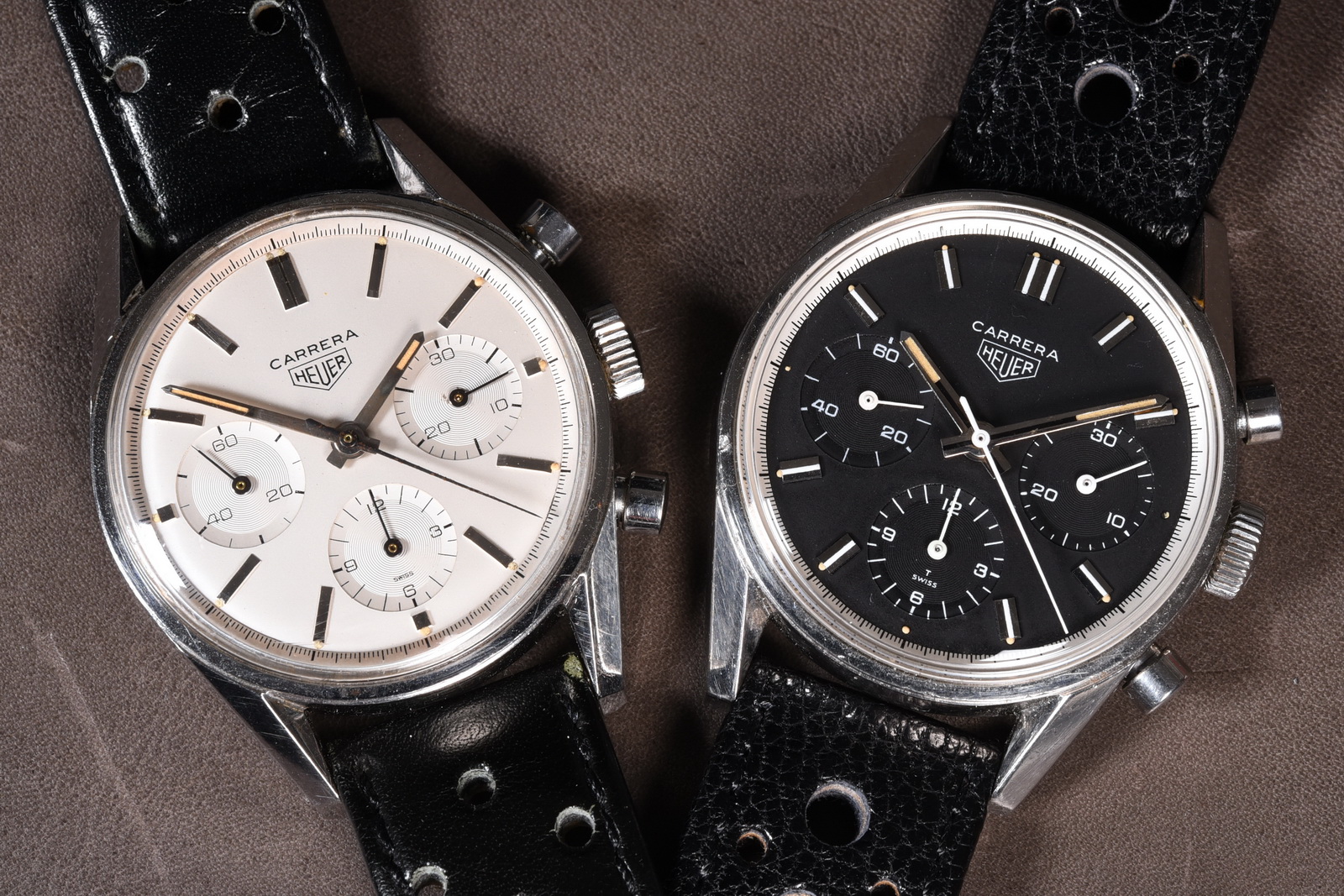
The story of Jack Heuer’s “design brief” for the first Carrera is familiar to vintage chronograph enthusiasts. Jack Heuer would employ modern design to create a chronograph that would be the ideal tool for the racer at the track, while also being an elegant timepiece for the black-tie victory dinner. Jack Heuer would employ minimalism to create a clean dial that would ensure legibility. The 1963 Carrera had to be rugged, with a strong, waterproof stainless steel case and oversized crown and pushers to be operated by the racer or a crew member. Jack Heuer was experienced in using modern design to build timepieces for racers, having redesigned Heuer’s dashboard timers (circa 1958) and its catalog of stopwatches (circa 1960).
Still, in designing timepieces, Jack Heuer worked within the limitations of his era. In 1963, the registers of a chronograph had numerals, to indicate the hours and minutes. Chronographs of the period typically had prominent markers on the dial to indicate the hours — sometimes numerals, sometimes applied indices, and sometimes painted indices. An inner flange was utilitarian, a place to print the hashmarks for seconds and 1/5 seconds, while also serving to secure the crystal in place.
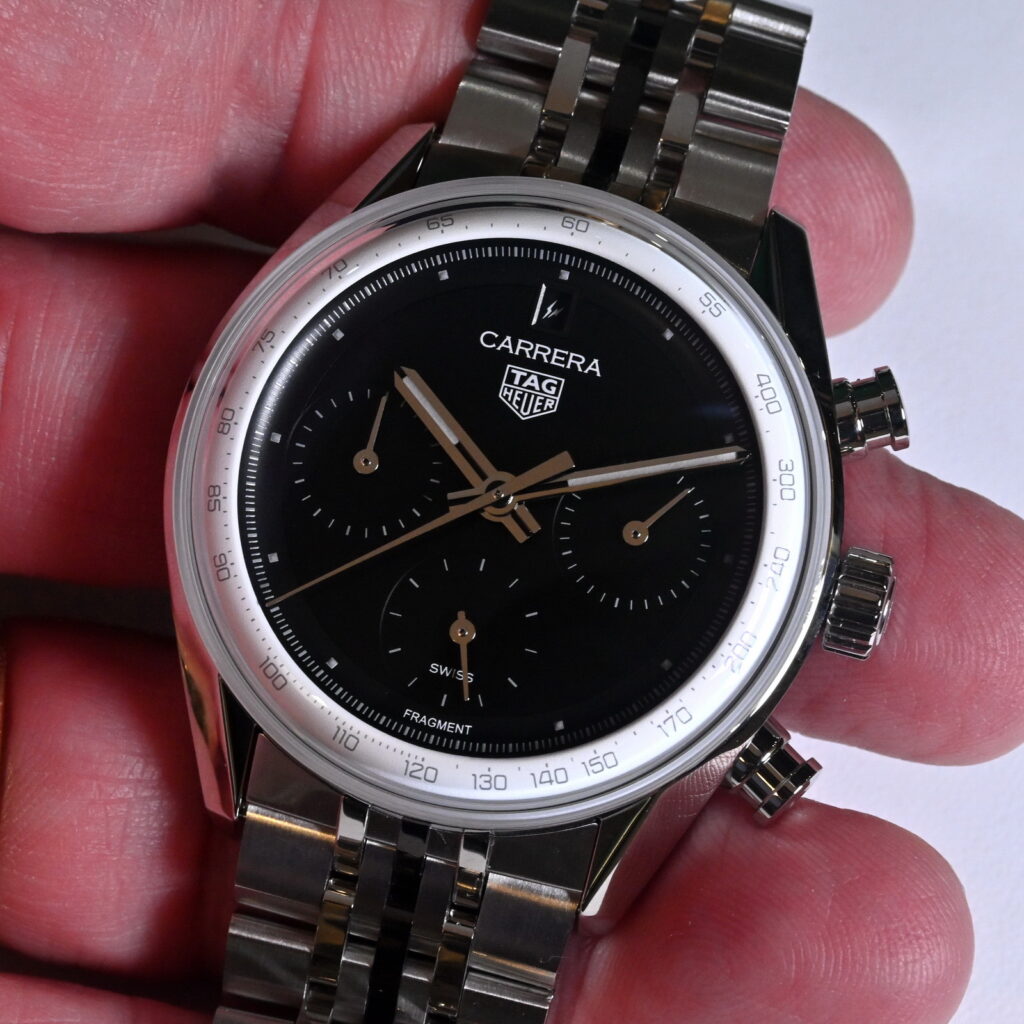
I imagine Hiroshi Fujiwara reviewing this same design brief in 2025 – with its emphasis on modernism, minimalism, legibility and utility – and showing Jack Heuer what those elements might look like, in a watch that will capture the spirit of the original Carrera. In 2025, Fujiwara can say to Jack Heuer, “I understand your design brief; I understand your love of minimalism and a clean dial. And 62 years later, let me show you what that looks like.” The indices on the dial to mark the hours can be small dots; there is no need for numerals on the three recorders; and, of course, the tachymeter is no longer being used as an instrument to compute speeds over a measured mile.
The Fragment Design Playbook
This is Hiroshi Fujiwara’s third collaboration with TAG Heuer. In November 2018, TAG Heuer introduced the TAG Heuer Carrera Heuer 02 By Fragment Design / Hiroshi Fujiwara (which we will call the “2018 Fragment Design Carrera”). This watch was based on the Heuer Reference 2447 NT, circa 1967, and comes close to being a one-to-one copy of the predecessor, with Fujiwara changing some of the “accents” and accommodating the watch to the “Glassbox” case and Heuer 02 movement. See our posting on Hodinkee, In-Depth: The TAG Heuer Carrera Heuer 02 By Fragment Design Hiroshi Fujiwara.

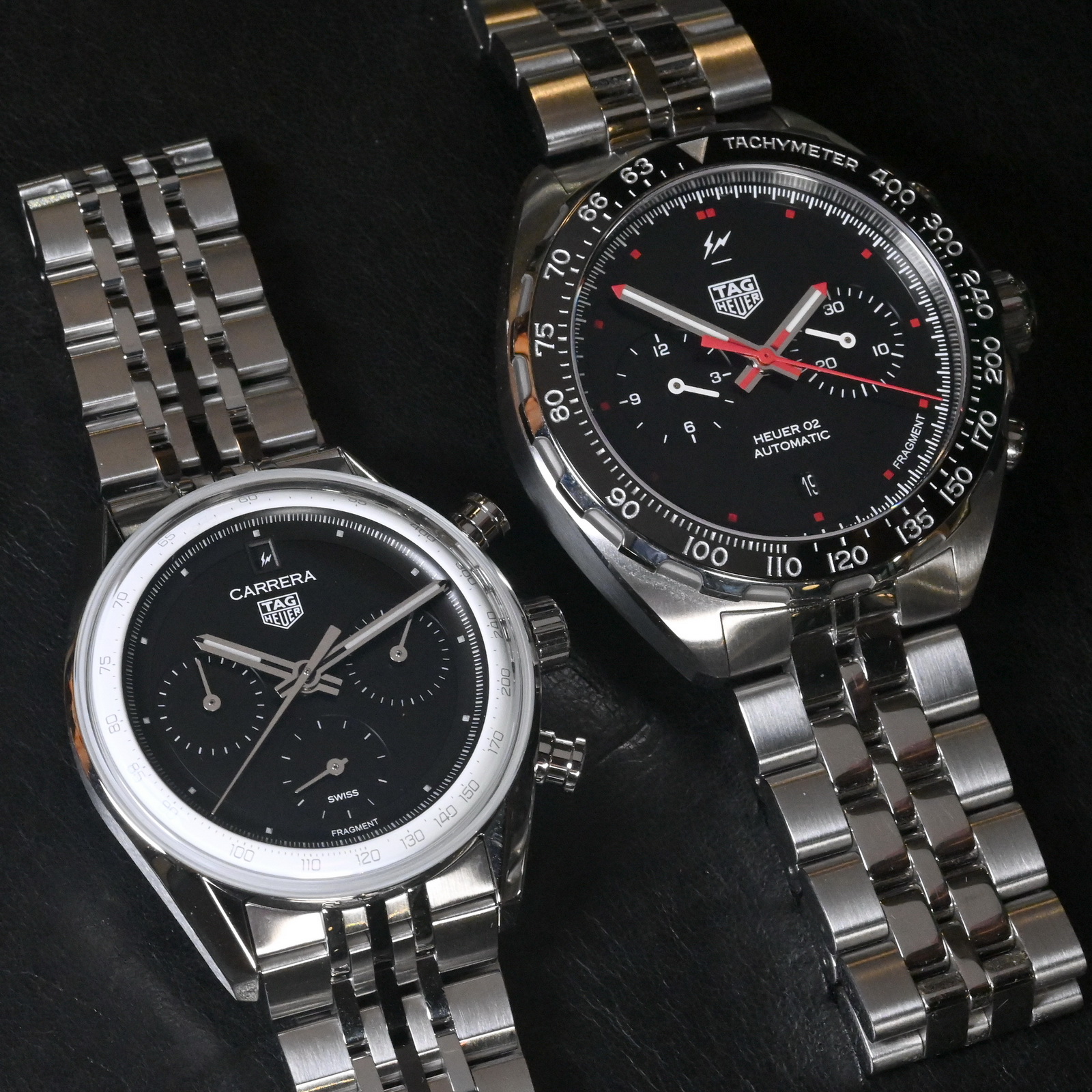
In 2020, Fujiwara followed the same basic approach that he had used with the 2018 Fragment Design Carrera to create the Fragment Design Heuer 02 Chronograph (which we will call the “2020 Fragment Formula 1”). Although called a “Formula 1”, this new chronograph captured the essence of the “Viceroy” Autavia, Heuer’s best-selling chronograph of the early 1970s.

In our posting introducing the 2020 Fragment Formula 1, we described the “four step” playbook that Fujiwara might have used in both the TAG Heuer collaborations, as follows – (1) select an icon from the Heuer portfolio, (2) remove the non-essential elements, (3) dial up the drama, and (4) add accents to taste.

Although he seems to employ the same basic approach in creating the 2018 Fragment Design Carrera and the 2020 Fragment Formula 1, it seems clear that in the intervening two years, Fujiwara became comfortable making more significant changes in the additions and deletions. While the 2018 Fragment Carrera is instantly recognizable as a near-copy of the Reference 2447 NT, the 2020 Fragment Formula 1 reflects a designer taking more liberties in making changes from the antecedent watch.
Yes, the 2020 watch clearly reflects the Viceroy Autavia, but the changes are significant, all of them reflecting Fujiwara’s preferred minimalism. Rather than the contrasting white registers on the Viceroy Autavia, the Fragment F1 uses black registers on the black dial; the light silver date disc is now black; the shiny applied markers of the Autavia yield to 12 small red dots; and the hour recorder has four numerals rather than 12. Perhaps the most significant change is that while the 2020 watch is clearly a homage to the Viceroy Autavia, it uses a TAG Heuer Formula 1 case, and the name “Autavia” is nowhere to be found on the watch.
Over the period from 2018 to 2020, Fujiwara seems to have become more comfortable in making changes to Heuer’s grails, and in the year 2025, he is willing to go even further.
Step One — Select the Right Precedent. The first step in Fujiwara’s design process is the selection of an appropriate precedent and he chose well with the Reference 2447 N from 1963. With its black dial and registers, thin hands and applied markers, and contrasting white inner bezel, this model embodies the utility and elegance of modern design.
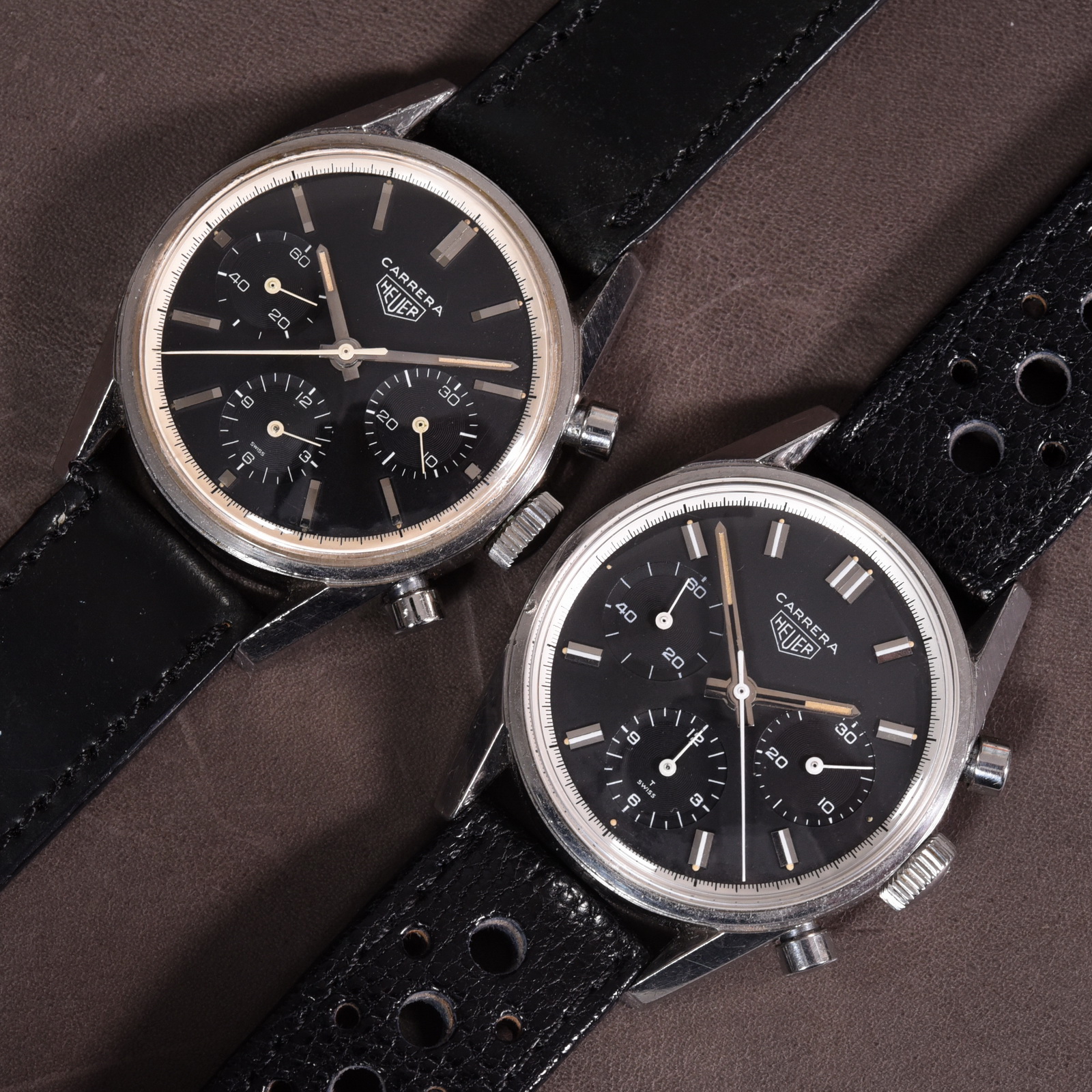
Before considering the choices that Fujiwara made in designing the new Carrera, we consider the current version of the “Glassbox” Carrera, the canvas for his work. TAG Heuer introduced its Glassbox Carrera in 2015, and produced 10 versions in what collectors call the “first generation” of the Glassbox. In 2023, TAG Heuer introduced a completely reworked version of the Glassbox case, as its “second generation” model.
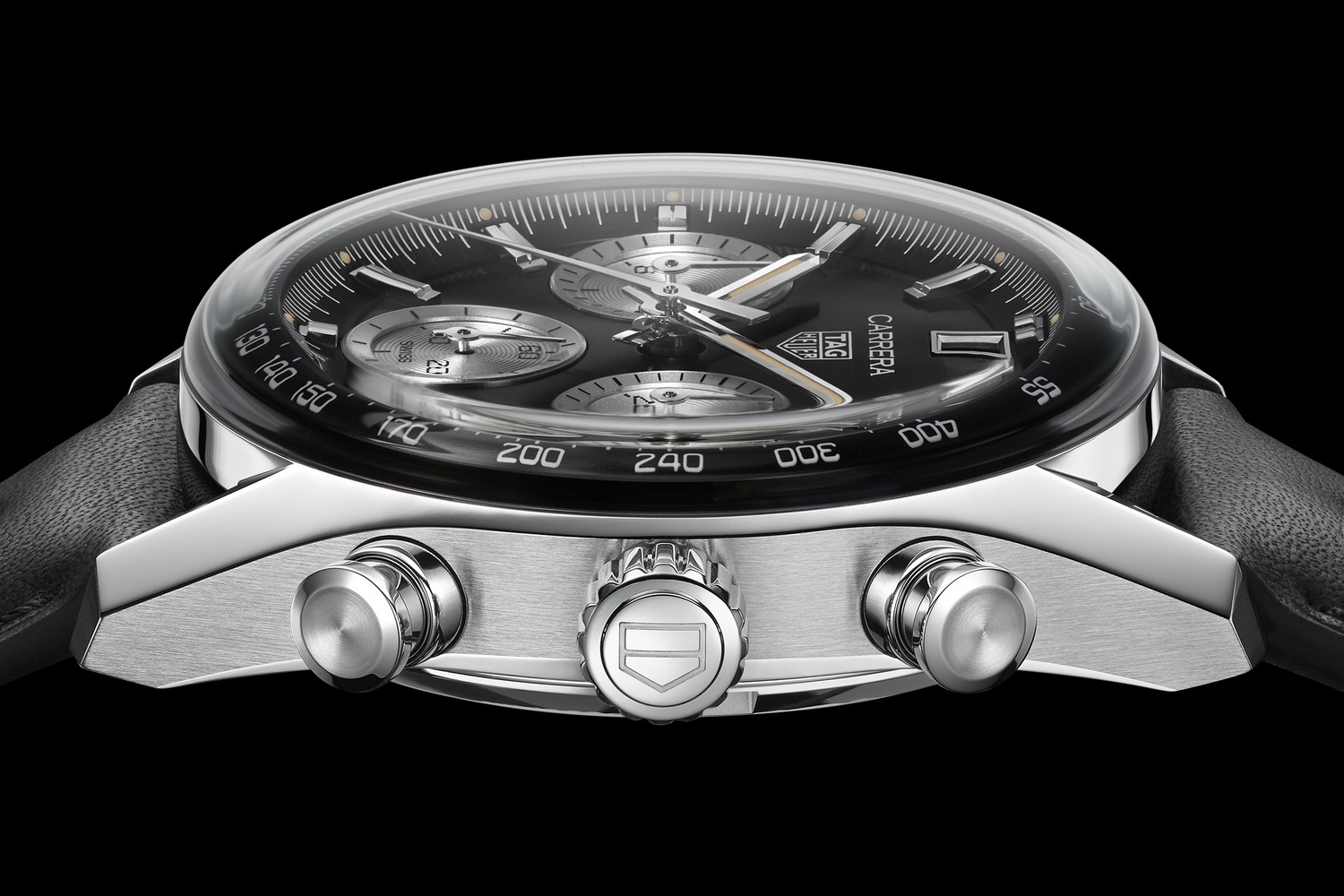
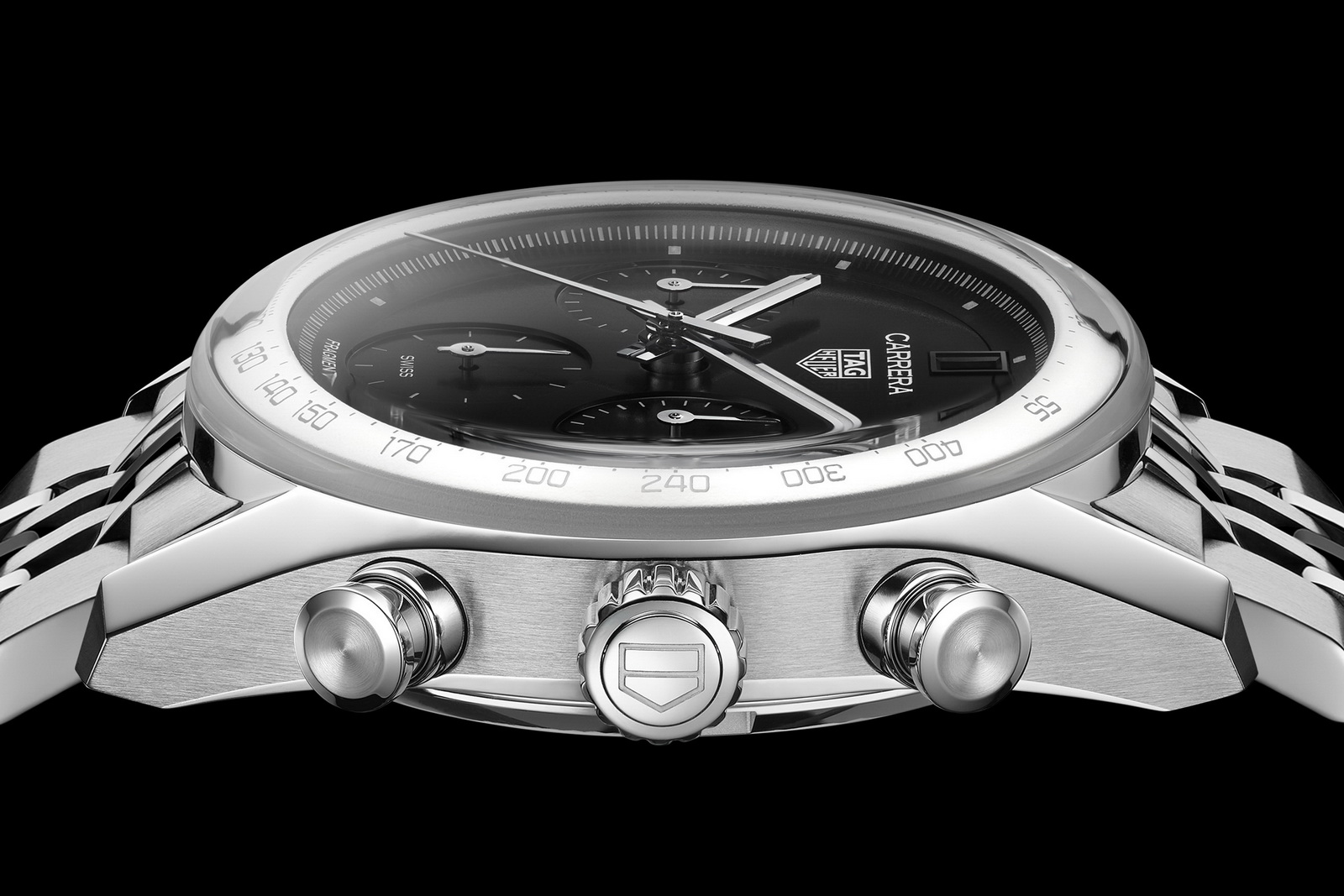
The second generation Glassbox Carrera is easily identified by the unique construction of its case, crystal and dial. The center area of the dial is flat, but it is surrounded by a concave inner flange and a convex outer flange, giving the dial considerable depth. The 39 millimeter case has no top bezel, and the domed sapphire crystal goes edge-to-edge, following the curvature of the outer flange and resting on the mid-case. See our recent posting, A Topographical Tour of the TAG Heuer “Glassbox” Carrera (Second Generation).
With the second generation Glassbox Carrera as his starting point, Fujiwara has created a new version of the Carrera that is dramatically different from both the heritage precedent (from 1963) and Fragment’s previous Carrera, from 2018, which used the more traditional first generation Glassbox case.
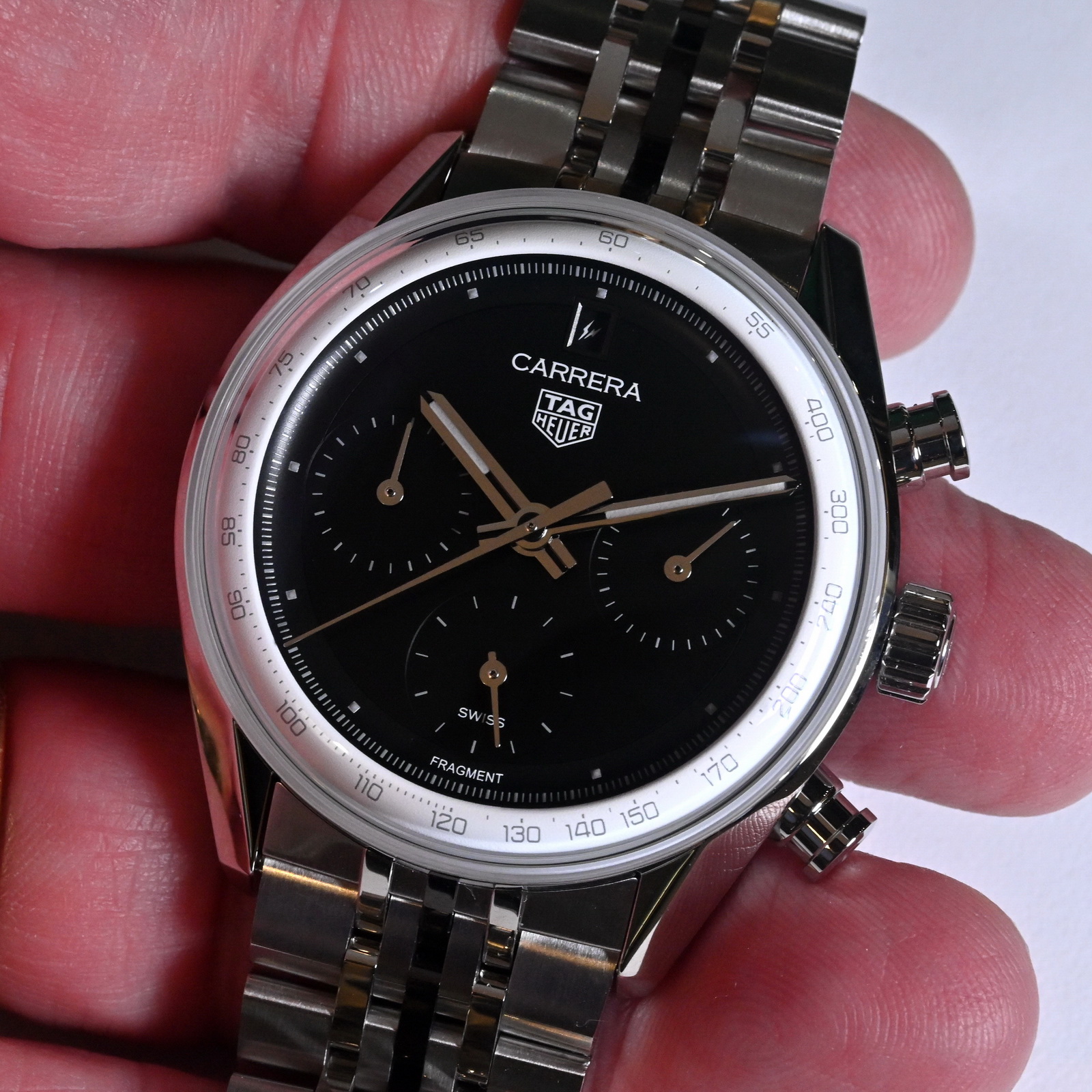
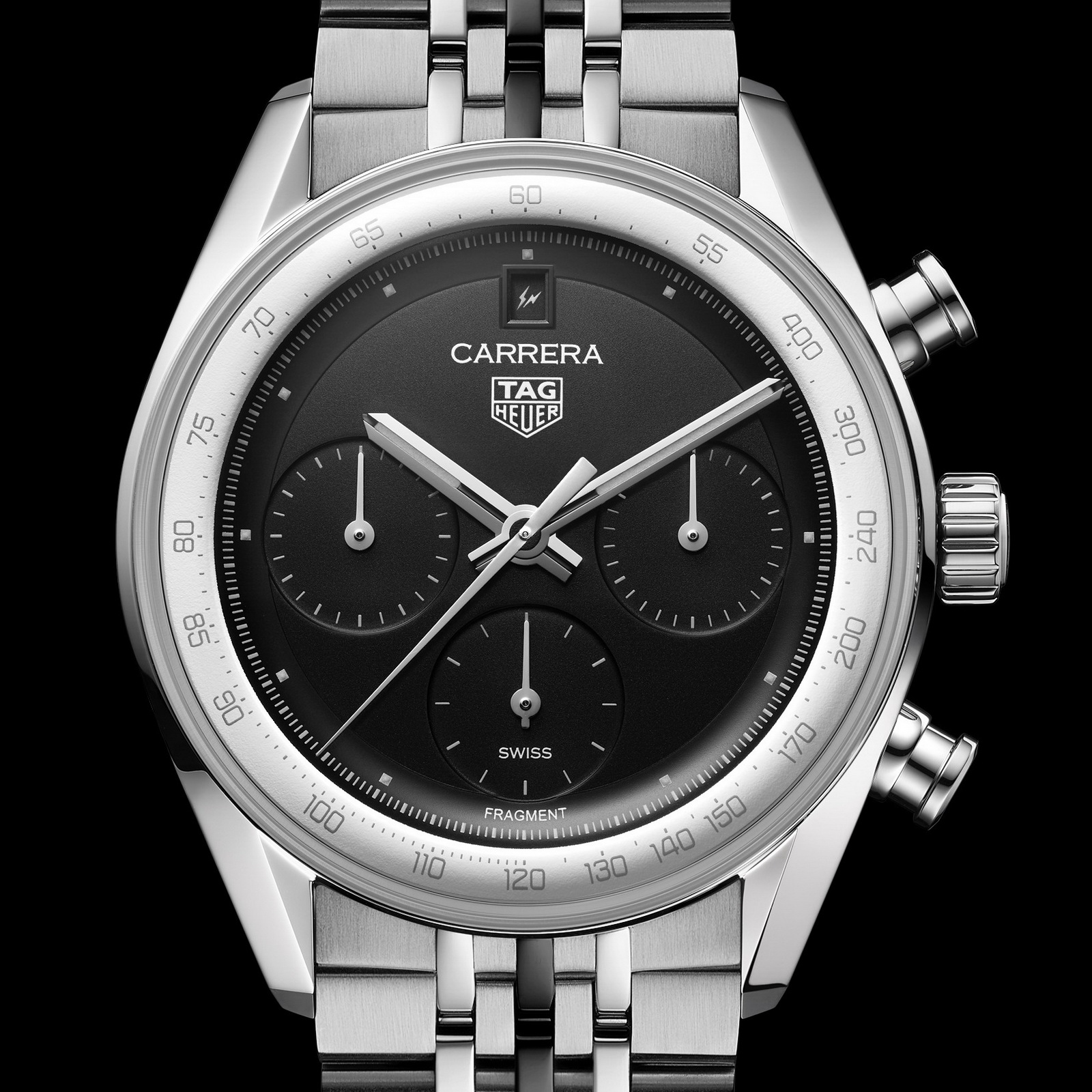
Step Two — Remove Non-Essential Elements. “Step Two” of our imaginary Fragment playbook involves removing the non-essential elements, and with the Carrera Reference 2447 as the starting point, there just aren’t many elements that are candidates for removal. Still, Fujiwara breaks new ground in the world of vintage Heuer chronographs, removing the numerals from all three of the registers. Additionally, the Fragment saves some visual weight by removing the applied indices that mark the hours on the 1963 version of the Carrera, instead marking the hours with 12 white luminous dots on the inner flange.
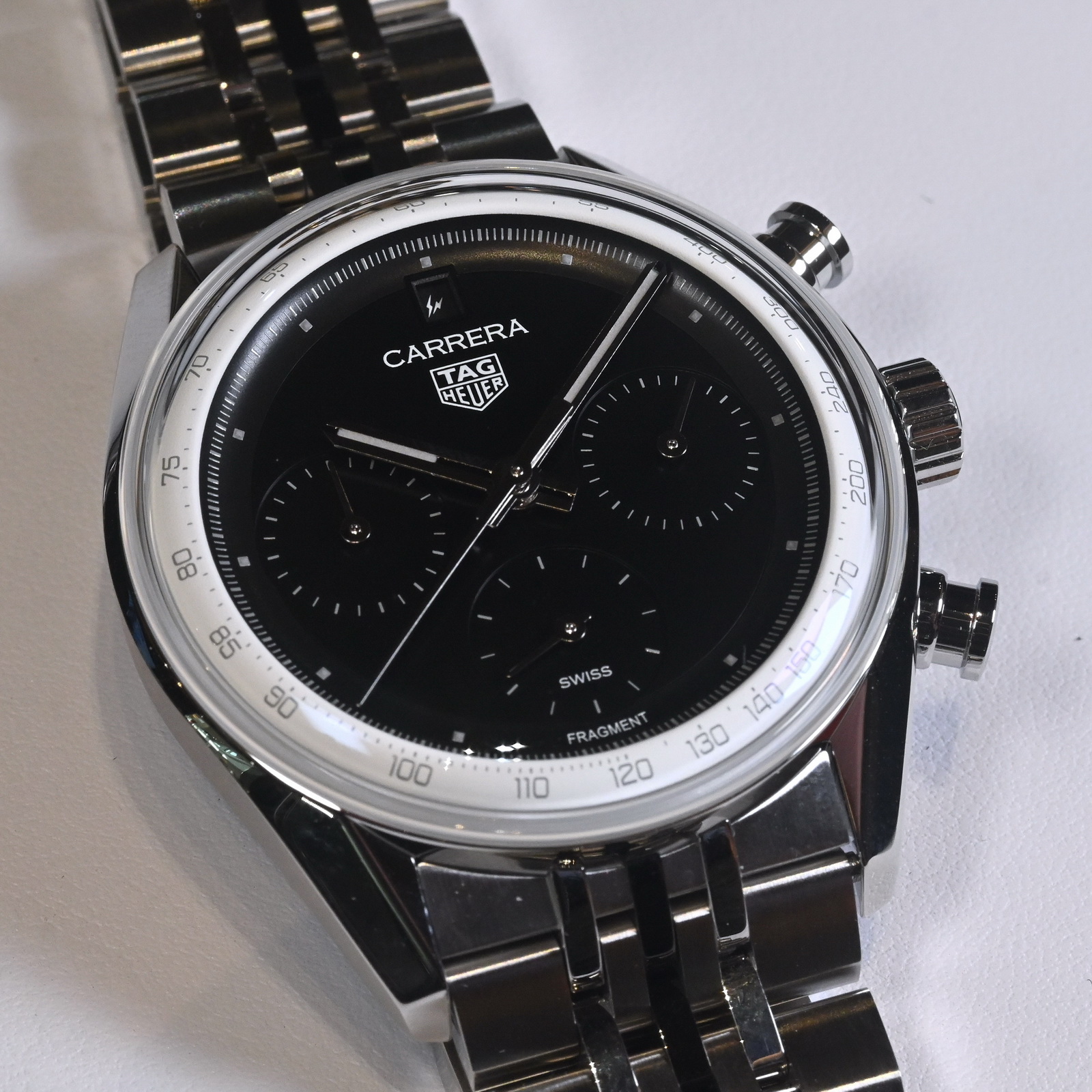
Step Three — Dial Up the Drama. There is no shortage of drama in the newest Carrera. The bright white outer flange, with the tachymeter scale printed in silver, frames the dial well, with the same effect as the inner white flange on the vintage Carreras. Some could suggest that any tachymeter scale violates the directive to remove all non-essential elements, however, the tachymeter scale on a racing chronograph is an exception to this mandate. While few chronograph enthusiasts will ever have the occasion to check their speed over a measure mile or kilometer, the tachymeter scale has become the symbol of racing. If you have any doubts, have a look at the Rolex Daytona, the Omega Speedmaster and numerous Patek Philippe chronographs.
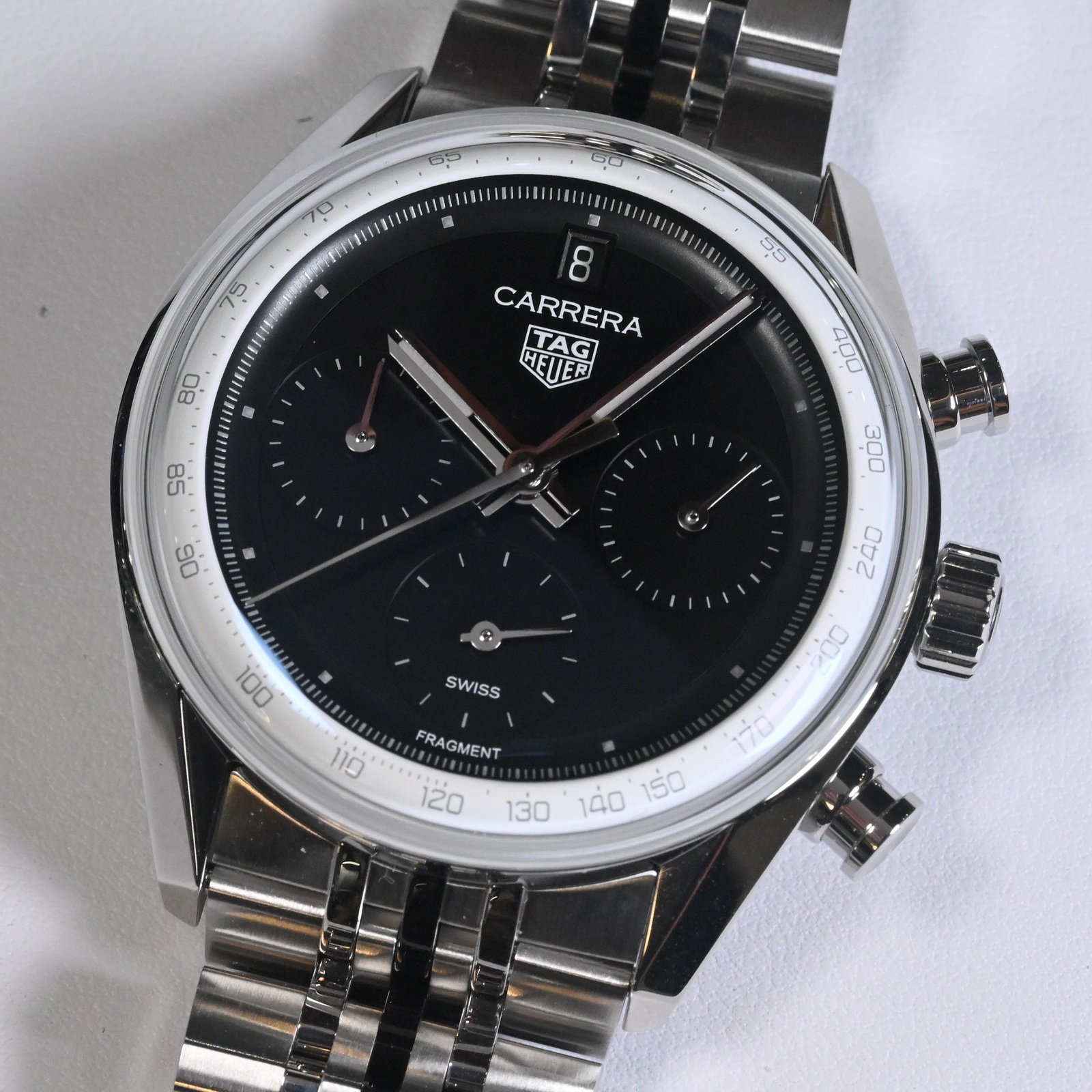
The time-of-day hands on the Fragment Carrera are another instance in which Fujiwara has “punched up” the elements of the Carrera. The are considerably wider than the hands used on the Carreras of the 1960s, and provide for excellent legibility, in daylight or darkness.
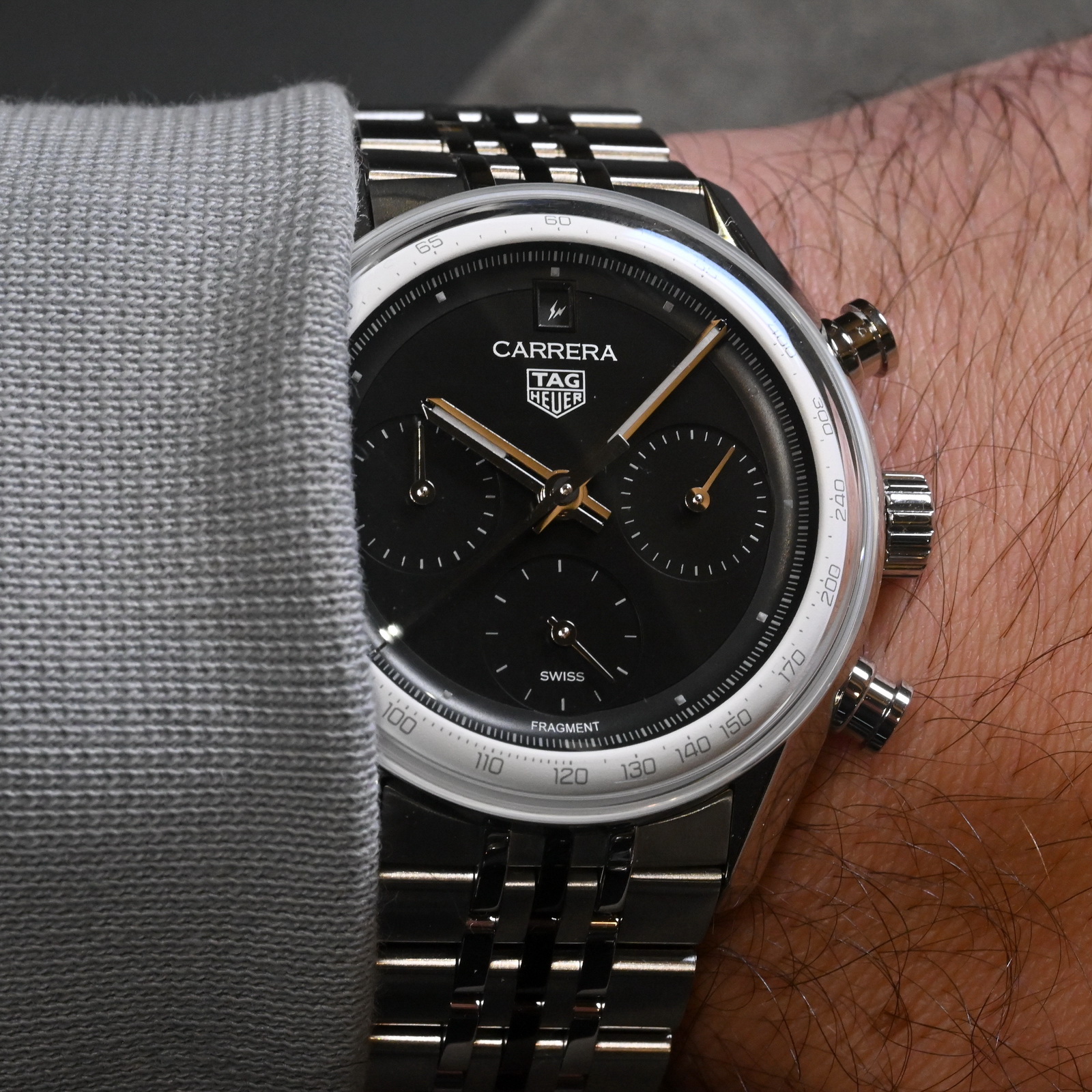
Step Four — Add Accents to Taste. The final step of the Fragment collaboration involves adding accents, and again we see Fujiwara leaving his mark on the Carrera. On the date disc, at 12 o’clock, in the place of the numbers “1” and “11”, we see the Fragment thunderbolts logo, while all other dates are shown by the usual numerals – 2, 3, 4, etc.
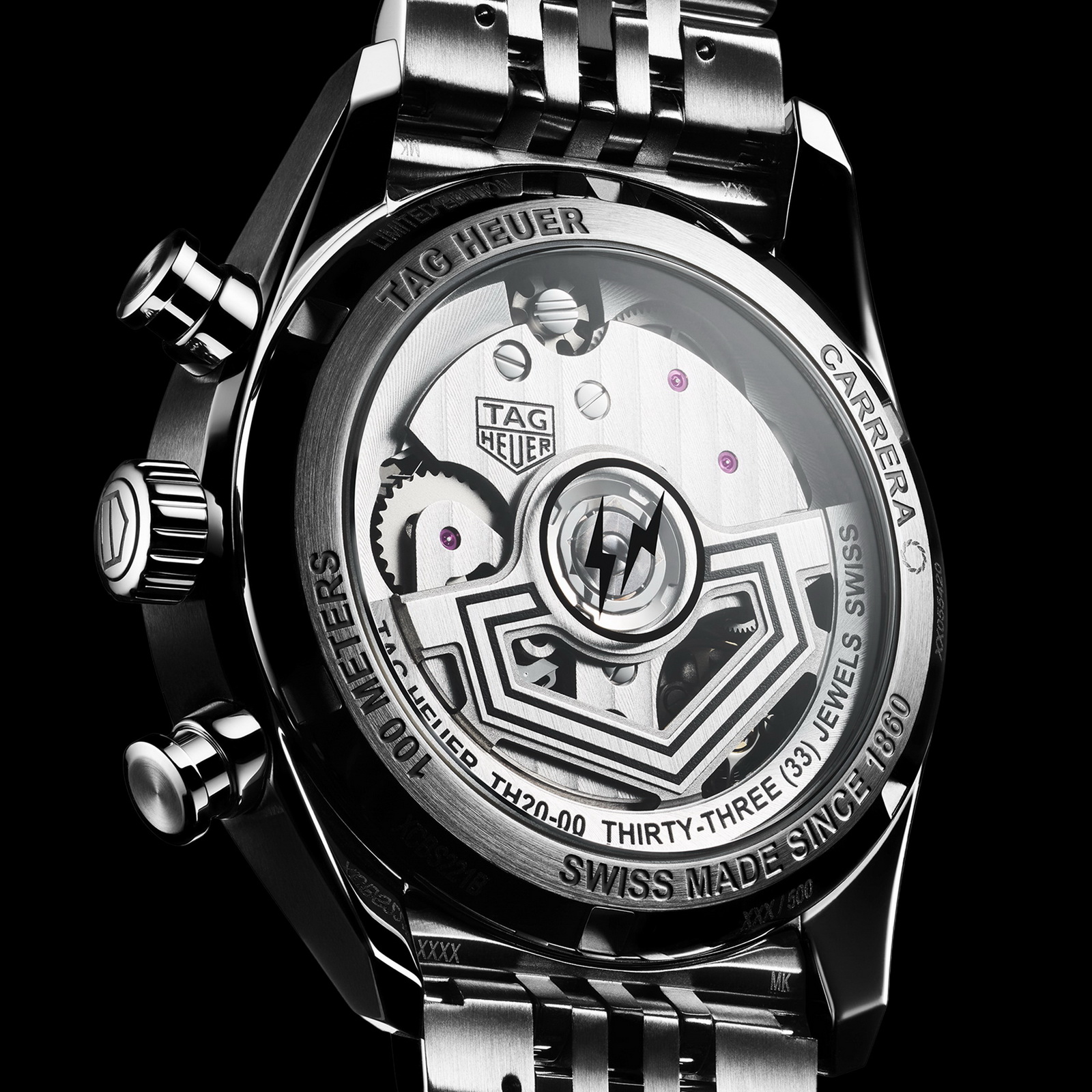
For the oscillating weight that powers the automatic movement, the familiar TAG Heuer shield has been “flattened”, so that it is shaped more like the vintage “Heuer” shield than the modern “TAG Heuer” shield, a nice touch on a watch derived from a heritage model.
Impressions
The bright white outer bezel of the Fragment Carrera is the first thing that you notice when you see the watch in photos, and it was no different when I first saw the watch at the Atlanta TAG Heuer Boutique.
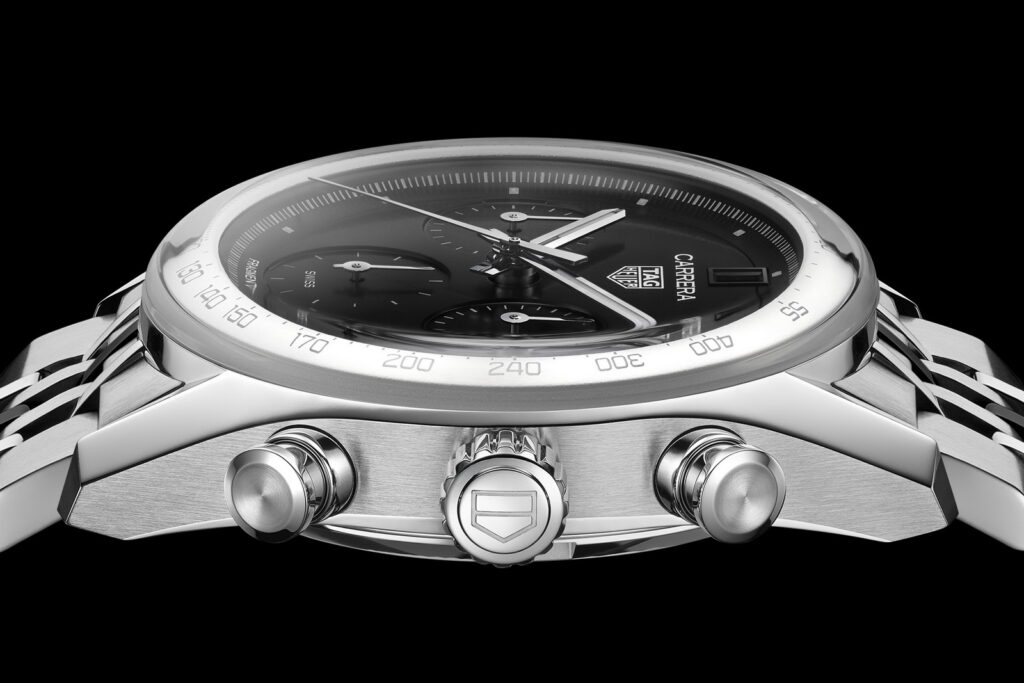
The outer flange tends to be prominent on all the second generation Glassbox Carreras, and having it in bright white surrounding an all black dial and black inner bezel definitely gets your attention. Looking inside the bezel, however, you realize that it is providing a very elegant “frame” for the black dial, and there is a nice balance between these areas. Yes, the white outer bezel is intense, but so is the dial that it is framing.
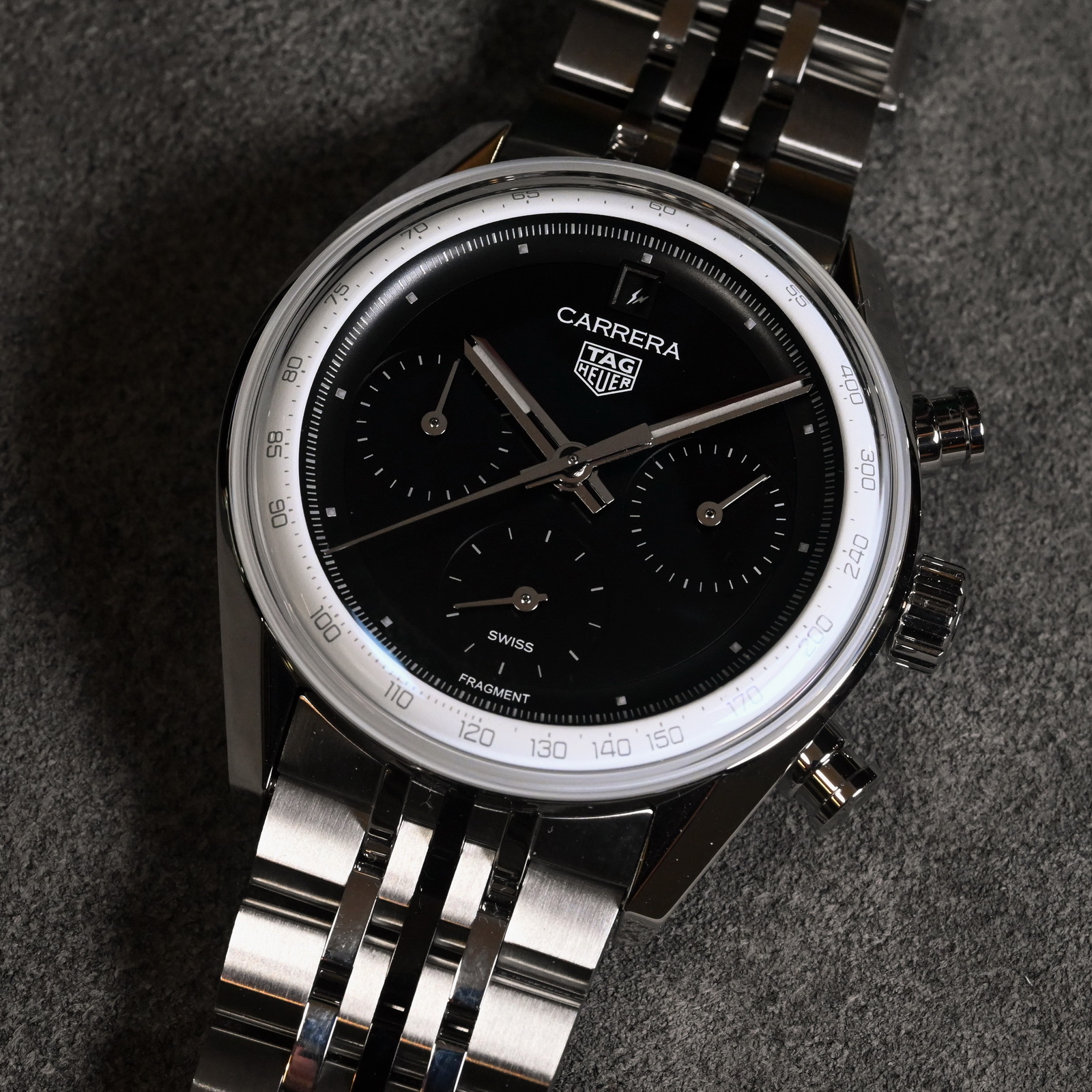
With a closer look at the white outer bezel, you notice the silver numerals of the tachymeter, a very soft presence on the bright white. Yes, this tachymeter scale is not part of a tool designed to be used as an instrument at the racetrack, it’s a reminder of the origins of the Carrera chronograph, when racers or their crews used these instruments. The soft silver is almost a shadow, filling the space on the bezel nicely.
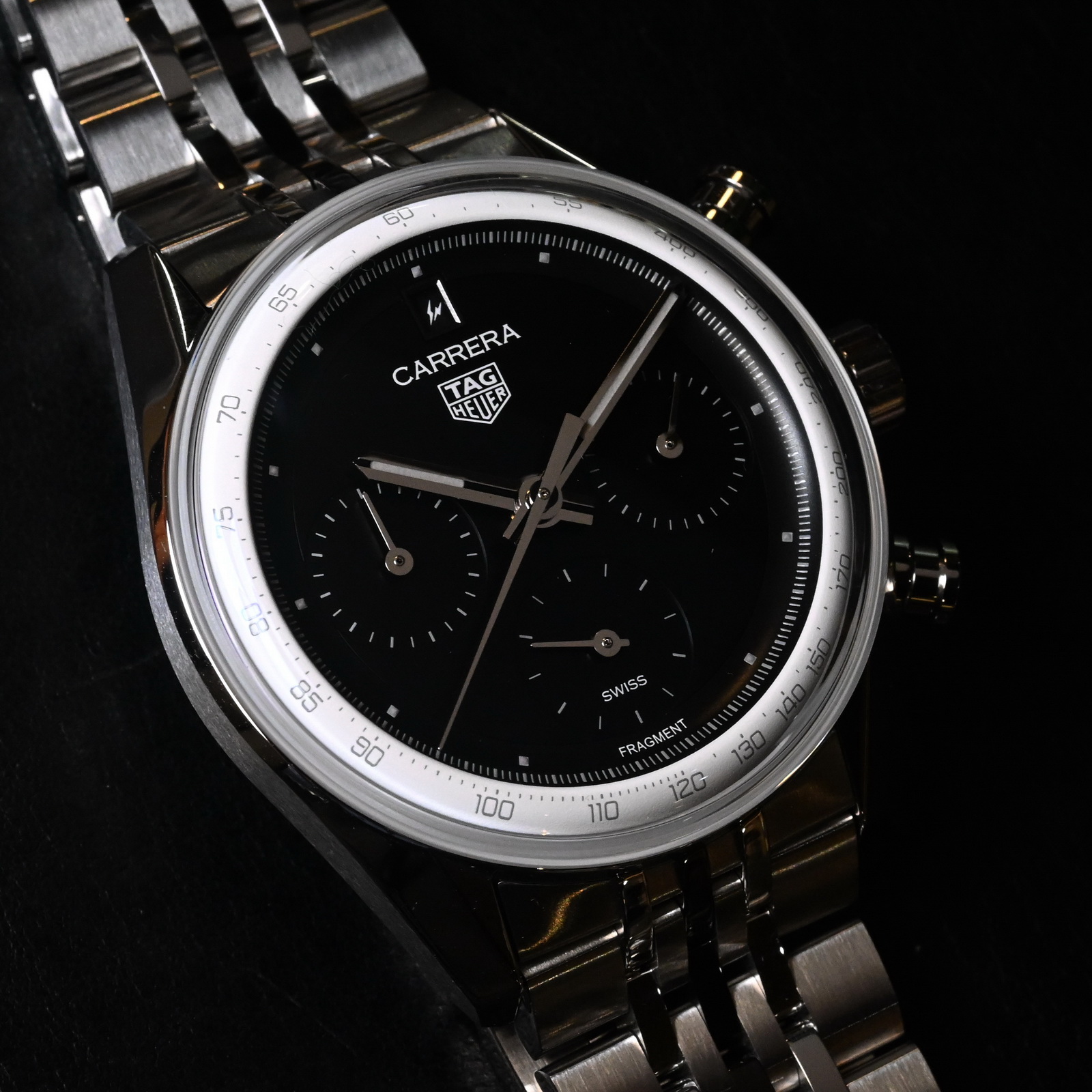
The hands of the Fragment Carrera also got my attention quickly. Perhaps another message to the enthusiast – you are more likely to be using this chronograph to tell the time of day than to be timing laps at the track.
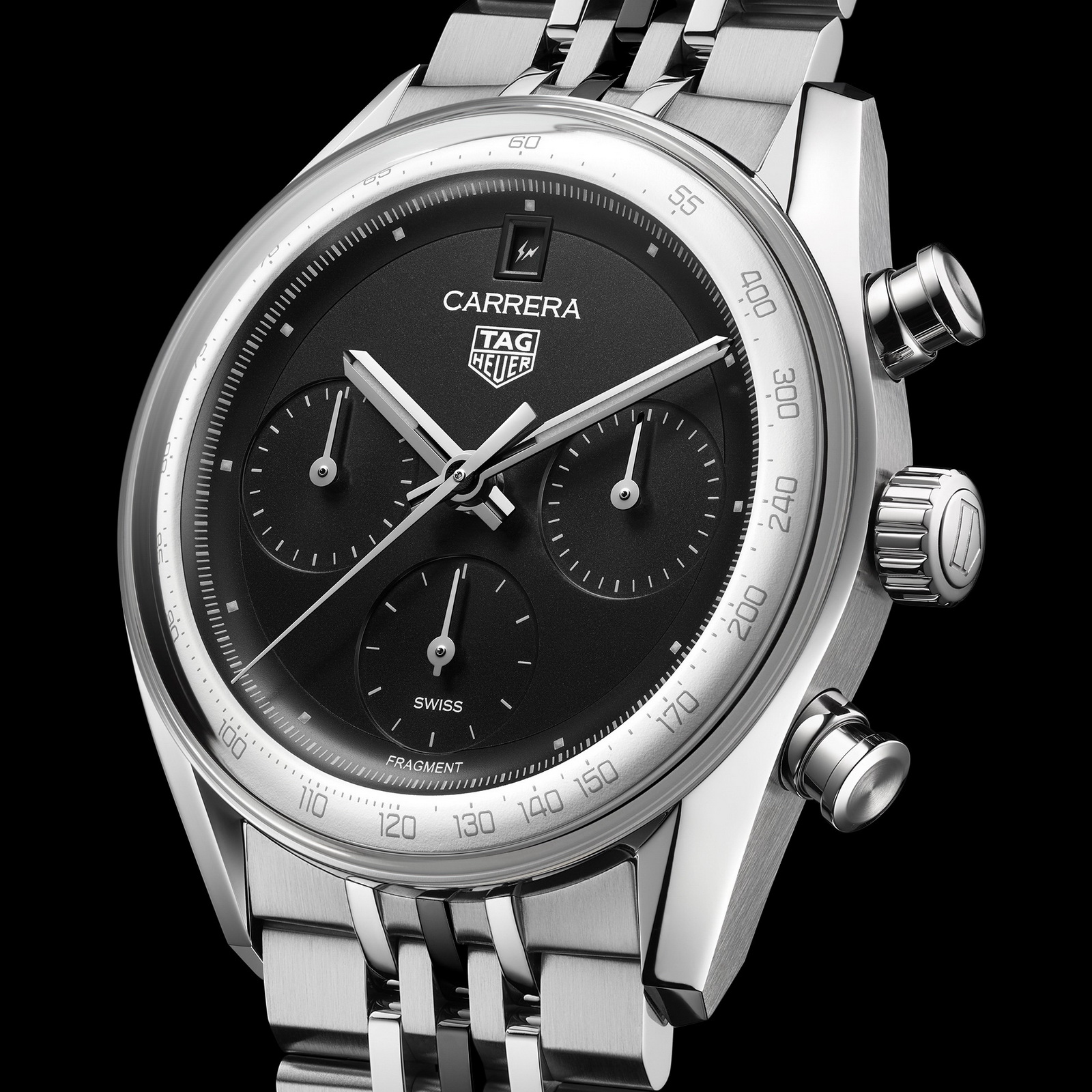
I expect that deletion of numerals on the registers will be the most controversial element of the new Fragment Carrera and after the initial shock of not seeing these numerals, I realized that – with the heavier ink for the 5-10-15 minute marks and the 1-2-3 hour marks — reading the time from the chronograph recorders will be routine. To my eye, the benefit of producing a black dial with black registers, interrupted only by the hashmarks, outweighs any loss of legibility. Again, the design brief for this watch suggests that it will be used by racing enthusiasts, more than by racers.
Returning to Grovier’s idea that great artists reshape the “classics” that inspire them, Fujiwara’s Carrera Chronograph x Fragment LE reframes how many enthusiasts will see the original 1963 Carrera. By bringing his own minimalist, modern sensibility to Jack Heuer’s first Carrera, and adding his own accents to the mix, Fujiwara casts a new halo over the original dial and hands, highlighting the power and timelessness of the vintage design. In doing so, he not only alters our perception of the classic Carrera but also uses Jack Heuer’s favored design criteria to create a contemporary racing watch for today’s enthusiasts.
Specifications – TAG Heuer Carrera Chronograph x Fragment Limited Edition (Reference CBS221B.BA0045)
Case — 39 millimeter polished stainless steel “glassbox” case, with thickness of 13.9 mm; domed sapphire crystal with double anti-reflective treatment; case-back has sapphire crystal, engraved “# /500”; water-resistant to 100 meters (10 bar). 46 millimeters lug-to-lug; 20 millimeters between the lugs (bracelet width).
Dial — black opaline center area surrounded by black opaline inner flange, marked for 1/4 seconds and seconds / minutes; white outer flange with silver tachymeter scale (marked 55 units per hour to 400 units per hour); three black opaline registers – 3 o’clock chronograph minutes counter, 6 o’clock running seconds recorder, and 9 o’clock chronograph hour recorder; gray printed indices with gray Super-Luminova; date window at 12 o’clock (disc has Fragment thunderbolt logo in place of numerals “1” and “11”.
Hands — Hour and minute hands are faceted, polished rhodium plated, with white Super-Luminova; central chronograph second hand is rhodium plated, polished; hands on registers are rhodium plated, polished.
Movement — TAG Heuer Calibre TH20-00 automatic movement; 28,000 beats per hour (4 hertz); 80 hours power reserve.
Bracelet — “seven row” stainless steel, with black center link; butterfly folding clasp, with push buttons; TAG Heuer shield.
Availability – 500 watches, priced at 8,150 CHF, available in December 2025
Thanks
Special thanks to Erika and her team at the TAG Heuer Atlanta Boutique for showing me the newest Fragment Carrera and for sharing their enthusiasm. Visit them at Lenox Mall, 3393 Peachtree Road, Atlanta, GA, or call 470-750-0390.
Jeff Stein
December 2, 2025