I sometimes enjoy task-repetitive projects. Give me a spreadsheet that lists 592 models of Heuer chronographs, tell me the 30 items of information that we want to present for each model, and some months (or years) later, I’ll have most of those 17,760 fields of data filled in. To add images of catalogs to OnTheDash, we scan each page of the catalog, rotate, crop, rename and resize each image, do any necessary clean-up, create the index page, select the “featured” image, and then upload the whole thing to the server. After 23 years, I’m happy to say that OnTheDash includes more pages of catalogs than I can count. I like my chances in any contest where “Sitzfleisch” (literally “sitting meat”, referring to the part of the body that you sit on) will determine the winner.
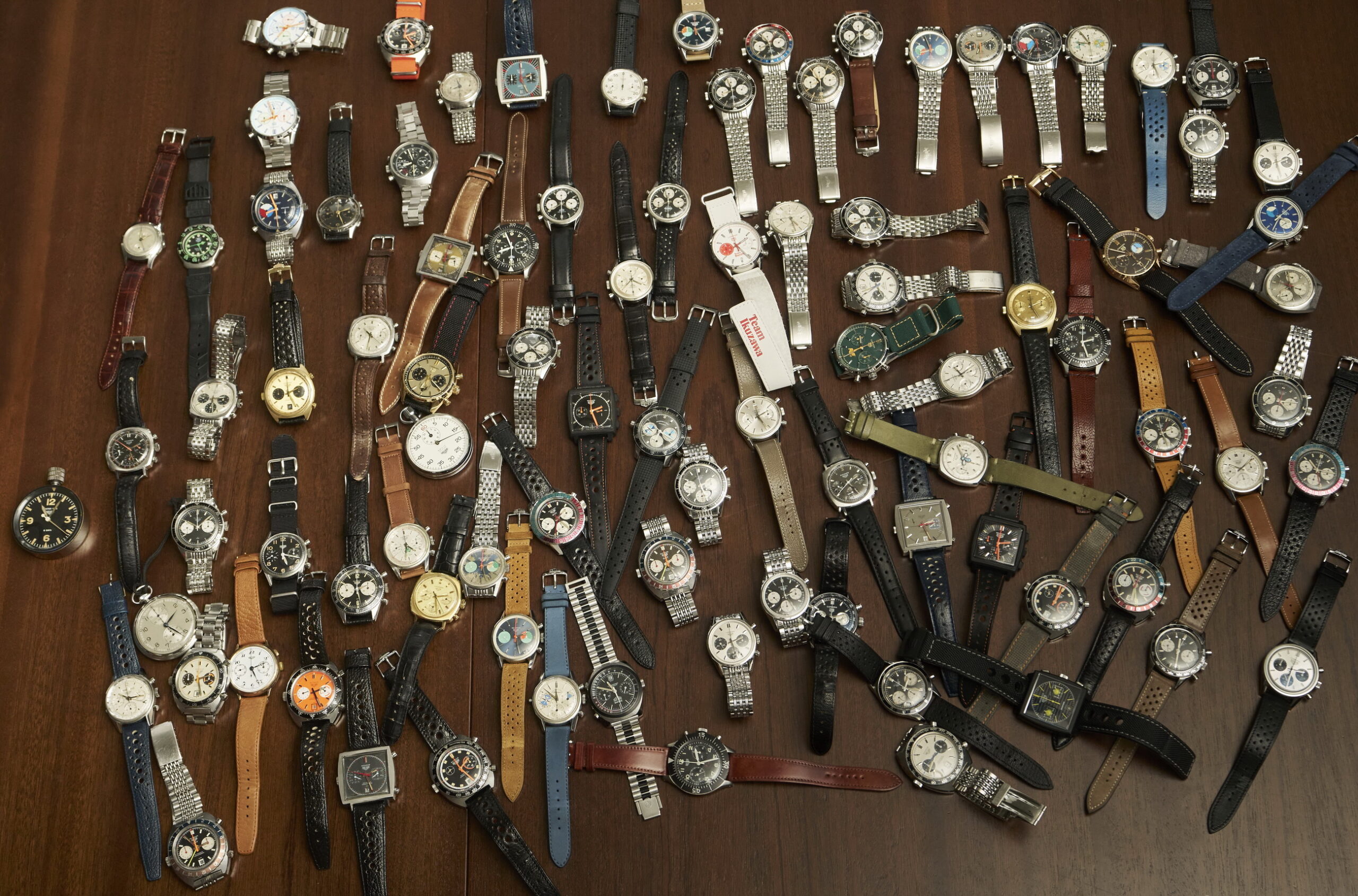
And so the task of identifying and commenting on the 90 watches that were in the “Table Shot” at the November 2024 TAG Heuer Collectors Summit was an attractive project for me. Yes, it took me a little over a year to get started on the project, but once I got rolling, it was pure joy.
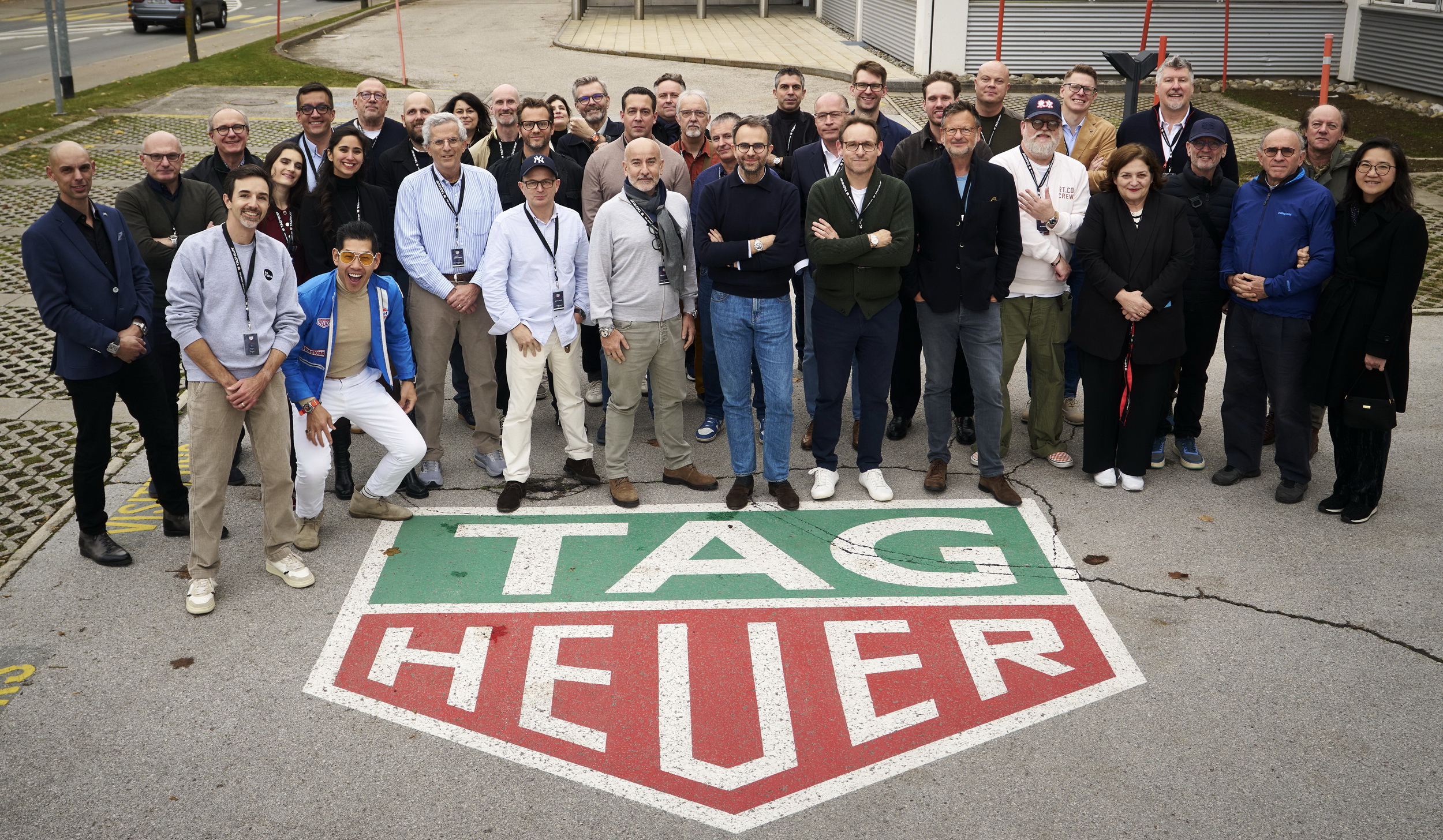
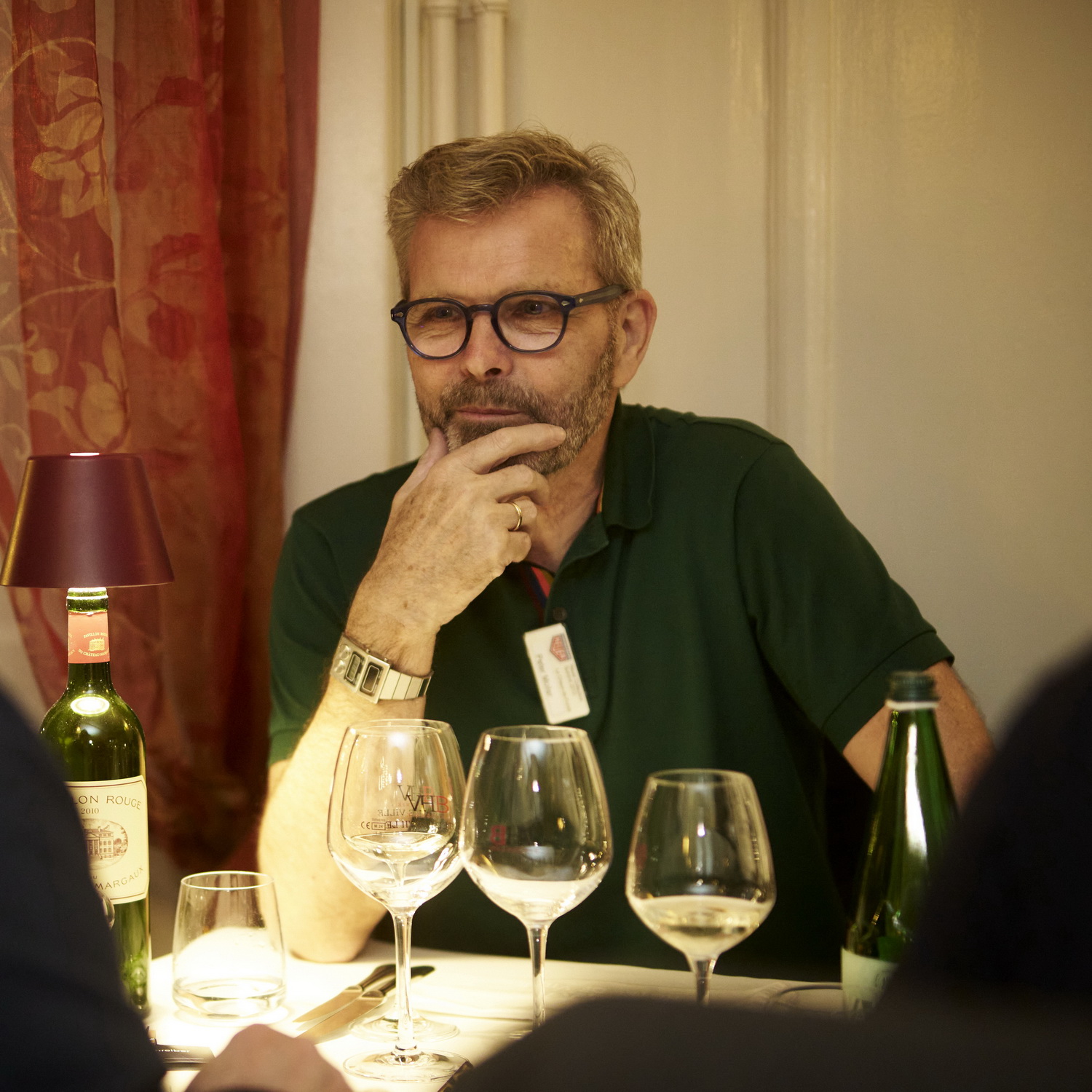
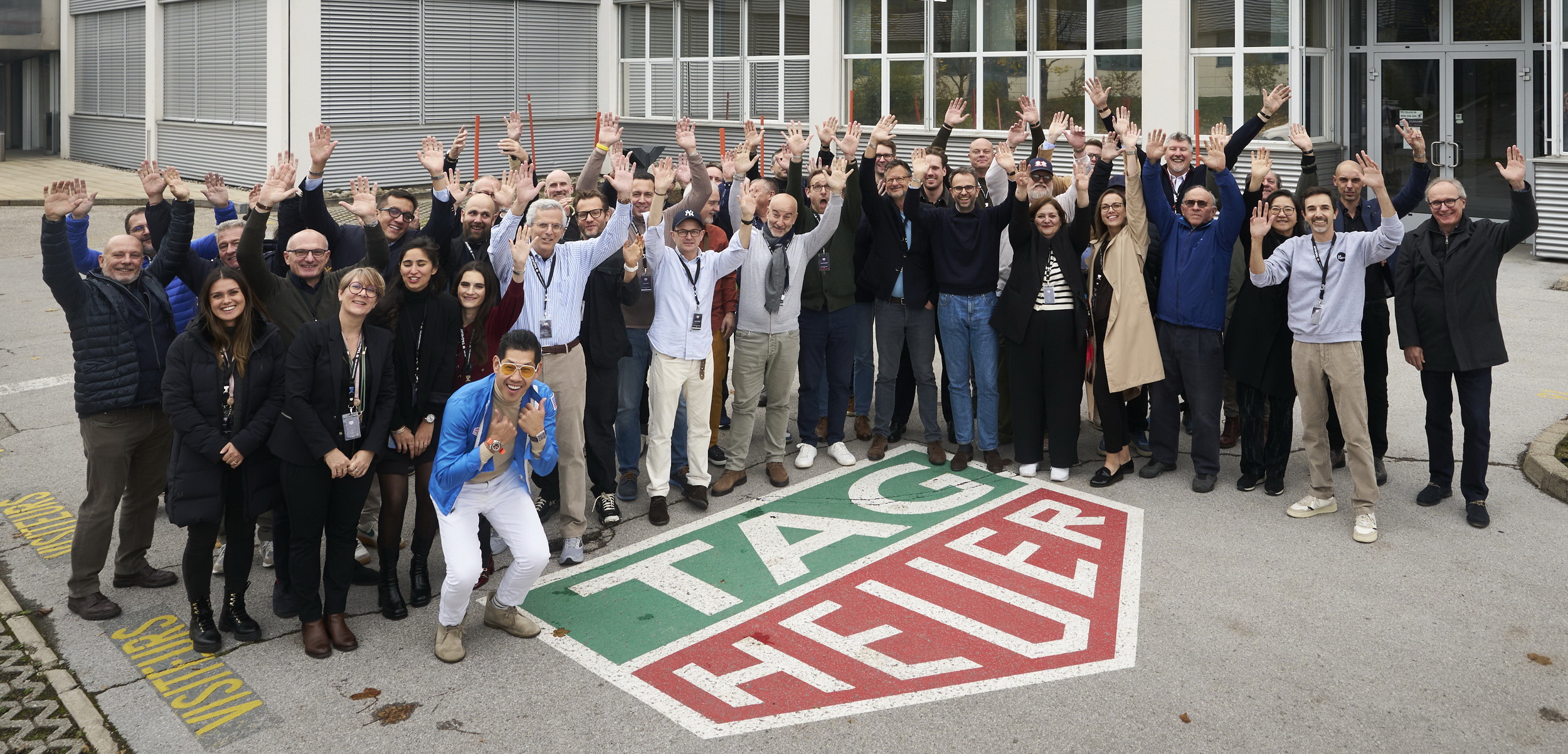
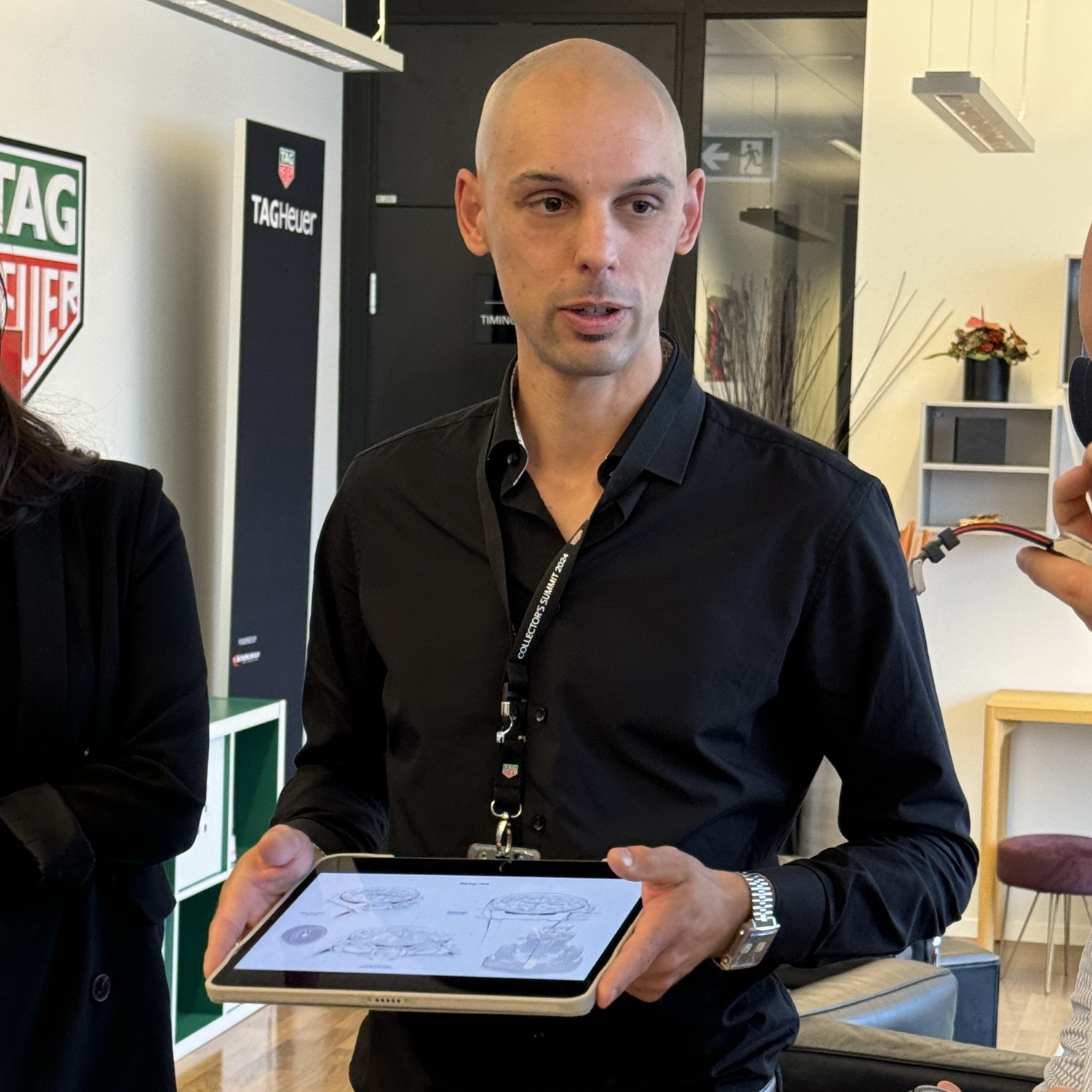
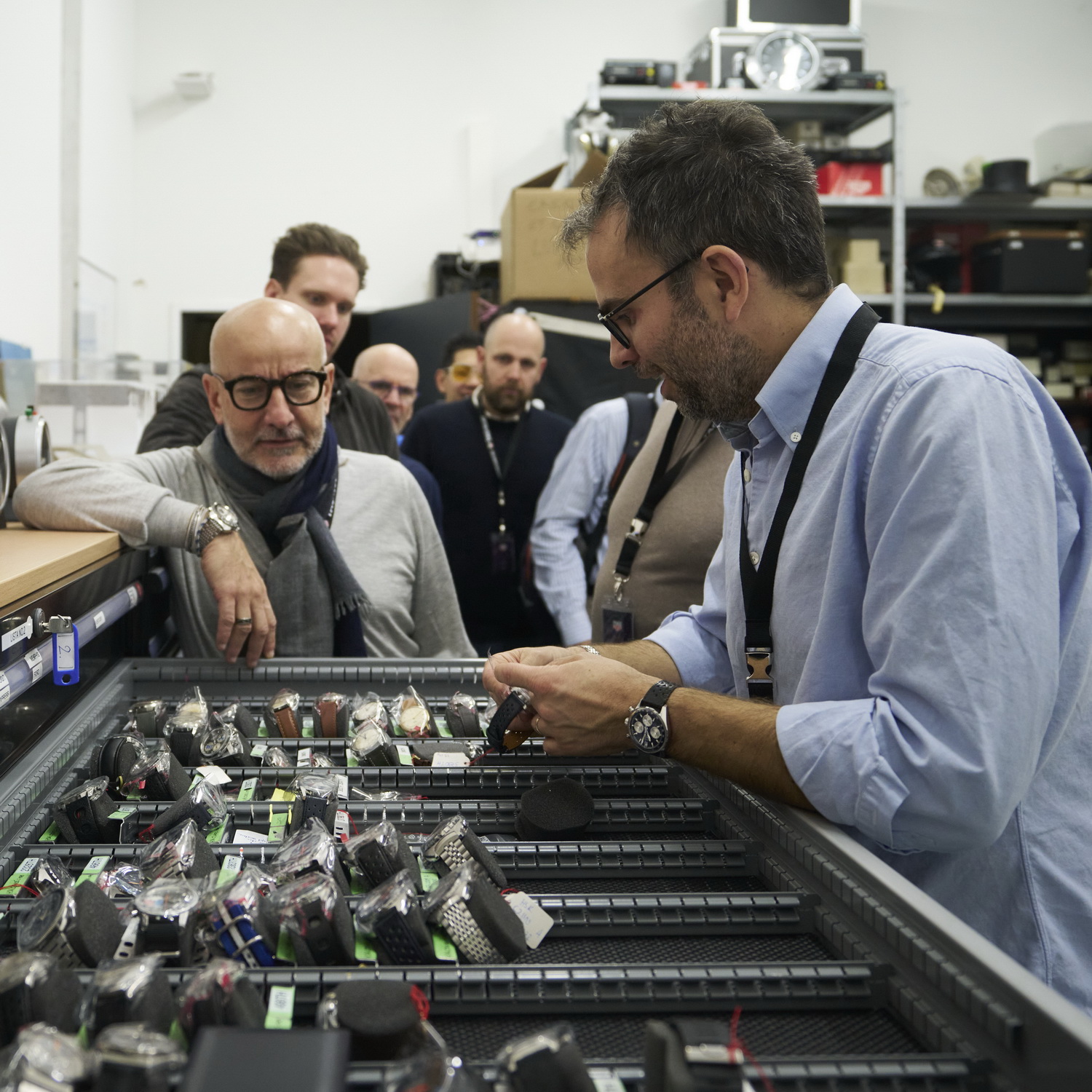
Before we get to the “table shot”, we’ll start with the Summit. TAG Heuer held a Collectors Summit from November 11 to November 13, 2024, at company headquarters in La Chaux-de-Fonds.
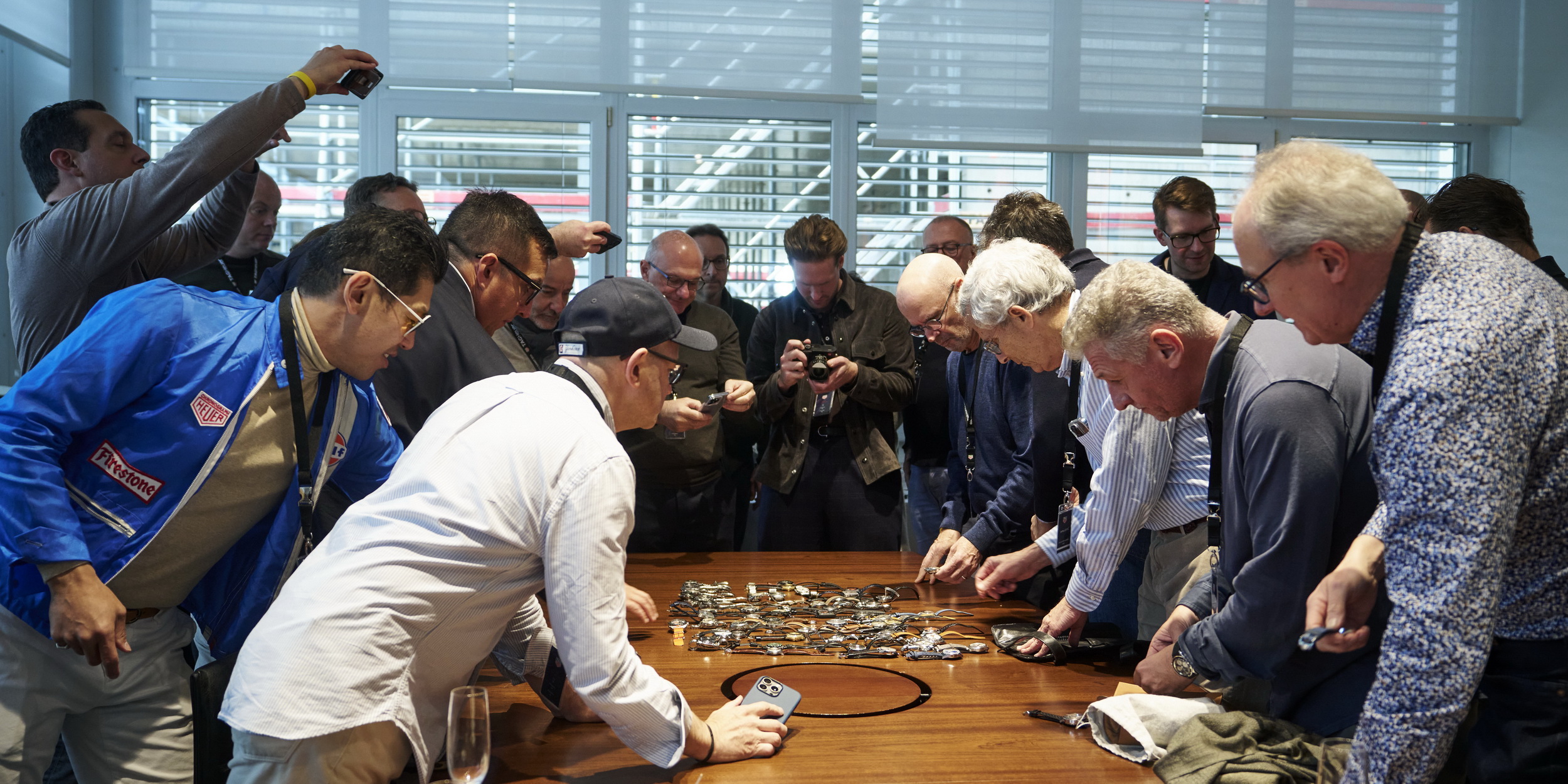
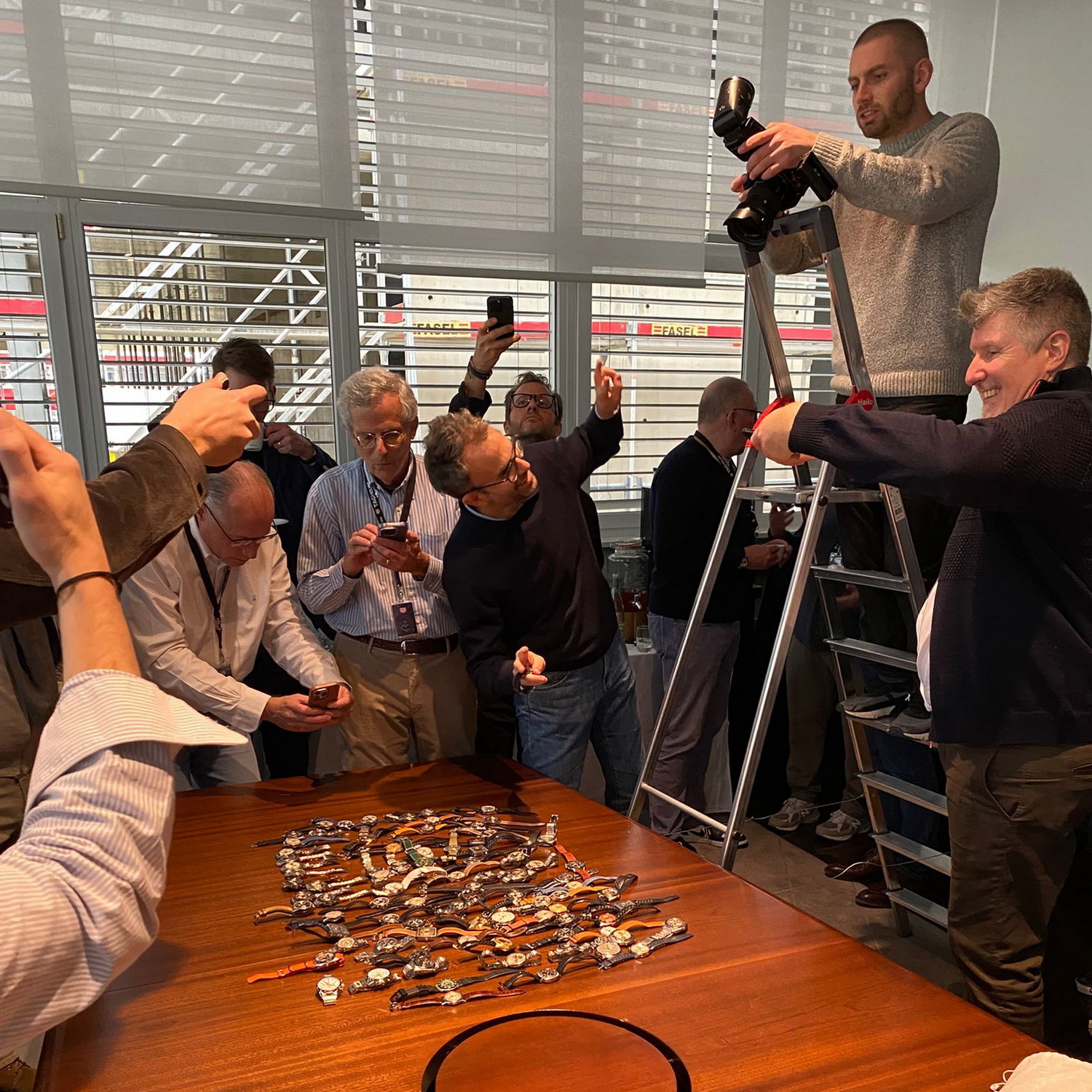
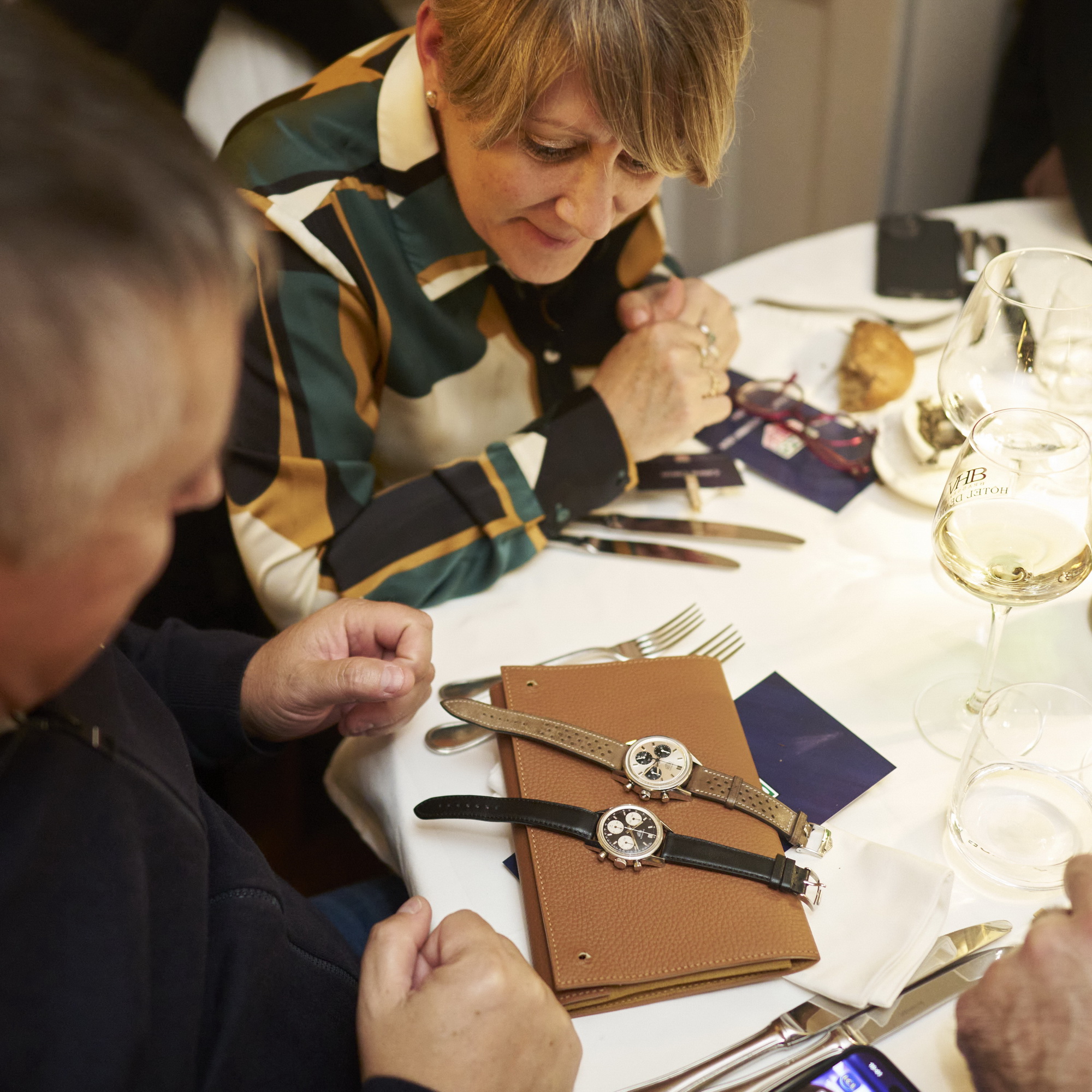
During a break between sessions, the approximately 30 collectors attending the Summit decided that it would be fun to put their watches on a table, allowing photographers to capture the legendary “table shot”. There was no planning for this table shot; our hosts hadn’t made any suggestions about which watches the participants should bring to the Summit; in fact, we were advised to be cautious regarding bringing watches into and out of Switzerland.
Looking at the watches on the table, I was struck by the fact that there was no sense of any “competition” among the collectors in bringing watches to the Summit. Rather, we brought the watches that they were excited to share with the other participants. With the hazards of crossing borders with valuable watches, most participants left the rarest ones at home. The thrill of sharing watches at the Summit came from showing and discussing interesting watches with our collector colleagues.
Our Approach to This Posting
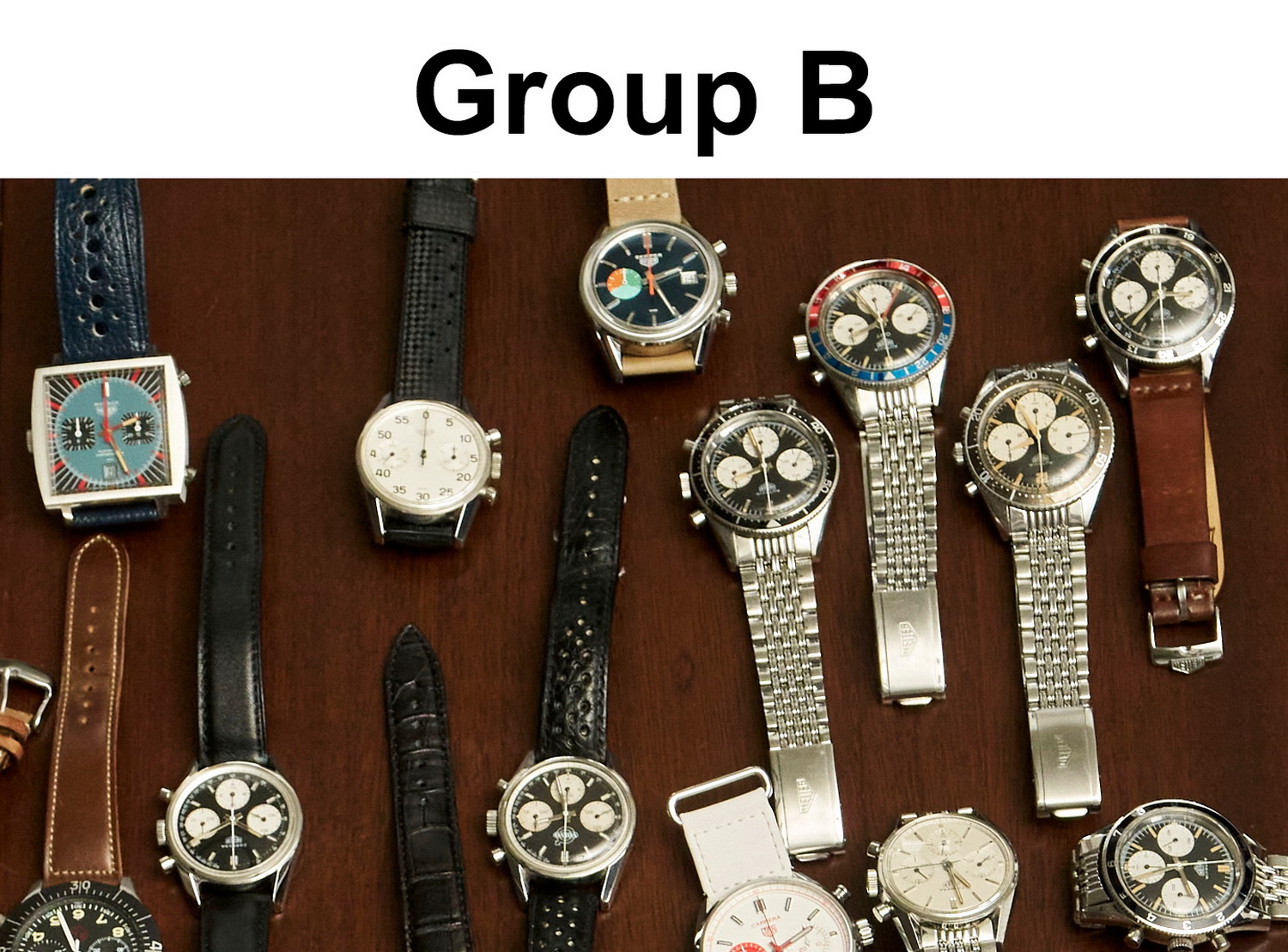
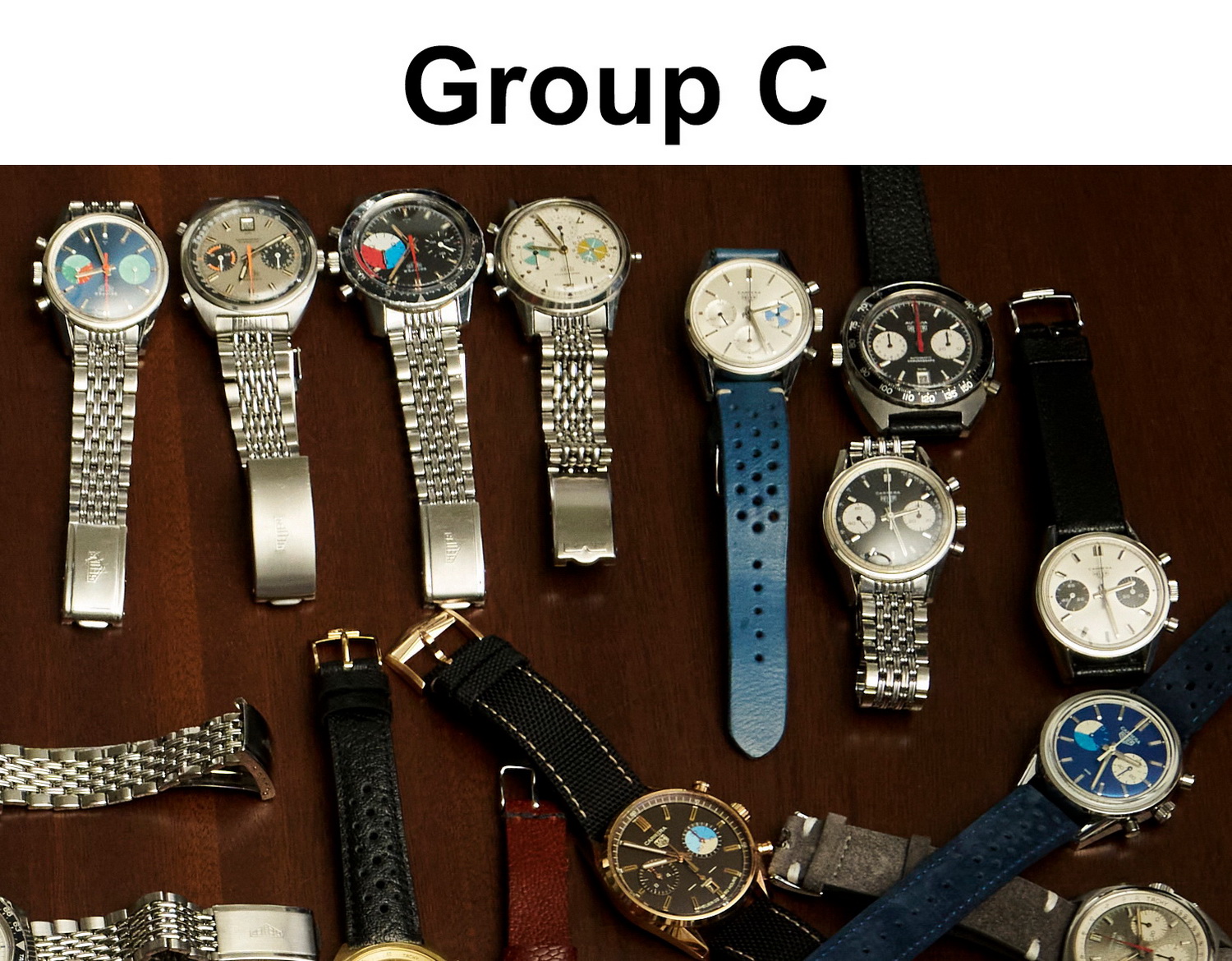
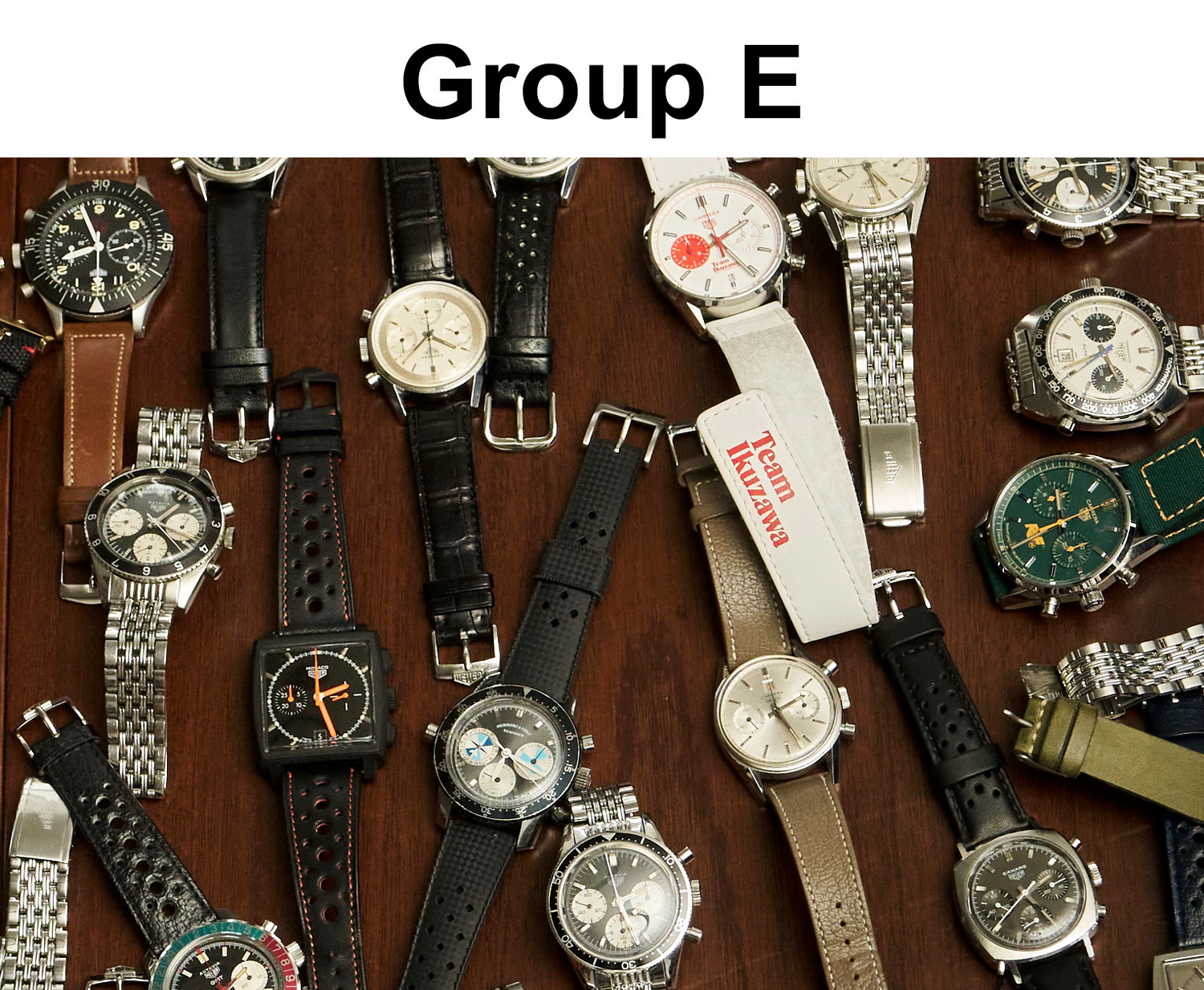
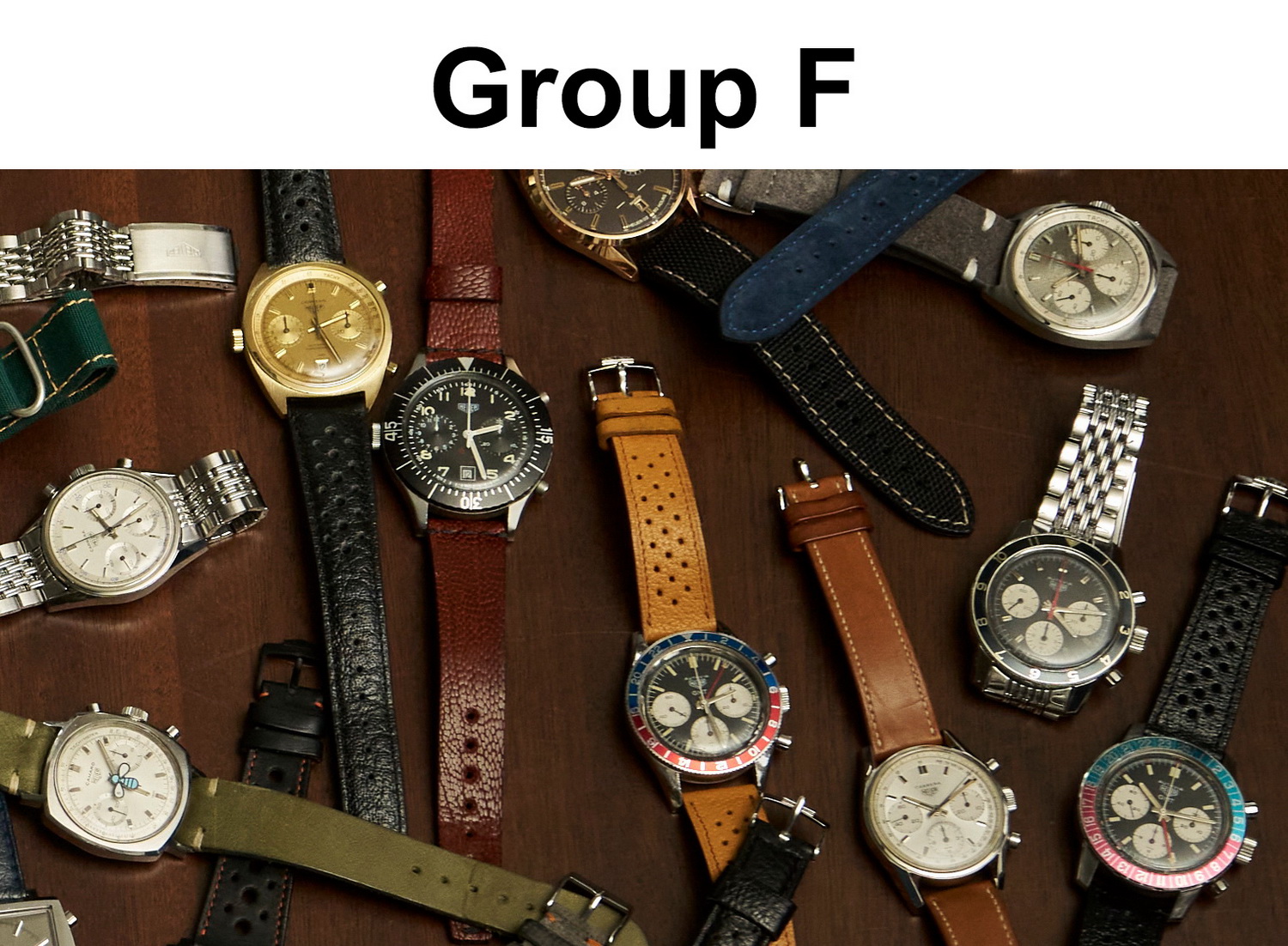
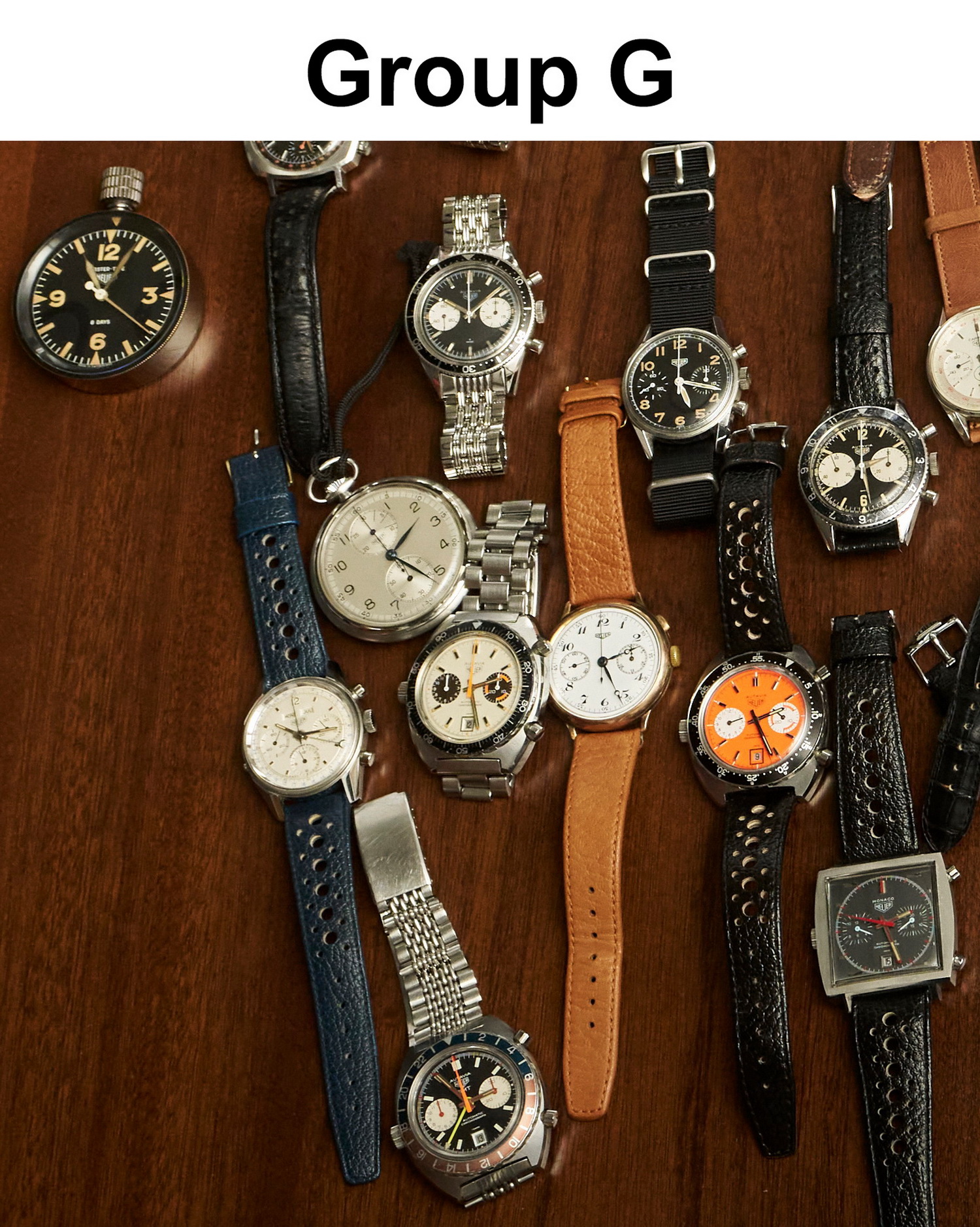
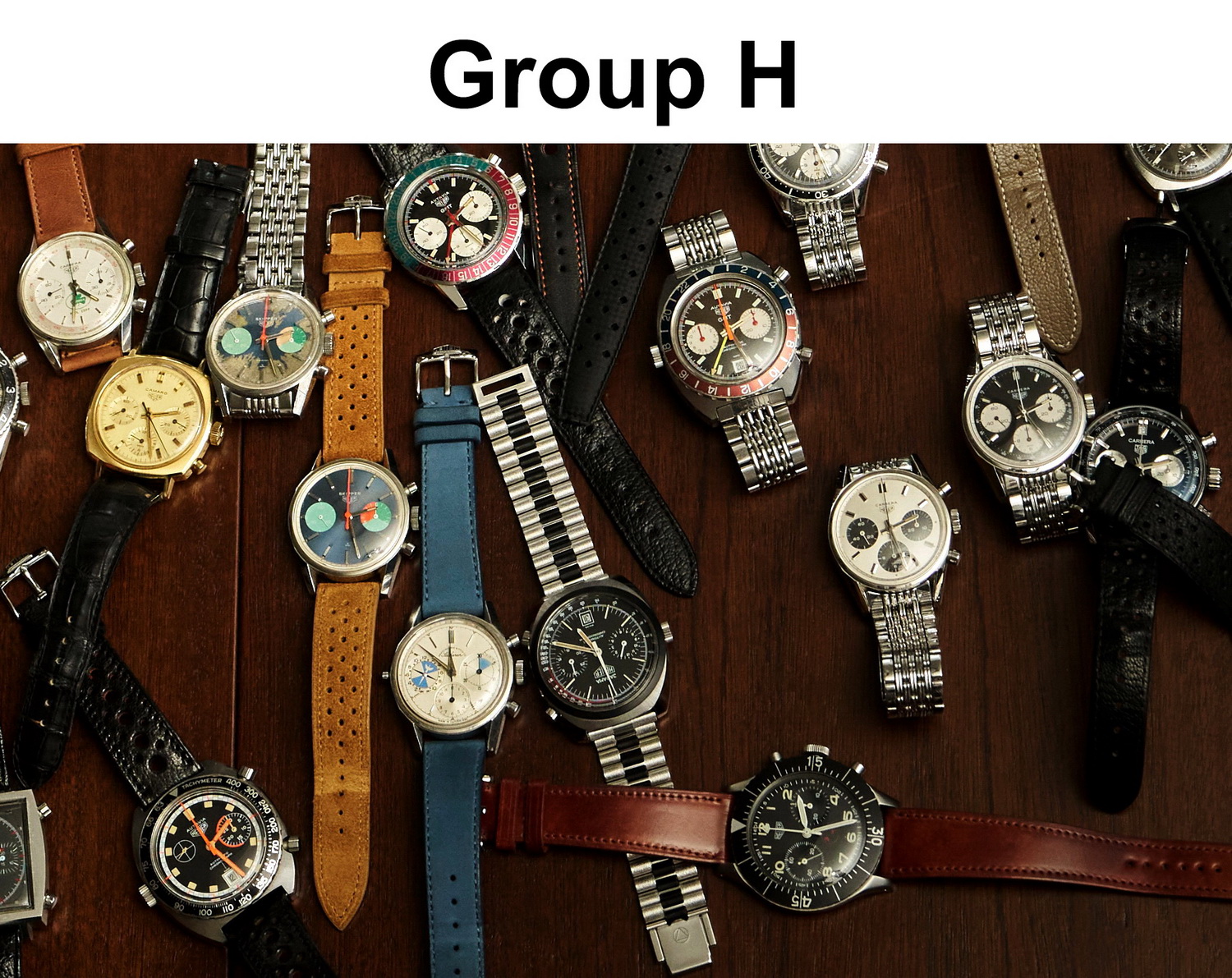
In order to be able to identify and discuss each of the 90 watches that were on the table at the Summit, I took the best photo of the and divided it into nine groups, as shown below.
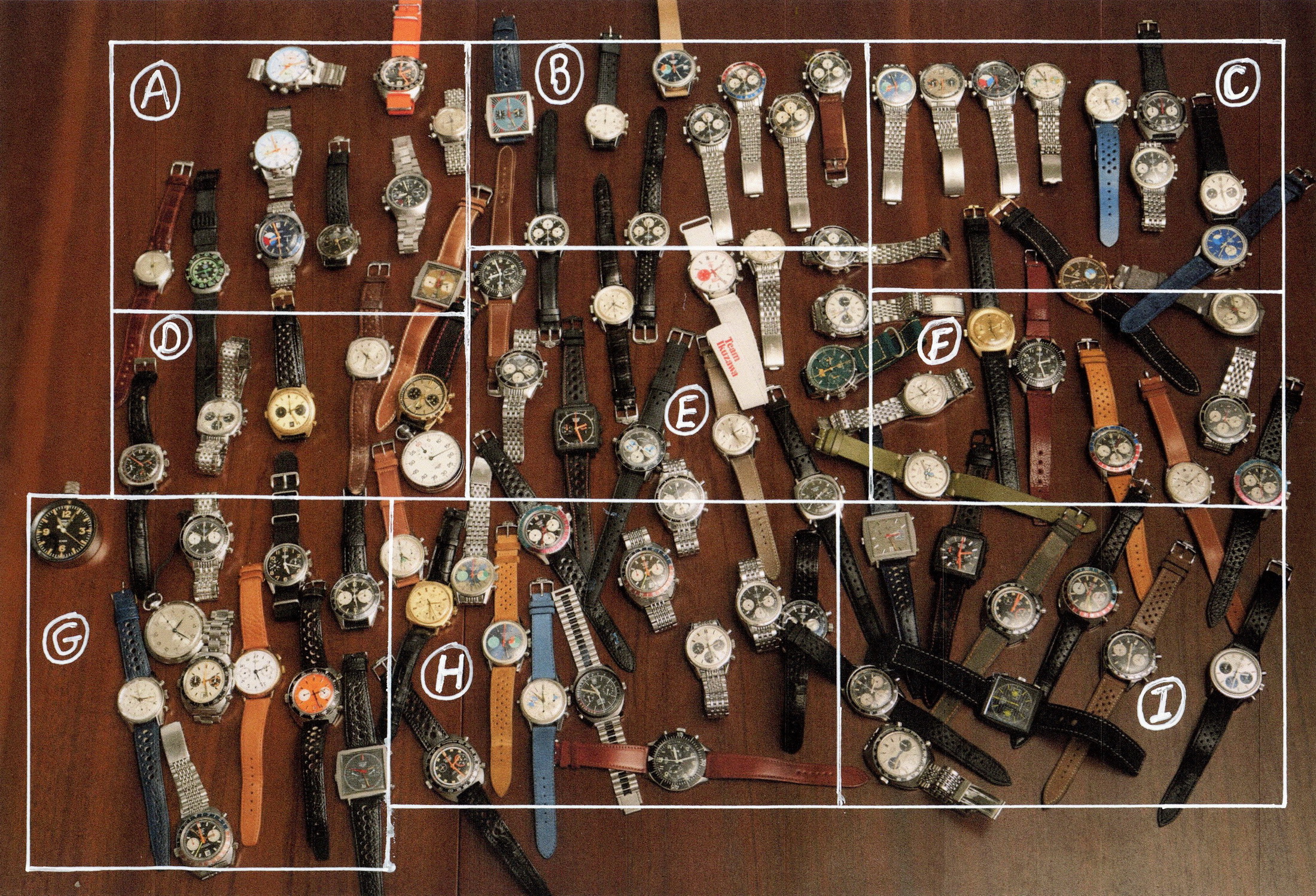
The type of watches included in each of the Groups is almost entirely random — collectors quickly dropped their watches onto the table, and there was no attempt to arrange them in any particular manner. For each of these nine Groups, the list of watches presented in this posting goes left to right across the image. It’s “longitude” that drives the ordering of the watches, without regard to “latitude.”
We have identified each of the 90 watches and provided brief comments about each of them. We hope that readers will use these brief descriptions as a gateway to explore the watches that they find most interesting. If a watch was on the table, then one of the 30 collectors brought it to the Summit, and that’s a pretty good indication that the watch may be of interest to other vintage collectors.
Some Observations About These Watches
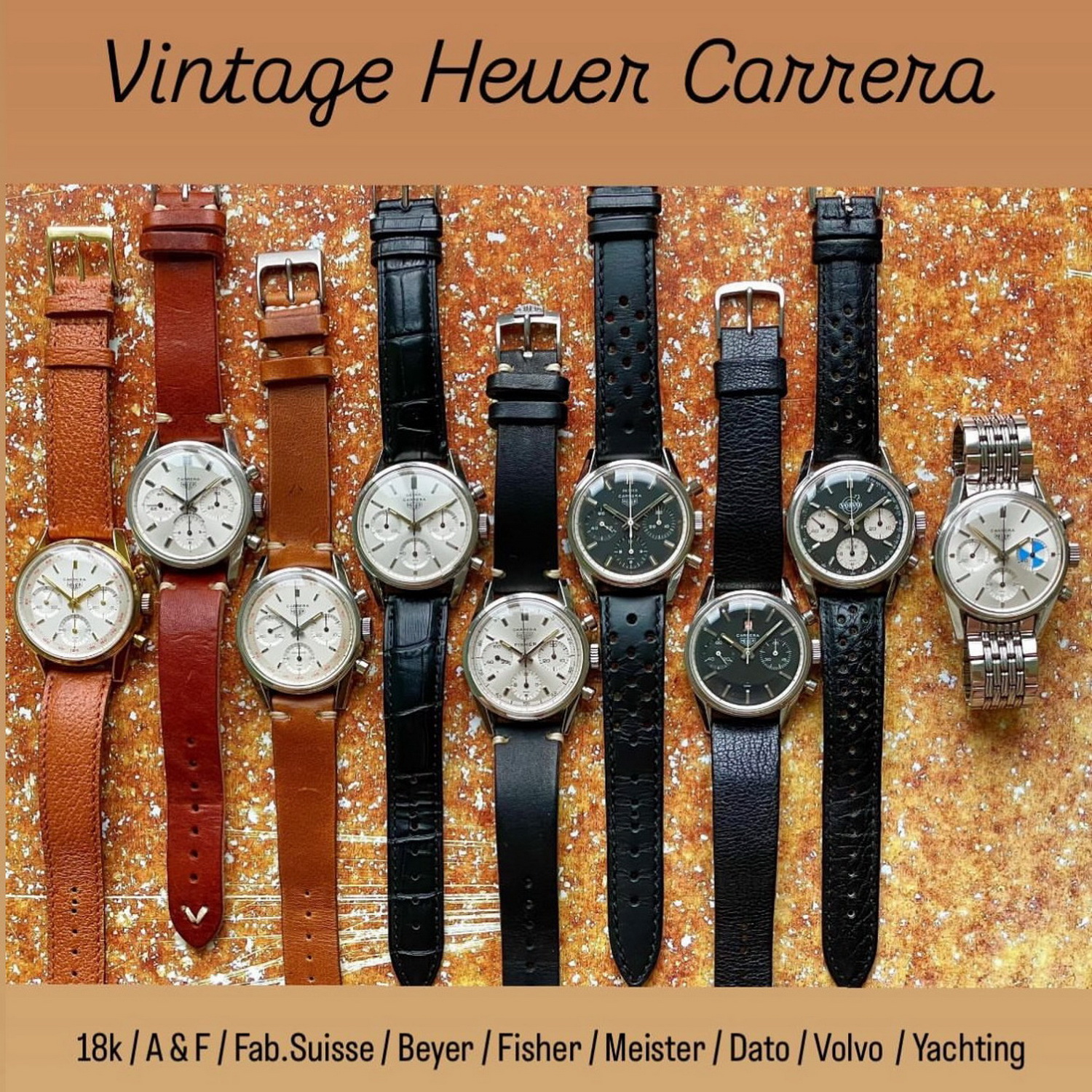
The Vintage Collectors Have Spoken, and They Love Autavias. Of the 90 watches on the table, representation of the Big Three – Autavia, Carrera and Monaco – was as follows: 29 Carreras, 27 Autavias, and 7 Monacos. This was a particularly strong showing for the vintage Autavias, as all 27 were Heuer models (with no TAG Heuer models). Of the 29 Carreras, nine were modern TAG Heuer pieces, so the 20 vintage Carreras get the silver medal. Camaro chronographs made a strong showing, with six on the table.
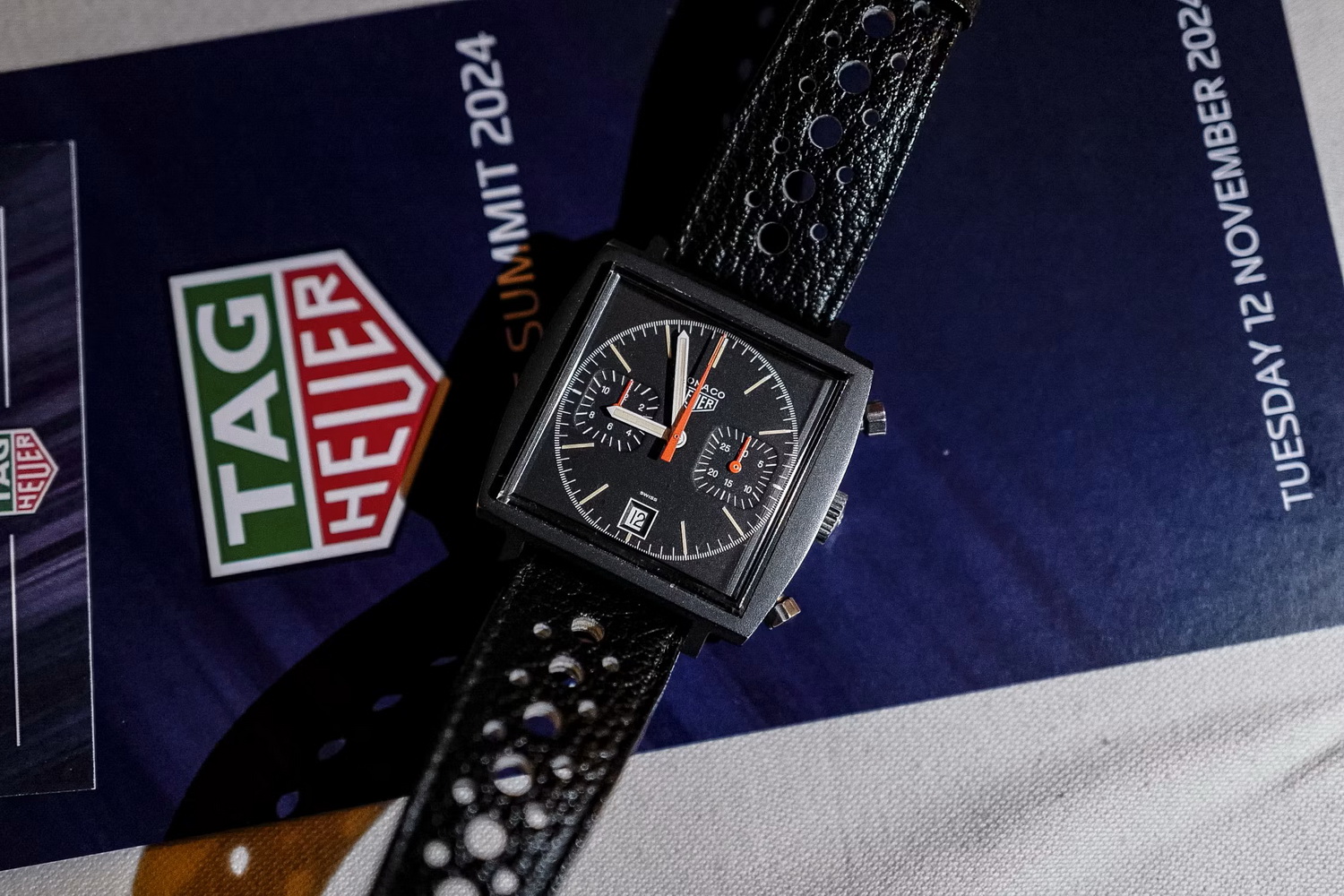
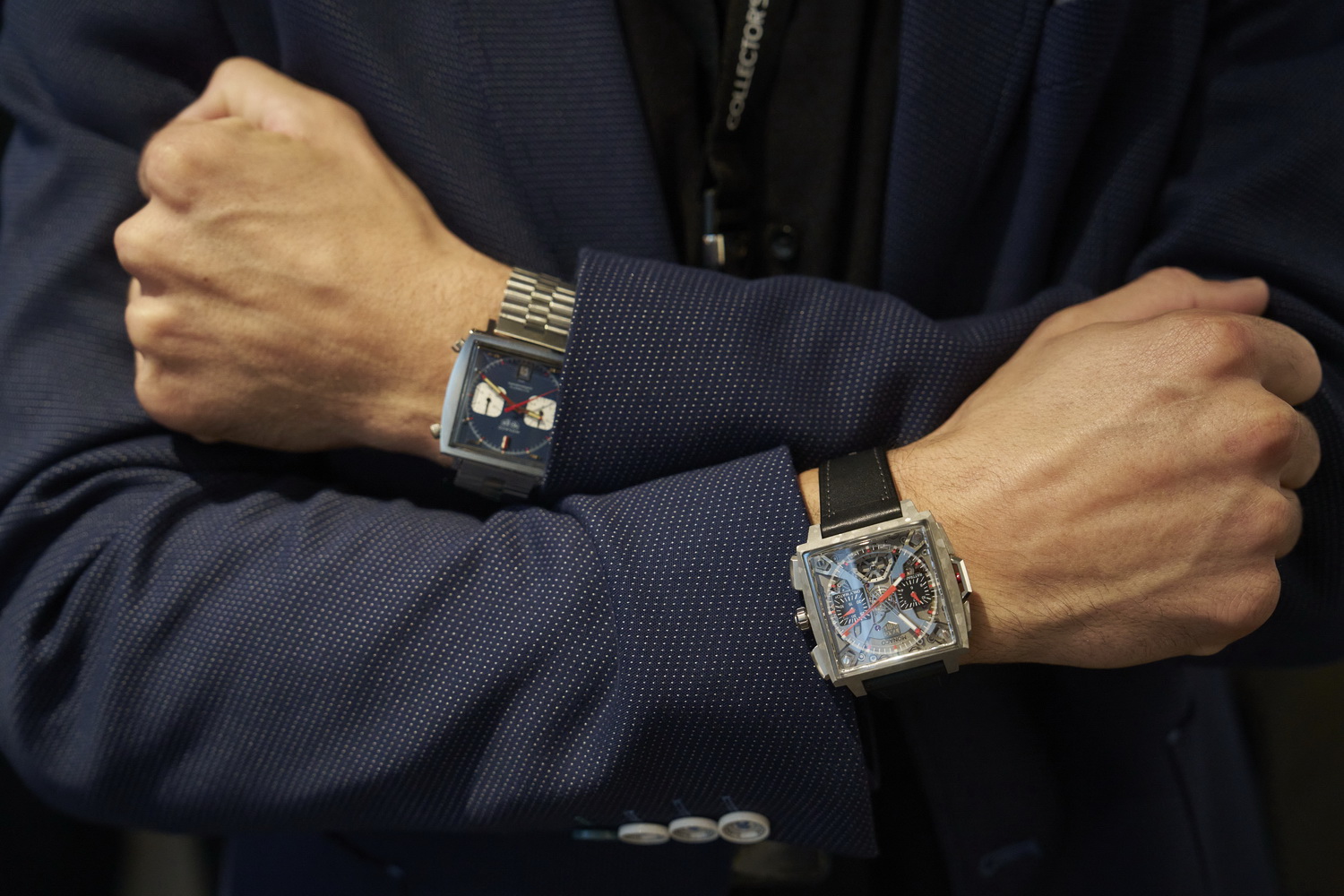
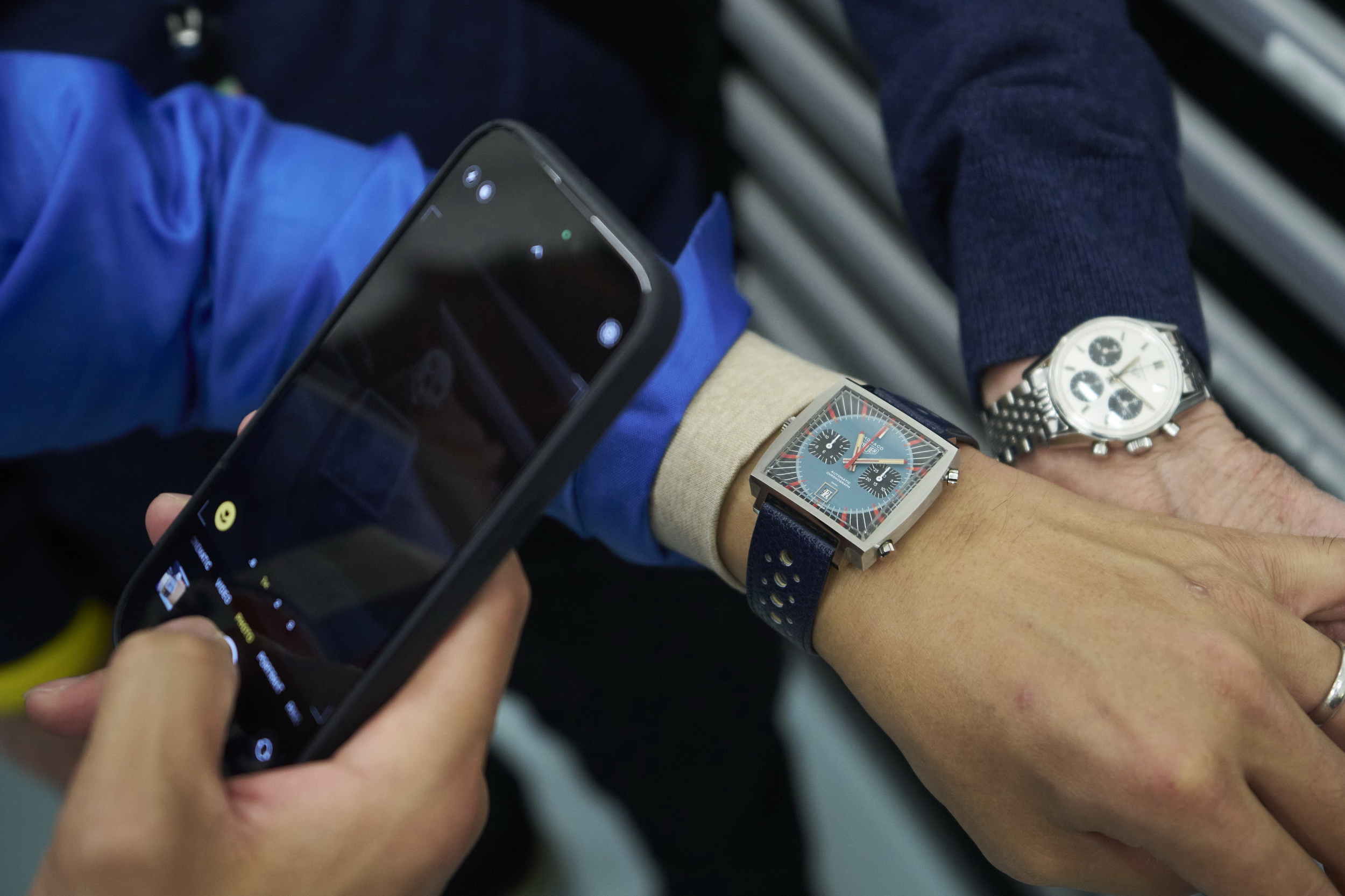
Some Special Monacos. While the nine Monacos on the table were outnumbered by the Autavias and Carreras, it was telling that only four of the Monacos were standard models from the catalog and five were “special” models. These special models included the well-known “Paintless Wonder” Chronomatic (from 1969), two models customized by Abel Court based on early TAG Heuer re-issues, Morgan King’s crazy red / blue prototype, and a model that had been customized by Bamford. So, yes, these Monacos were outnumbered, but captured plenty of attention.
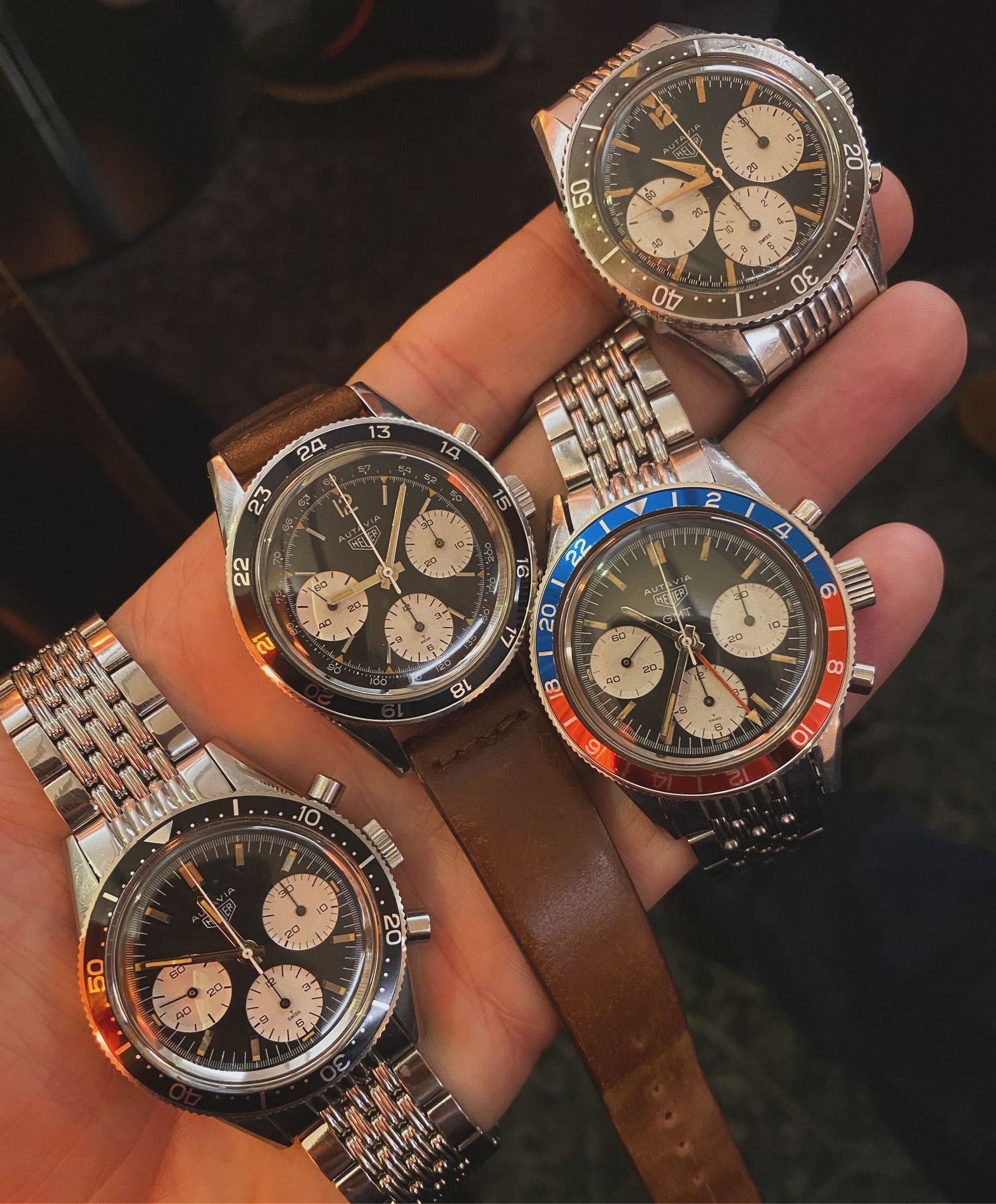
GMTs for the Global Gathering. Collectors travelled from around the world to get to La Chaux-de-Fonds for the Summit, so it’s not surprising that the Autavia GMT chronograph was the choice for many of our travelers. I count 10 on the table, including two of the super-rare reference 2446 first execution (screw-back case), as well as the reference 741.603, the last manual-winding model produced.
The Watches Traveled in Groups of Three. Study the table shot, and you will see that many of the chronographs arrived in groups of three. We have probably seen fewer than 30 samples of the Skipperrera chronograph (Reference 7754), and three of them attended the Summit. In the Seafarer category, we had two Abercrombie & Fitch models (2447 and 2446C) and one Heuer Mareographe (2443), perfect samples from the 1950s, 60s and 70s. For the Carrera 30 delegation (reference 7753), we had a panda, a reverse panda and the special model made for the Belgian Air Force. There is only one execution of the Autavia Reference 1563 “Exotic”, and we had three of them on the table.
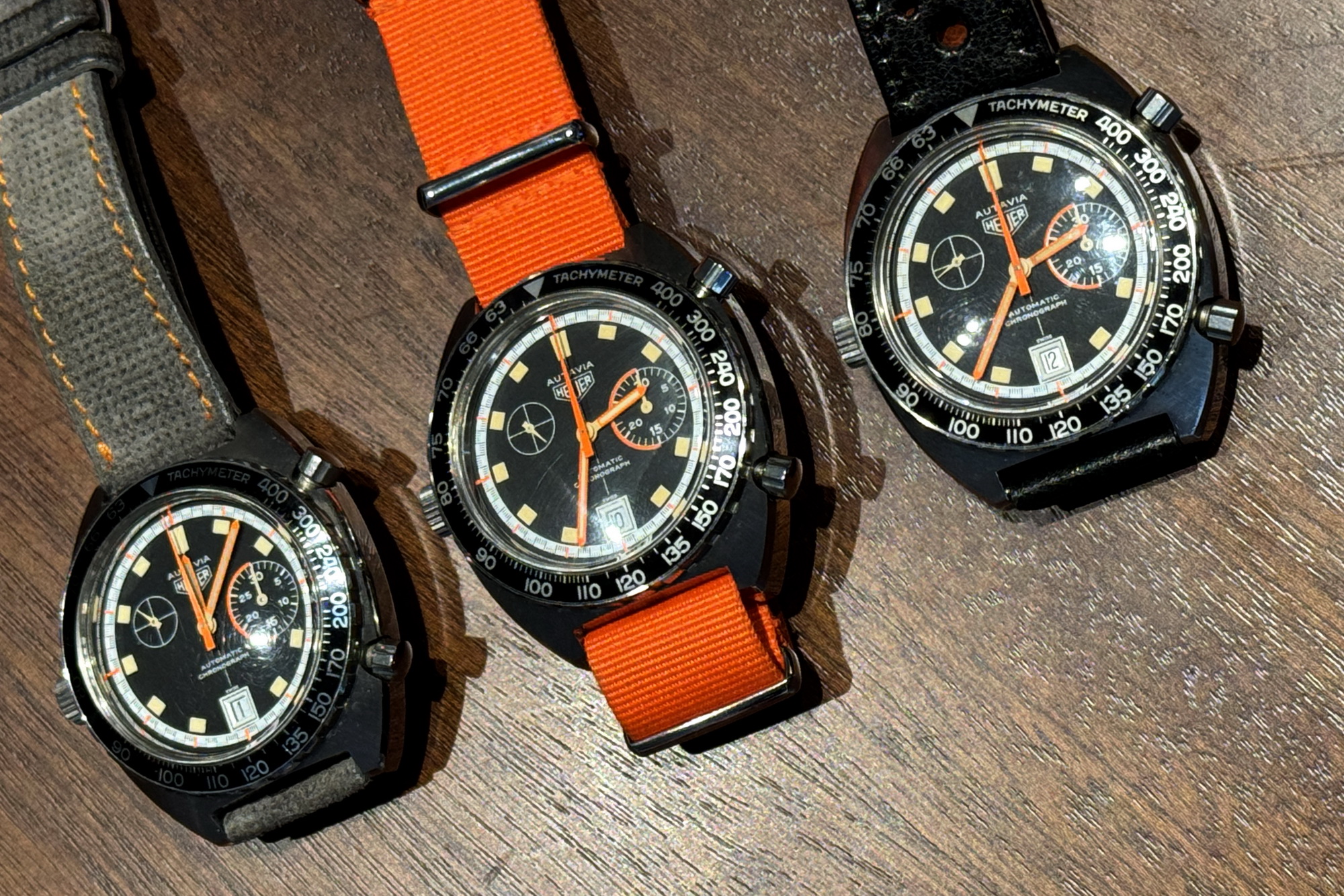
Three Rindts, Three Racers. Universal Geneve is making a big deal out of the chronograph that Nina Rindt wore, but let’s show some respect to the watch that her husband wore. In 1970, Jochen Rindt became Formula One’s only posthumous World Champion. His watch of choice was the Autavia, Reference 2446 (second execution case), which collectors call the “Rindt”. We had three Rindts on the table at the Summit. We also had two “Andretti” Autavias (reference 3646) and an Andretti 18 karat gold Carrera (reference 1158) and two “Siffert” Autavias (reference 1163T). See this page for more about Andretti and his watches.
We Welcome the “Glassbox” and Mr. Bamford, Too. TAG Heuer was well-represented by four Glassbox Carreras — the Hodinkee Skipper LE and the Revolution Blue Dreamer are from the first generation of the Glassbox Carreras; the 60th Anniversary LE (Panda) and the current Reverse Panda (reference CBS2210) are second generation models.
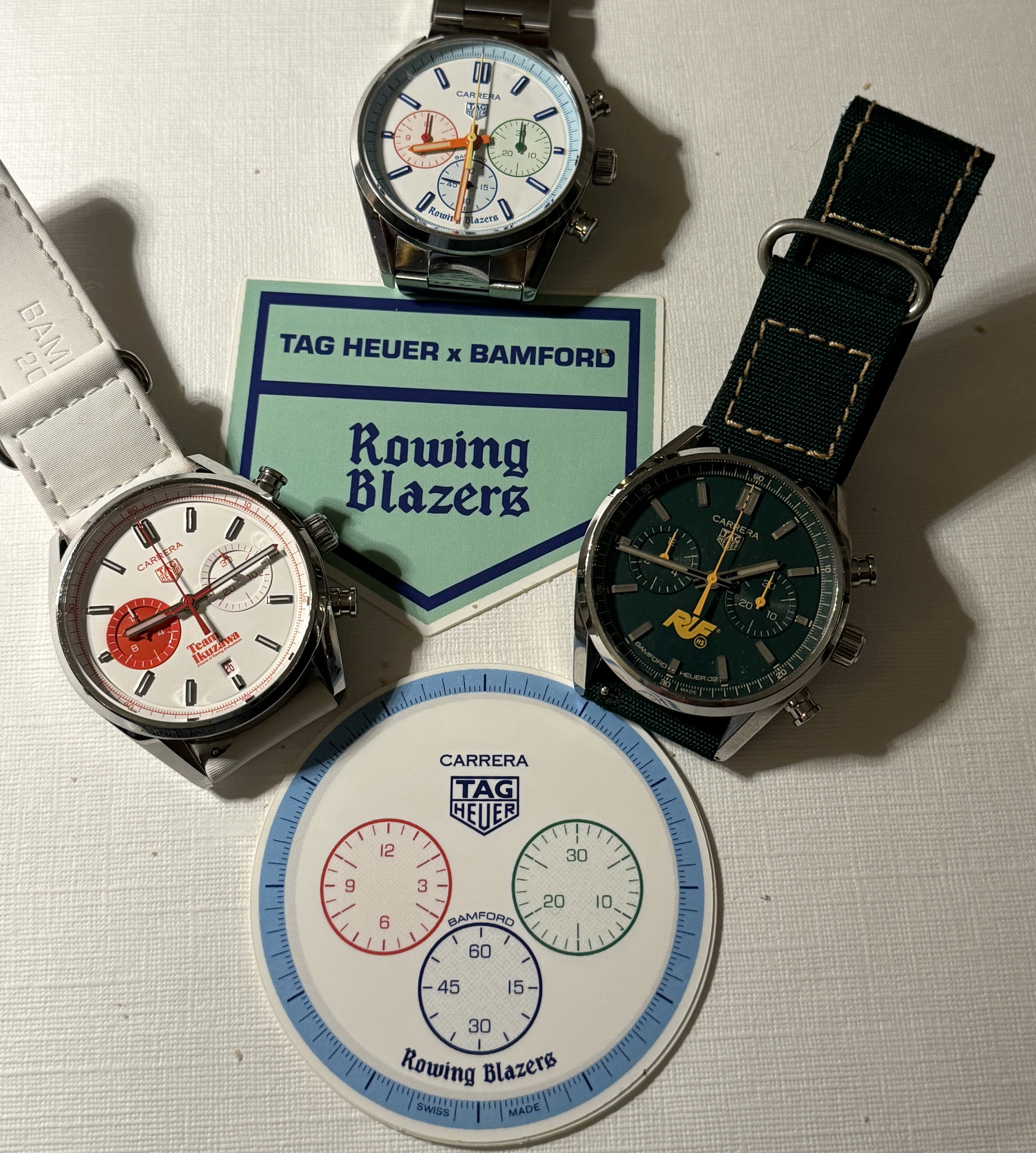
George Bamford, head of Bamford Watch Department, attended the Summit. The seven “Bamford” models added definitely added some color to the table.
What Was Missing? So what was missing from the 90 watches on the table? I would have liked to have seen more Heuer chronographs from the 1940s and 1950s. Next time, I’ll try to bring a couple of waterproof chronographs (references 346, 2447 and 2406), and a triple calendar chronograph (references 2543, 2547 or 2558), and we’ll see whether they get any love. The 1970s may have been underrepresented, with no Calculators, Silverstones or Montreals; we can’t expect to see the electronic models from the 1970s (Chronosplit and Senator), as relatively few collectors pursue these models and at any given time, the battery will be dead.
Missing in Action. Collectors attending the Summit brought a few watches that did not make it onto the table for the Table Shot. This is understandable, as the table shot was not on the schedule for the Summit, so some watches may have been out of the room when the photo was taken. Among these watches that were at the Summit, but missing for the table shot were a “Dark Lord” Monaco, two standard McQueen Monacos, a TAG Heuer Monaco Rattrapante, a Carrera reference 2447 with the Autoweek logo on the dial, and one of the craziest watches that Heuer ever made, the Split Lap Unit 77.
With that by way of an introduction, let’s have a look at the 90 watches that were present and accounted for at the TAG Heuer Collectors Summit, November 2024.
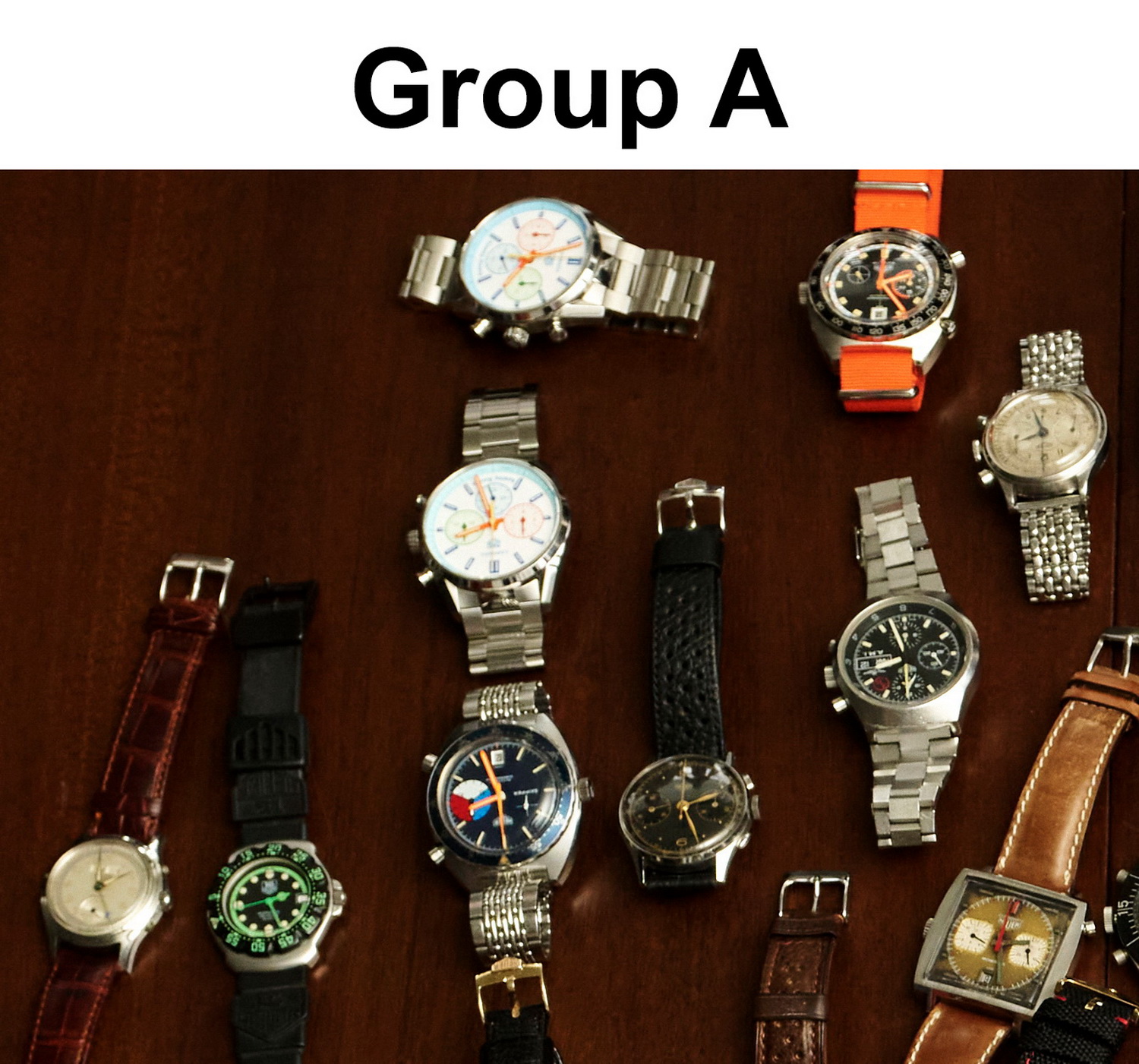
1. Triple calendar watch, white dial (1950s) – During the 1950s, the Heuer catalog was fairly well balanced, between chronographs and “three-hand” watches. By 1960, Heuer would go all-in on the chronographs, no longer offering three-hand or even calendar watches. It was nice to see this calendar watch on the table, representing a strategy that Heuer pursued 70 years ago.
2. TAG Heuer Formula 1 watch, reference 375.508 (stainless steel case, black dial, green accents) (1991) – with the current popularity of the early Formula 1 watches, this one made lots of collectors smile.
3. TAG Heuer x Rowing Blazers x Bamford “Yacht Timer” Carrera LE – Starting with a 42 millimeter Carrera, this 2023 Limited Edition (99 watches) represents the best of Eric Wind, everyone’s favorite vintage Heuer dealer, and George Bamford, the master of producing customized watches.
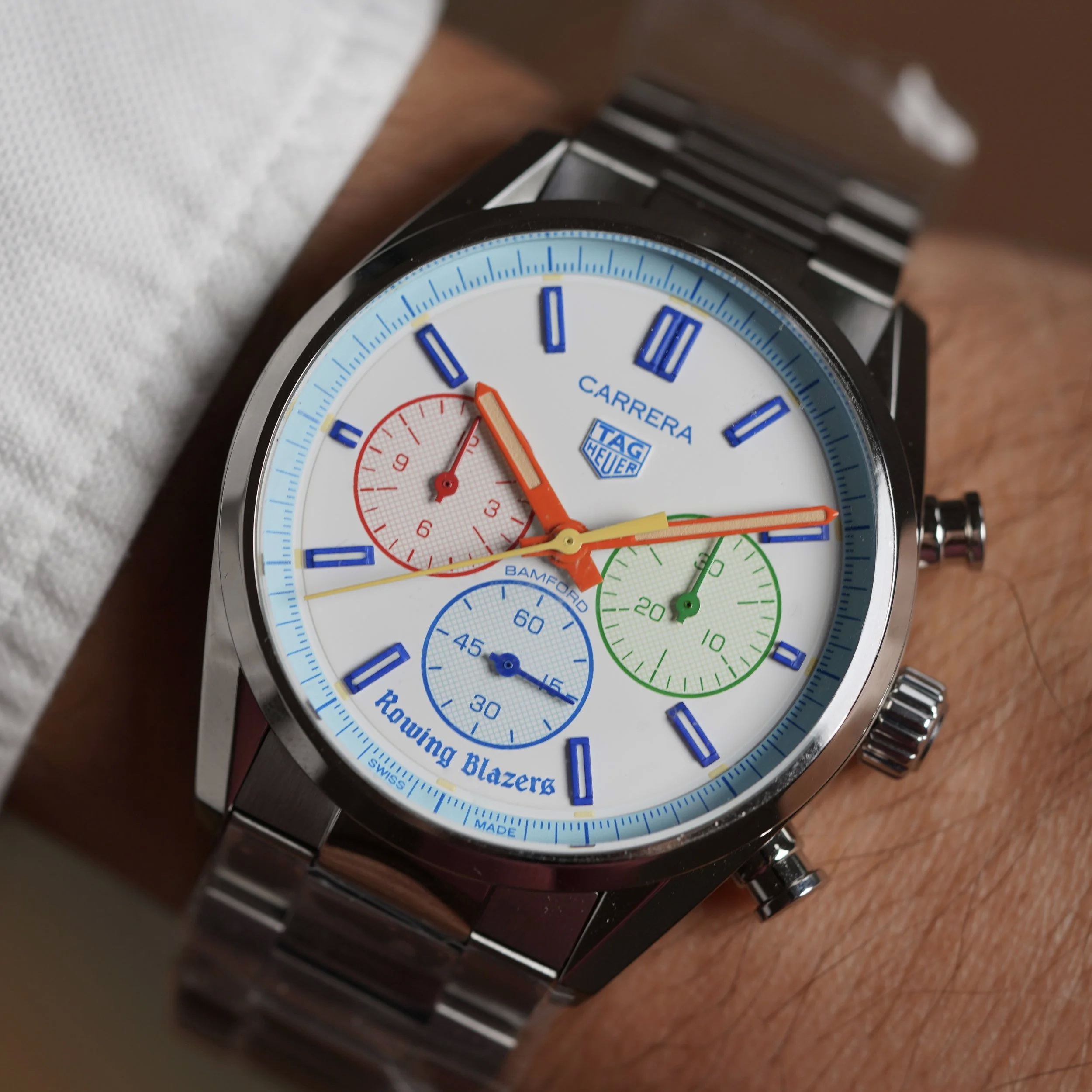
4. TAG Heuer x Rowing Blazers x Bamford “Yacht Timer” Carrera Limited Edition.
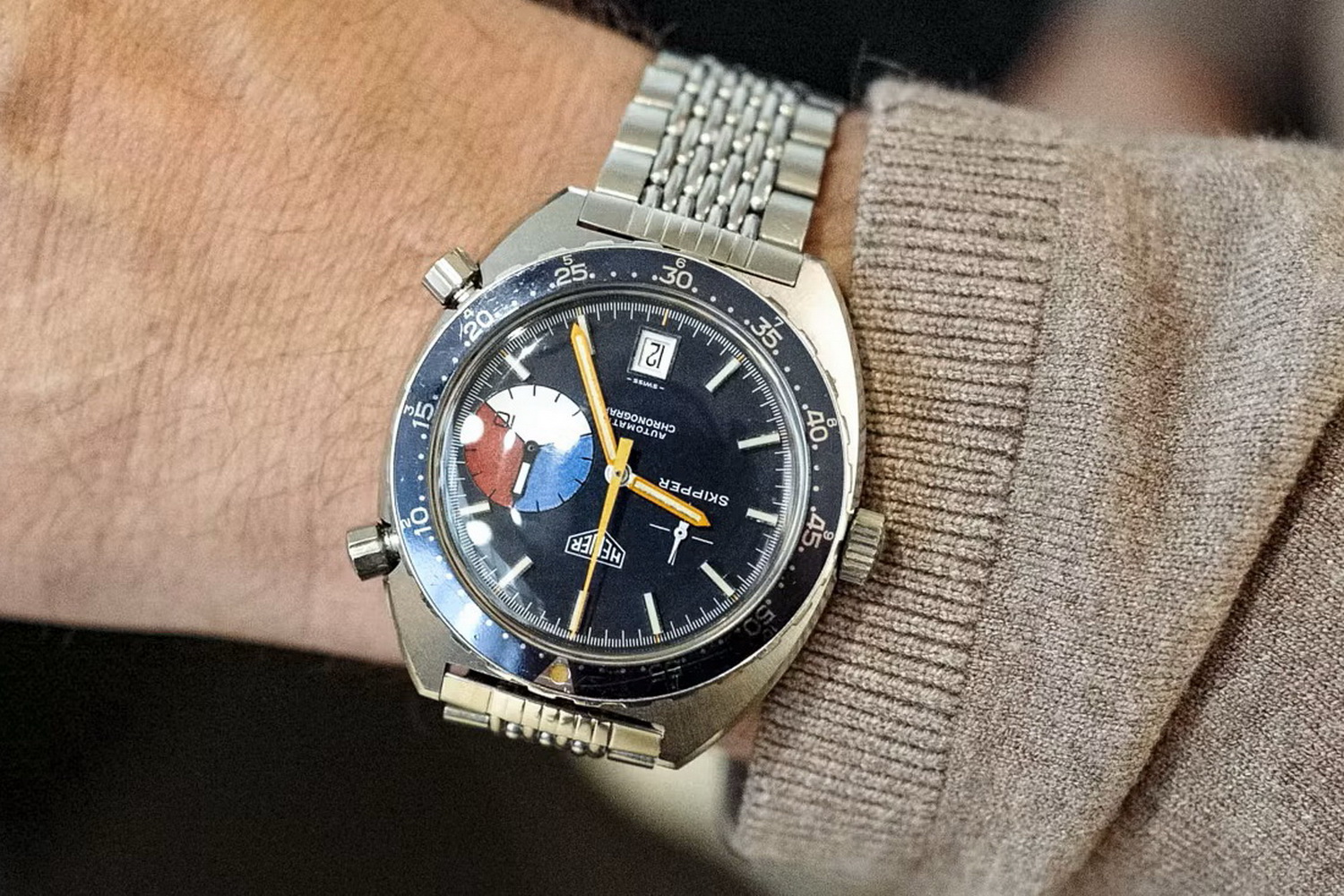
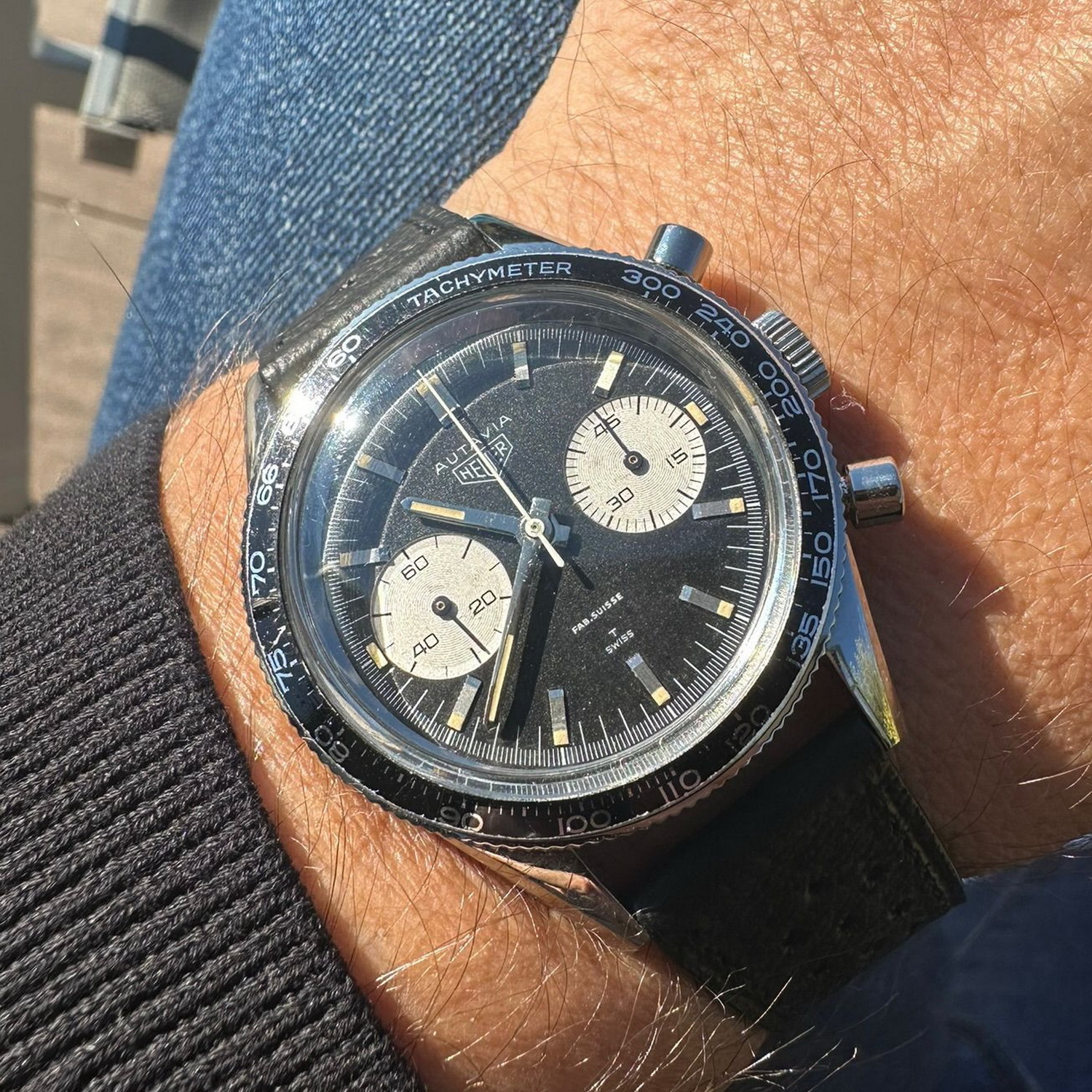
5. Skipper, reference 1564 (1972) – This was the first automatic Skipper chronograph, and many collectors declare it to be the best of the breed. It uses the thinner reference 1163 / 1563 case, while the later models (reference 15640) became rather top-heavy.
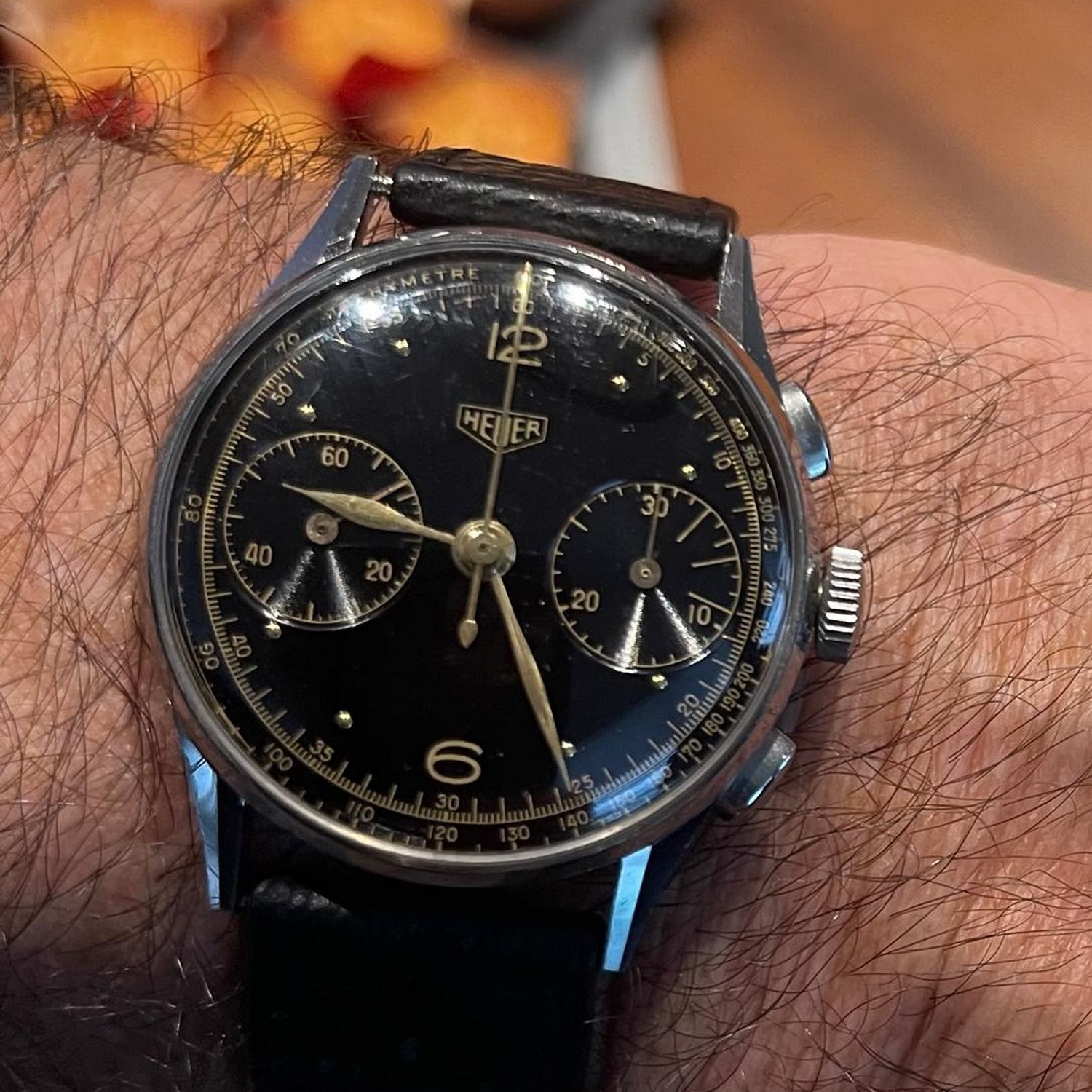
6. Reference 333 NTC chronograph (1940) – I’m thrilled that we had this beautiful chronograph to represent the 1940s decade. The reference 333 uses the Valjoux 22 movement, in a “flat” case.
7. Autavia, reference 1563, “Exotic” dial (1972) – We had three of these on the table, but this was the only one on an orange NATO strap. Collectors recall an earlier Summit when Morgan King went home with a carry-on full of these watches.
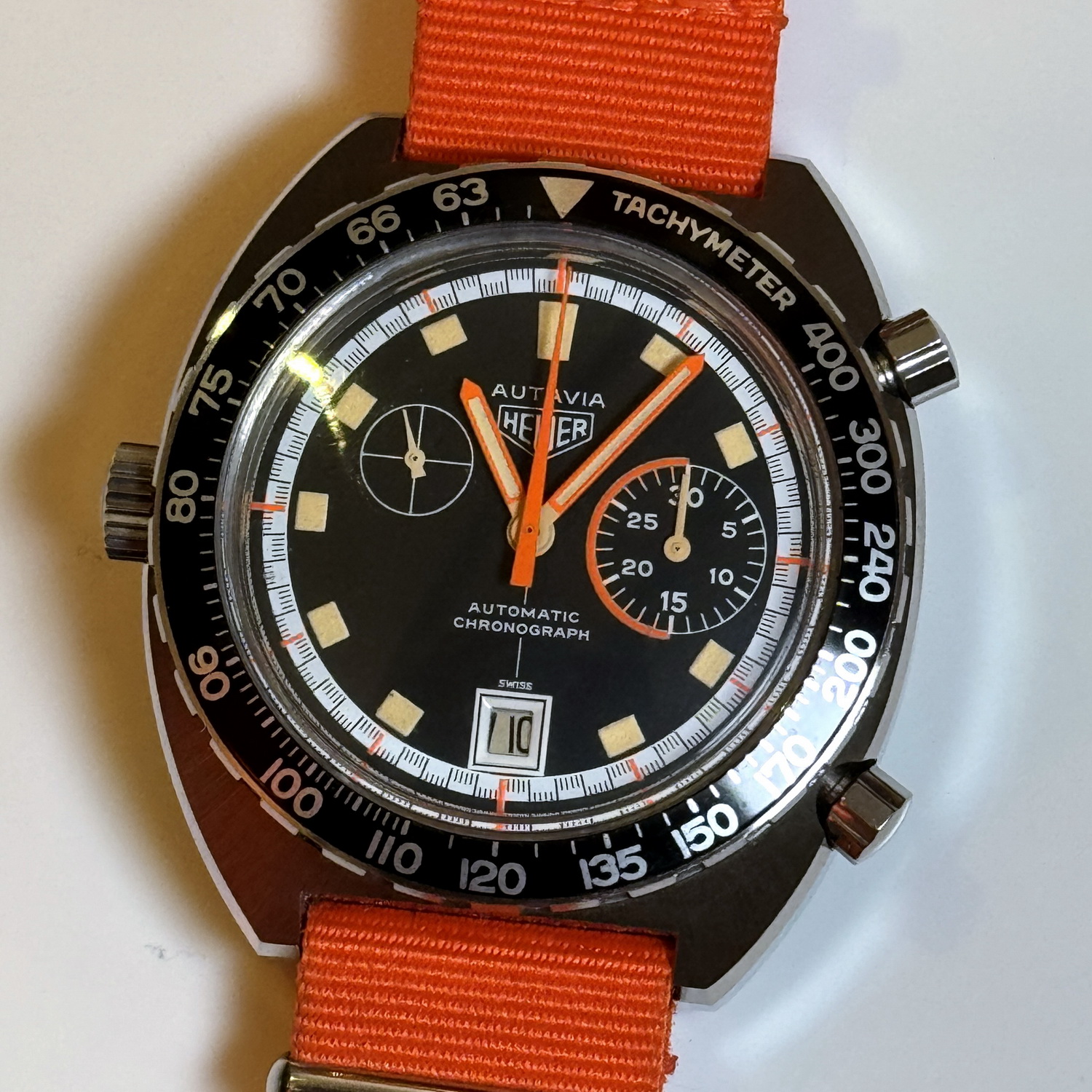
8. Reference 510.543 AMI chronograph (1982) — Heuer made these for the Aeronautica Militare Italiana (AMI), the Italian Air Force, and many collectors consider it the best of the Lemania-era chronographs.
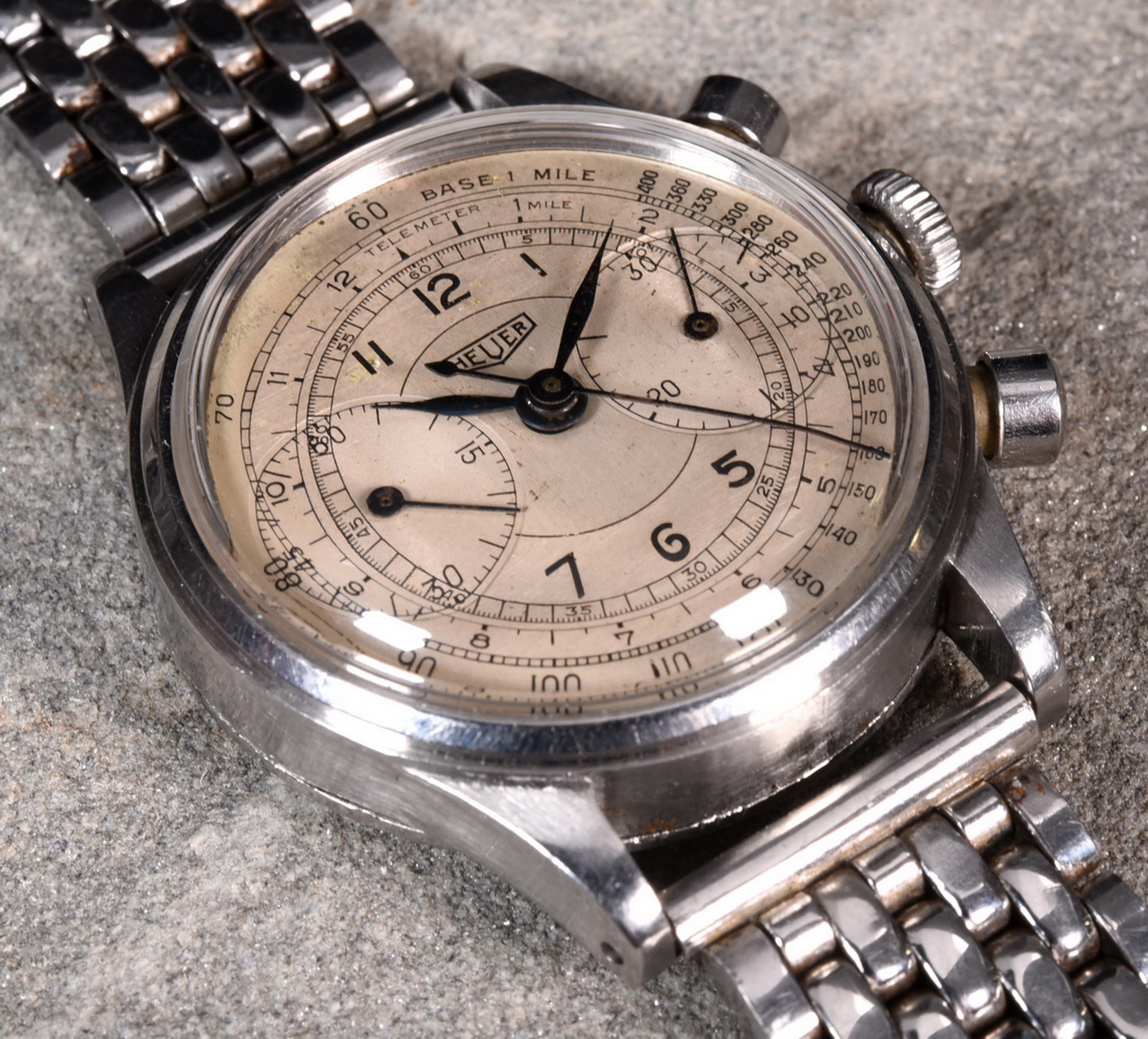
9. Reference 2406 chronograph, waterproof case (1942) – Heuer used the Landeron 13 movement from 1935 to 1945. With its white dial and colorful tachymeter and telemeter scales, this one is my candidate for the best looking chronograph .
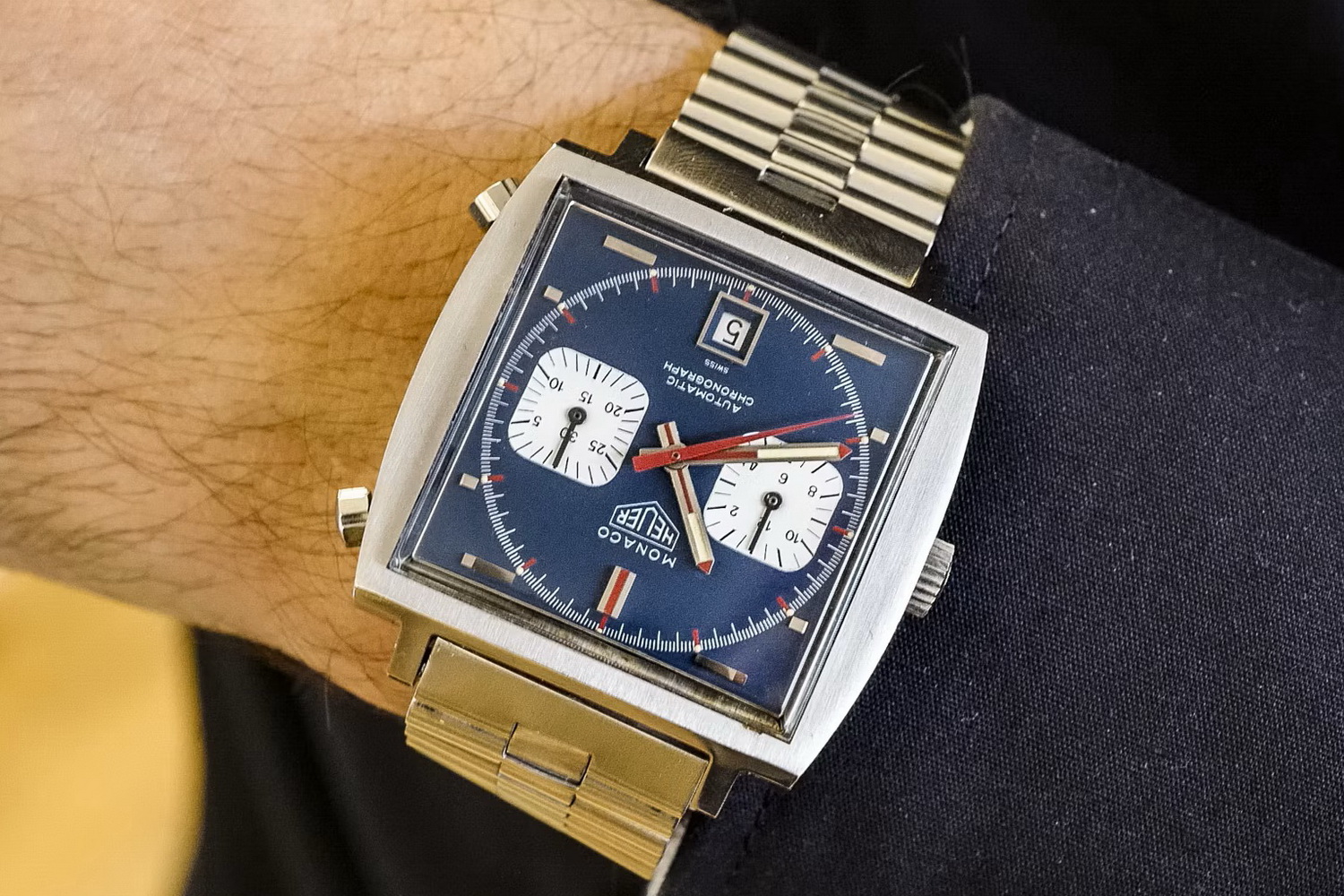
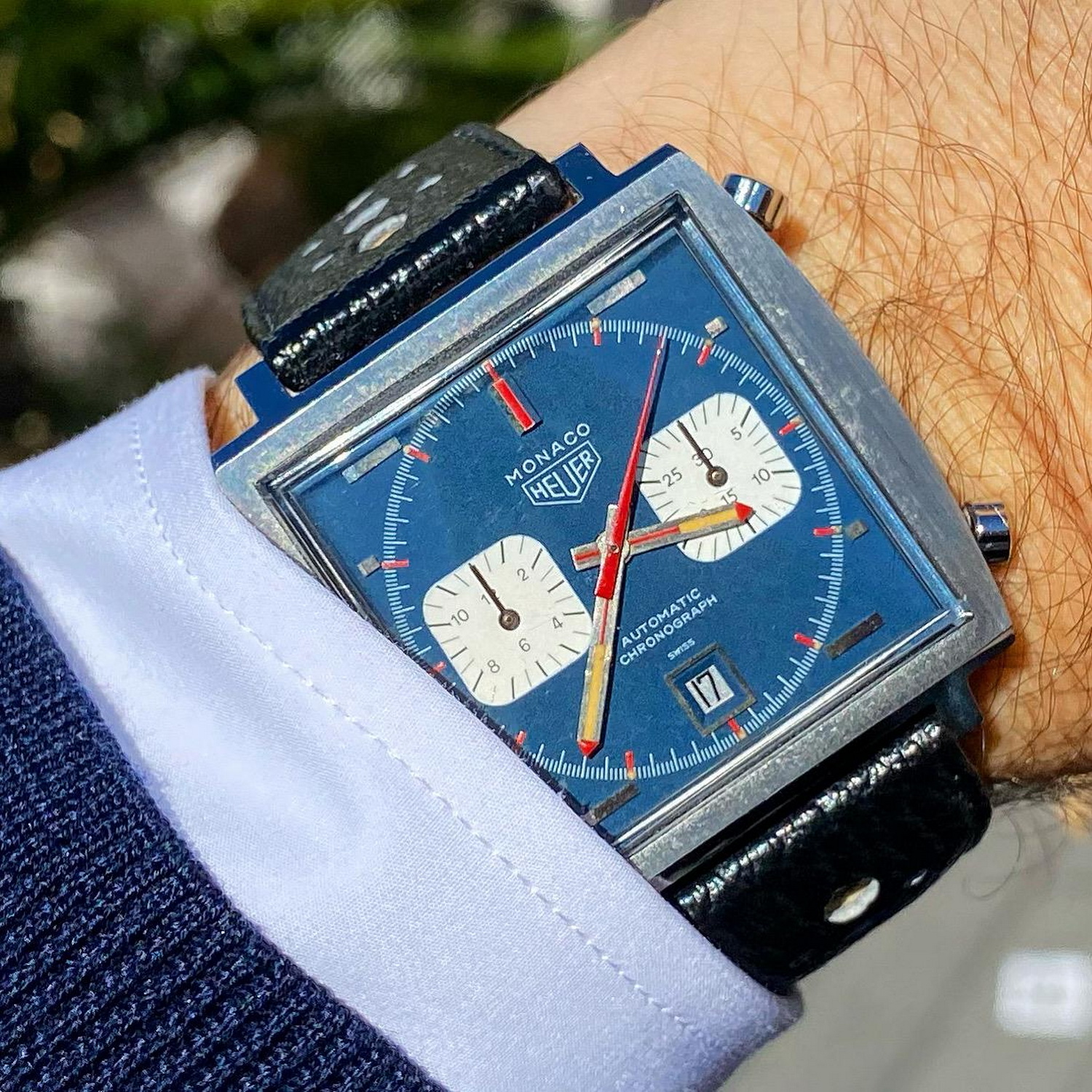
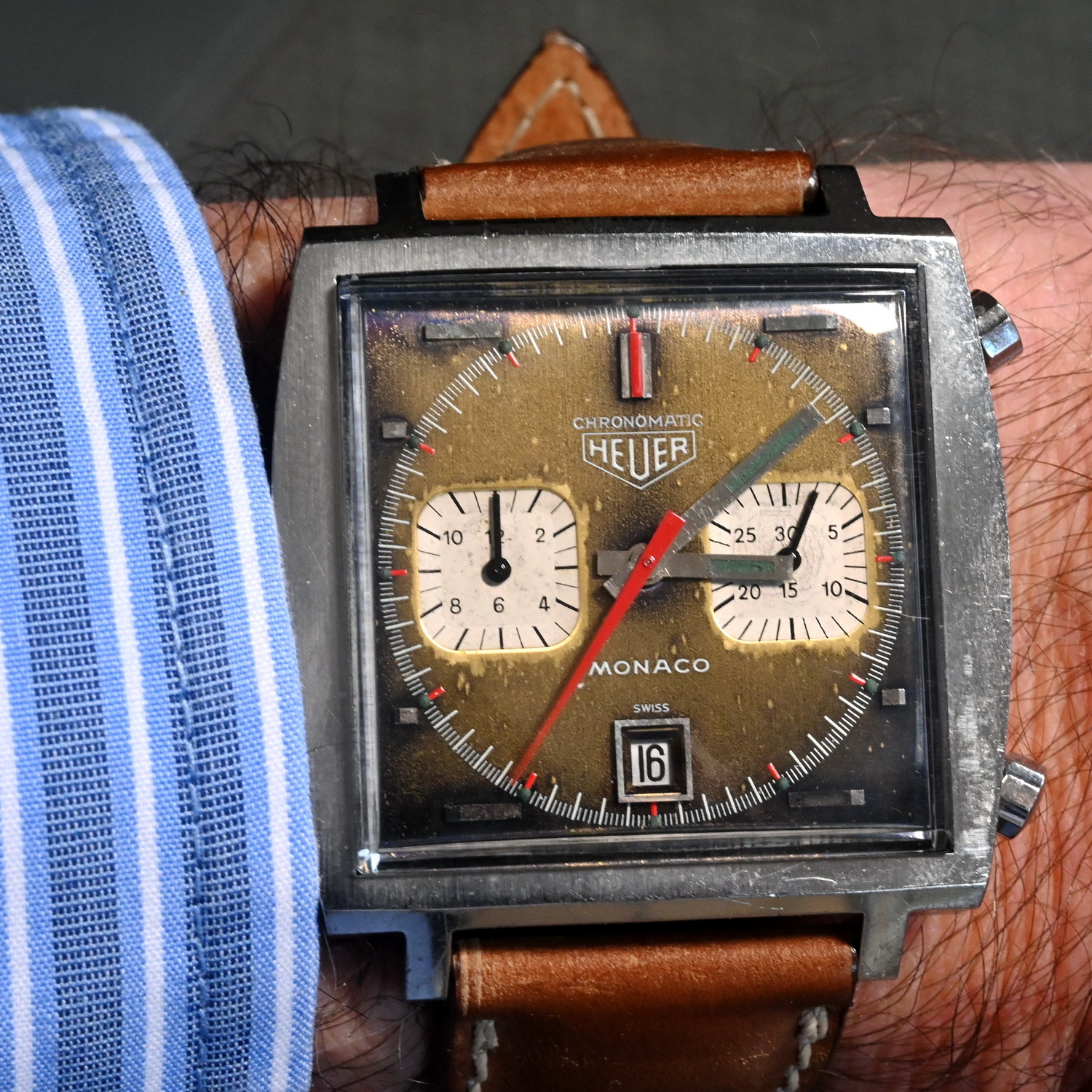
10. Monaco, reference 1133 B (blue dial) “Chronomatic” (1969) — collectors call it the “Paintless Wonder”, because it left the factory with midnight blue paint, but not much of it remains. The name “Chronomatic” across the top of the dial tells us that this is a very early Monaco.
11. Monaco, reference 1133, with blue, black and red test dial – Morgan King had the craziest looking watch on the table, and 50 years later we can only wonder why Heuer never pushed the button to put it into production. If you have to have one, Bamford Watch Department can give you one with a similar look.
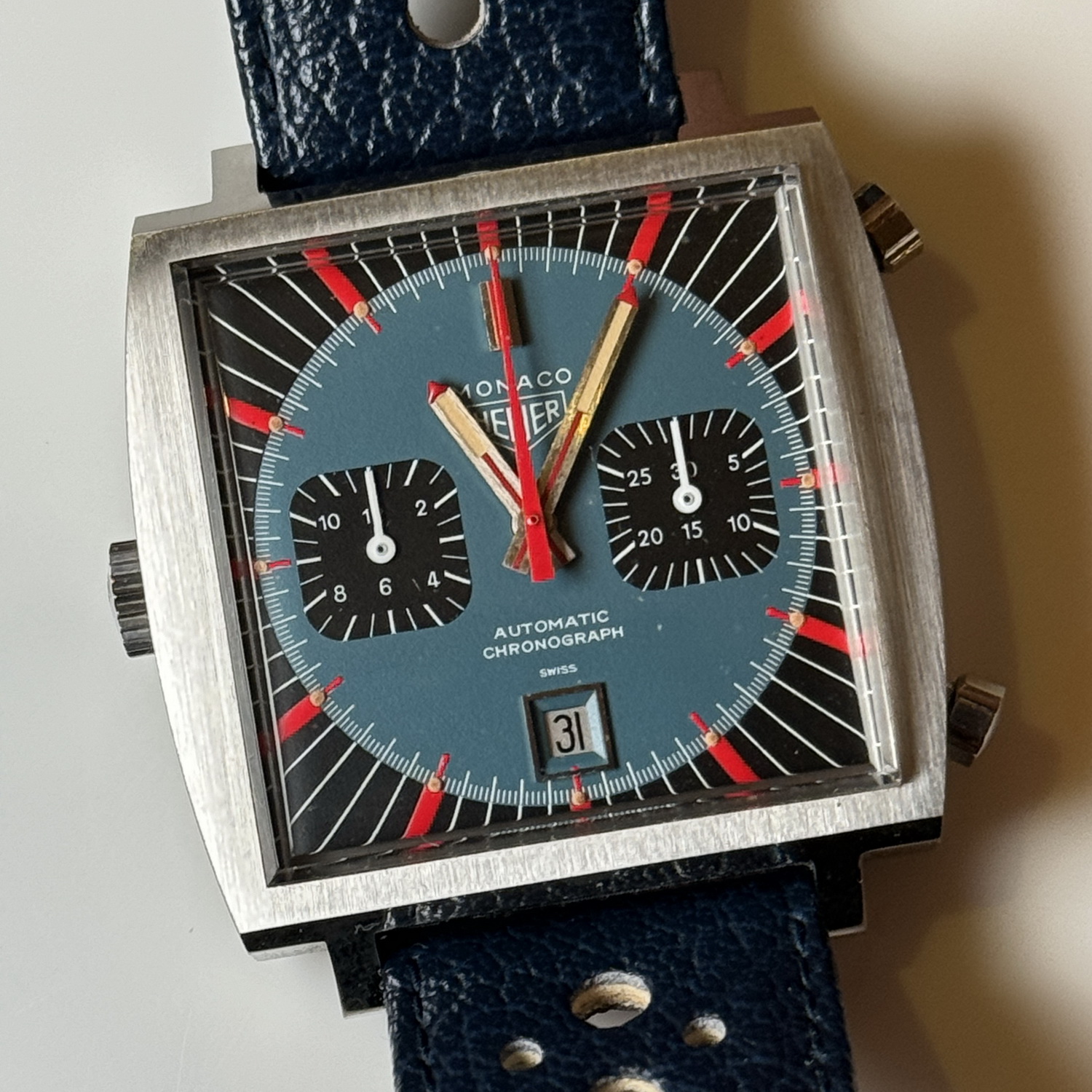
12. Carrera, reference 2447 NST (1970) — Around 1970, Heuer began offering contrasting registers on the Carrera chronographs. This “reverse panda” with the tachymeter scale on the dial was the version worn by James Hunt, who won the 1976 Formula 1 World Champion, driving for McLaren.
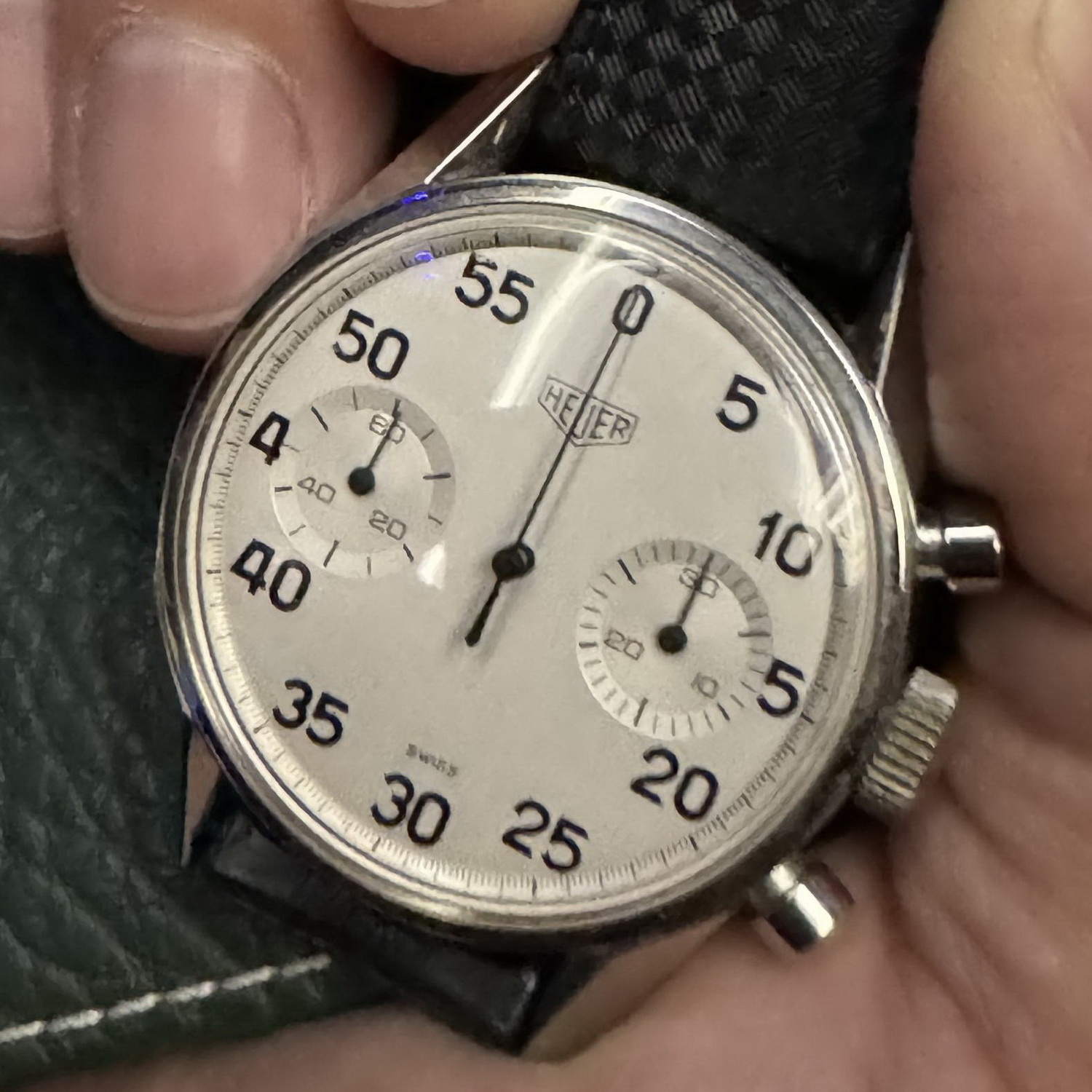
13. Carrera 30 chronograph, with stopwatch style dial – Perhaps the oddest timepiece on the table, this is basically a stopwatch with 30-minute capacity and a running seconds hand to let you know that it is wound and ready to go. Look twice, and you realize that it has no time-of-day indication. We have seen three or four of these over the years and it was a pleasure to see this one at the Summit.
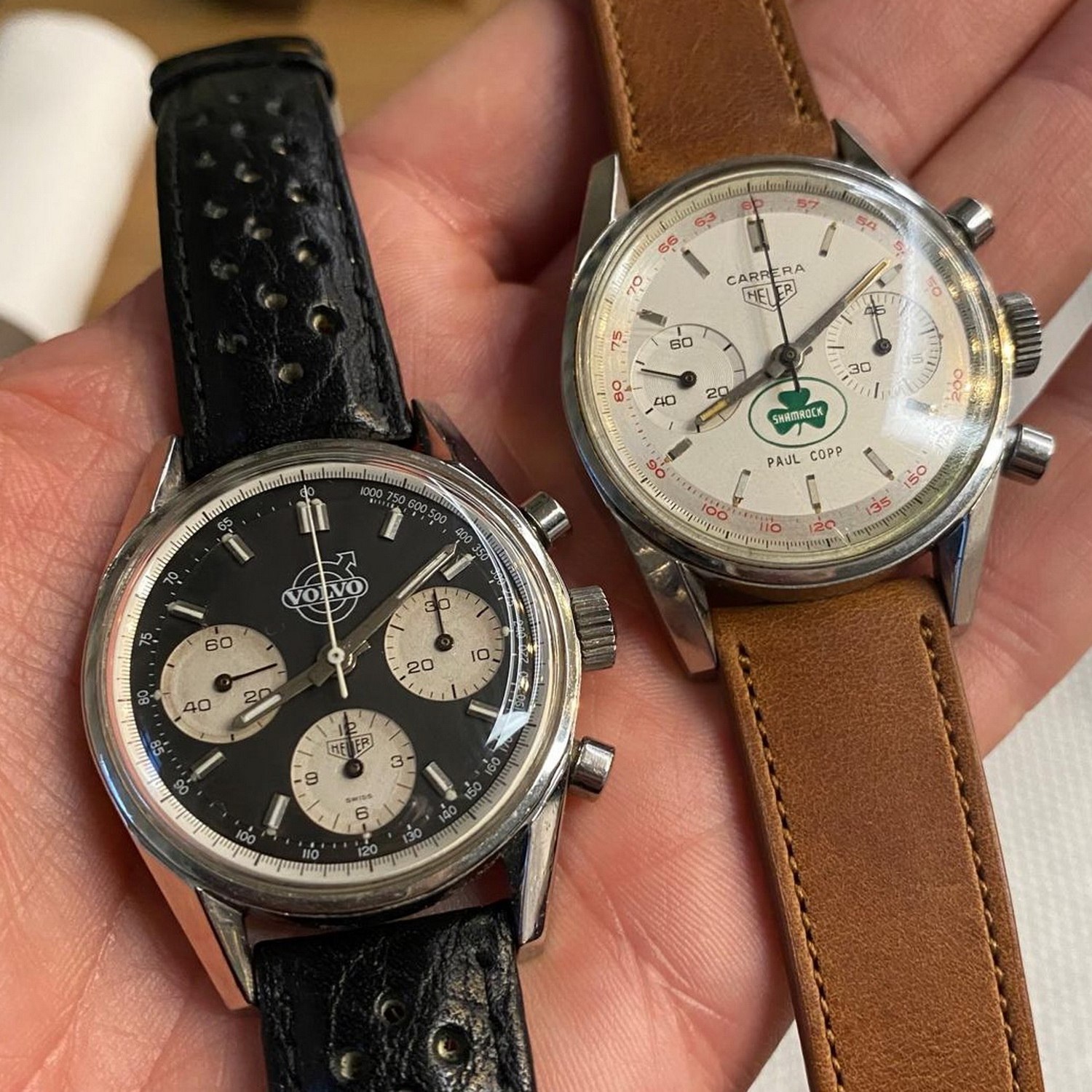
14. Carrera, reference 2447 NST, with “Volvo” logo (1970) — A “reverse panda” Carrera with a tachymeter scale on dial; a fine representative of the vintage Heuers with third-party logos on the dial
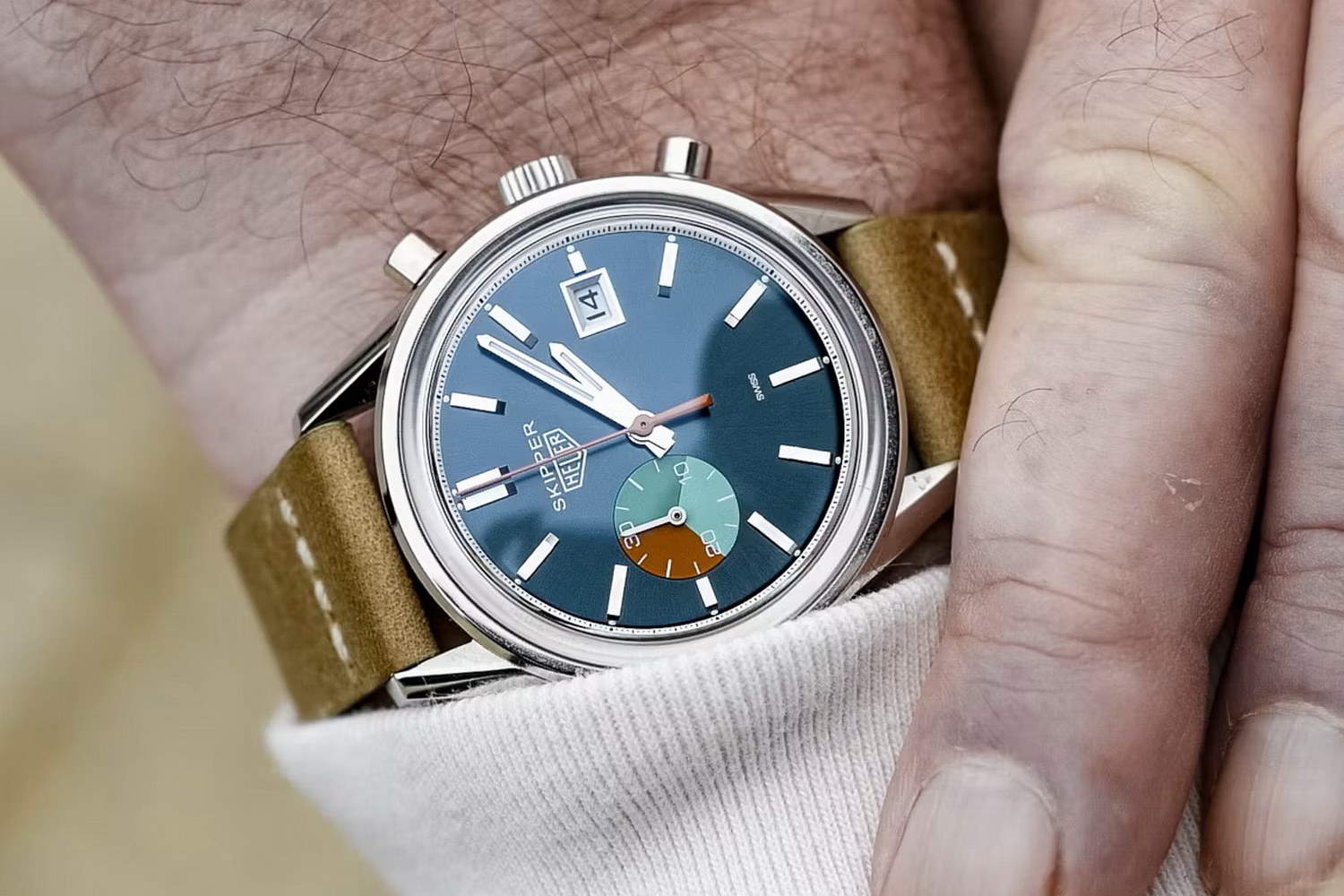
15. TAG Heuer Skipper Limited Edition for Hodinkee (2017) — TAG Heuer introduced the “Glassbox” case for the Carrera in 2015, but it was this limited edition of 125 watches offered by Hodinkee (reference CAR221B) that got everyone’s attention.
16. Autavia, reference 2446 M, “Rindt” model (1970) — Jochen Rindt won the 24 Hours of Le Mans in 1965, driving a Ferrari 250 LM, and the Formula 1 Driver’s Championship in 1970, driving a Lotus 72. His choice of watches was the three-register Autavia, with a minutes bezel), worn on a stainless steel bracelet.
17. Autavia, reference 2446 GMT, first execution (1967) – Heuer’s first version of the Autavia GMT used a screw-back case; these are super rare and super attractive; amazing to have two of them attending the Summit.
18. Carrera, reference 2447 S, first execution, on bracelet (1963) – In the beginning, there was the Carrera, a three-register Carrera with thin hands and thin markers on the dial.
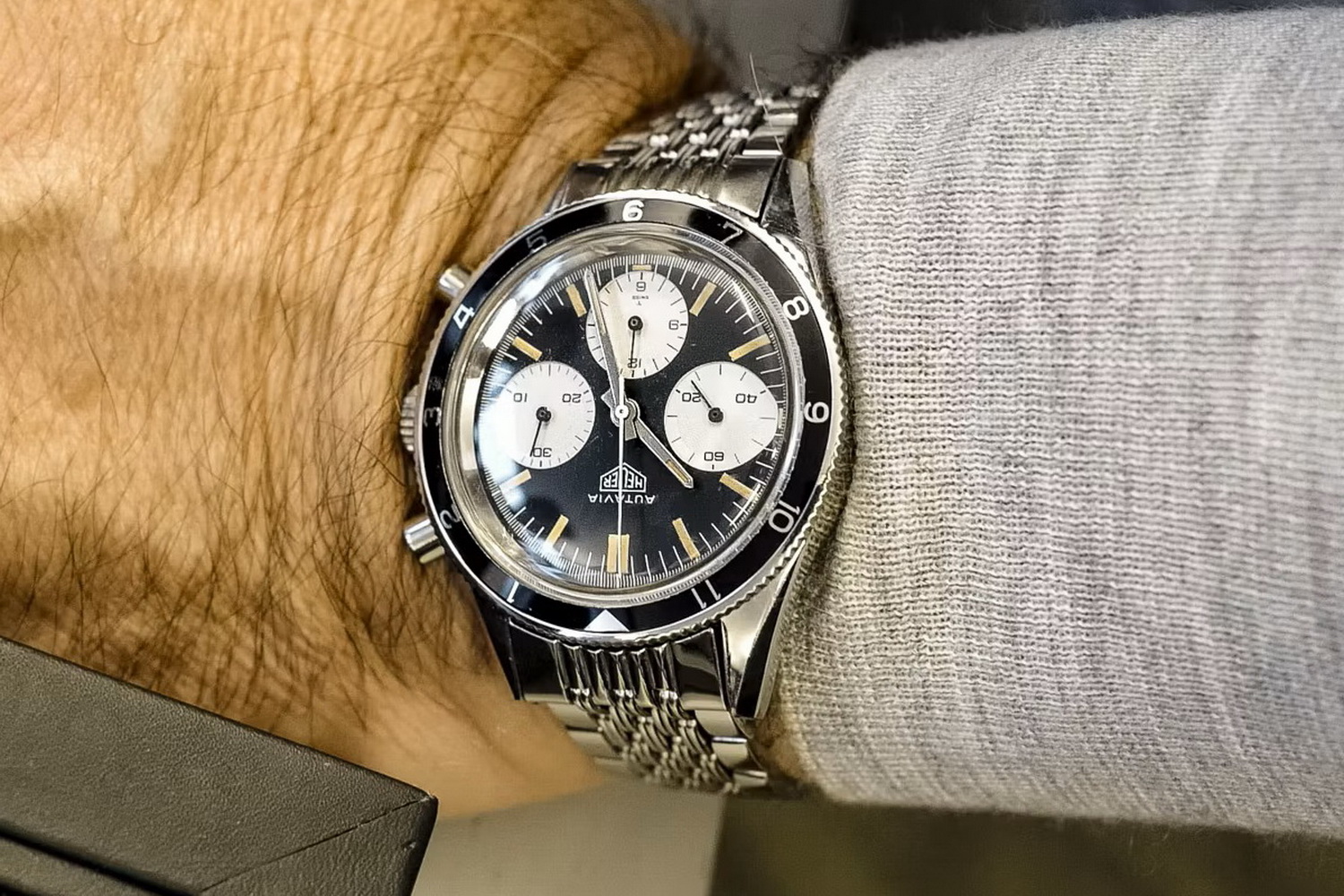
19. Autavia, reference 2446, first execution dial, first execution hands (1962) – Heuer “got it right” with the first Carreras; Autavia enthusiasts will tell you that this first version of the Autavia, with its “Big Subs” and all-lume hands was also the best of the breed. Watch 67 (below) is a slightly later two-register version.
20. Autavia, reference 2446, with tachymeter scale on dial, and 13 to 24 on the bezel — These dials and bezels were offered on a special order basis; rare and quirky, the kind of watch to share at a get-together
21. Autavia, reference 2446 H (hour bezel), fourth execution dial (1968) – at a glance, it looks like a standard “Rindt”; upon closer inspection we notice that the markers on the dial are all-lume, rather than applied hardware; a very rare execution of the Autavia.
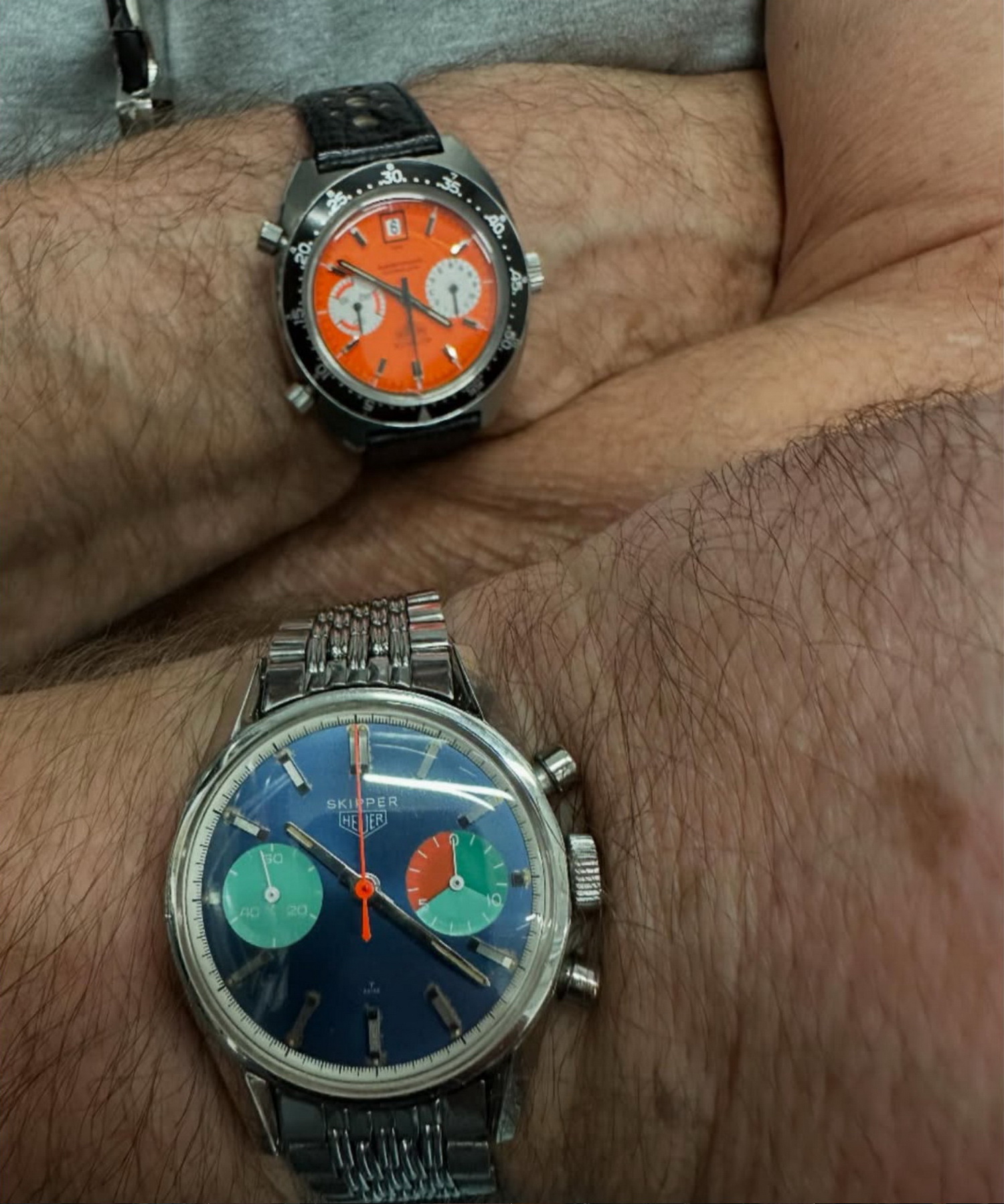
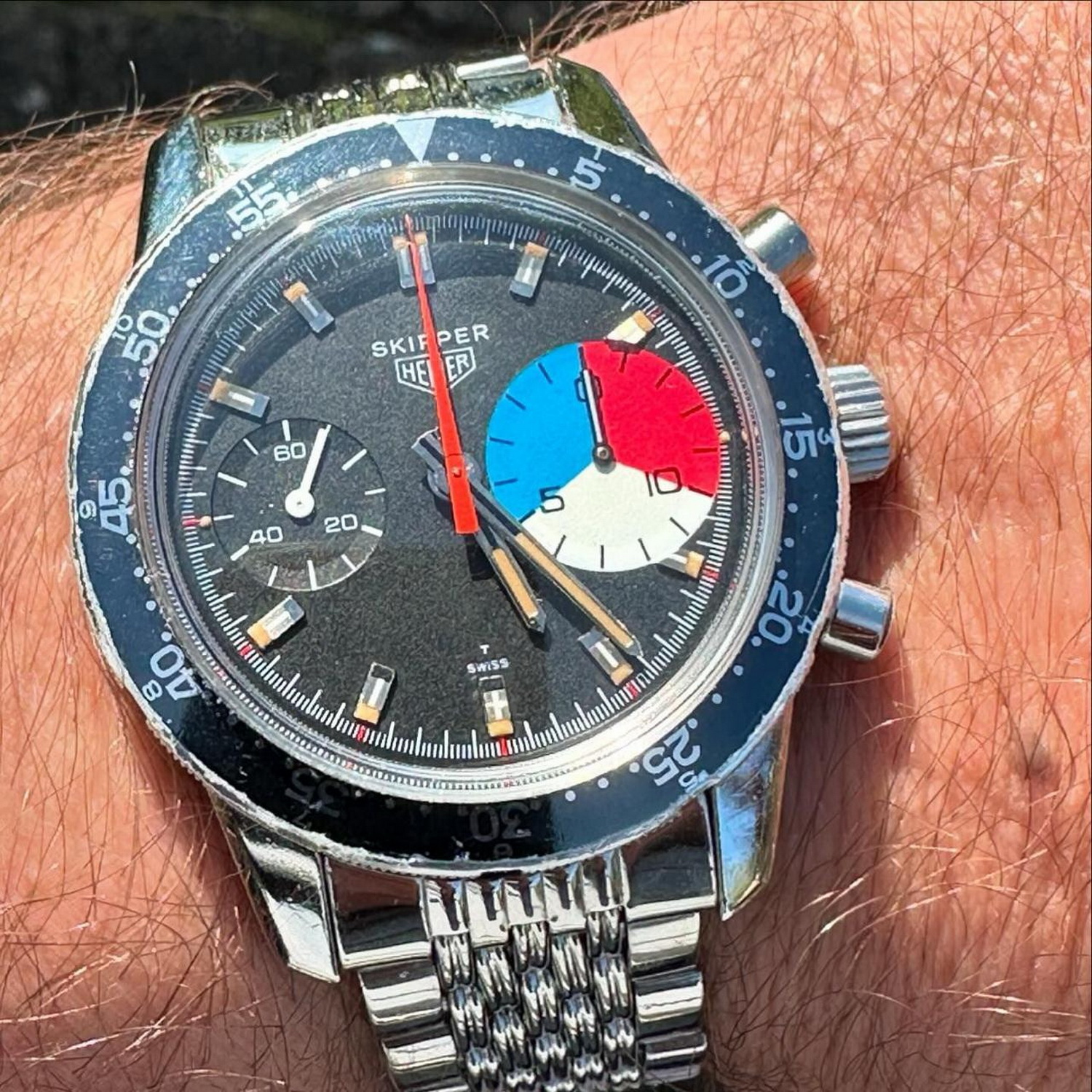
22. Skipper, reference 7754, “Skipperrera” (1968) — Heuer supplied the timing equipment for Intrepid, when it successfully defended the America’s Cup, in 1967. To celebrate the win, Heuer created the Skipper, an entirely new model, that incorporated the colors of Intrepid and the countdown timer used in yacht racing.
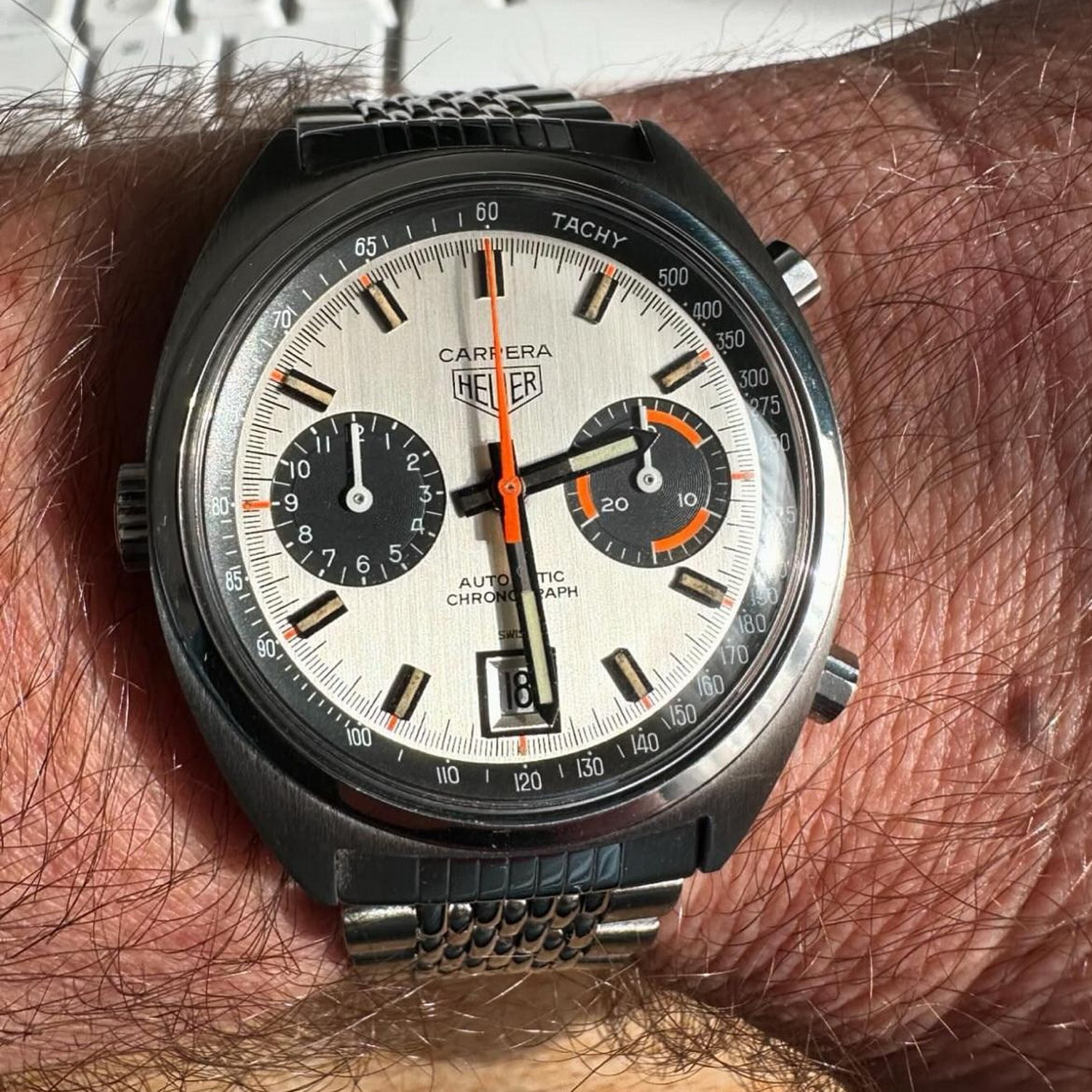
23. Carrera, reference 1153 SN (1974) — By the mid-1970s, Heuer had jazzed up the Carrera, with the “SN” model having a silver dial, with black registers, and orange accents. The companion reference 1153 BN featured a deep blue dial with black registers.
24. Skipper, reference 7764 (1969) — It didn’t take long for the Skipper to move from a Carrera case to an Autavia case, specifically the snap-back, compressor case. From there, it would move to the C-shape cases, with their screw-backs.
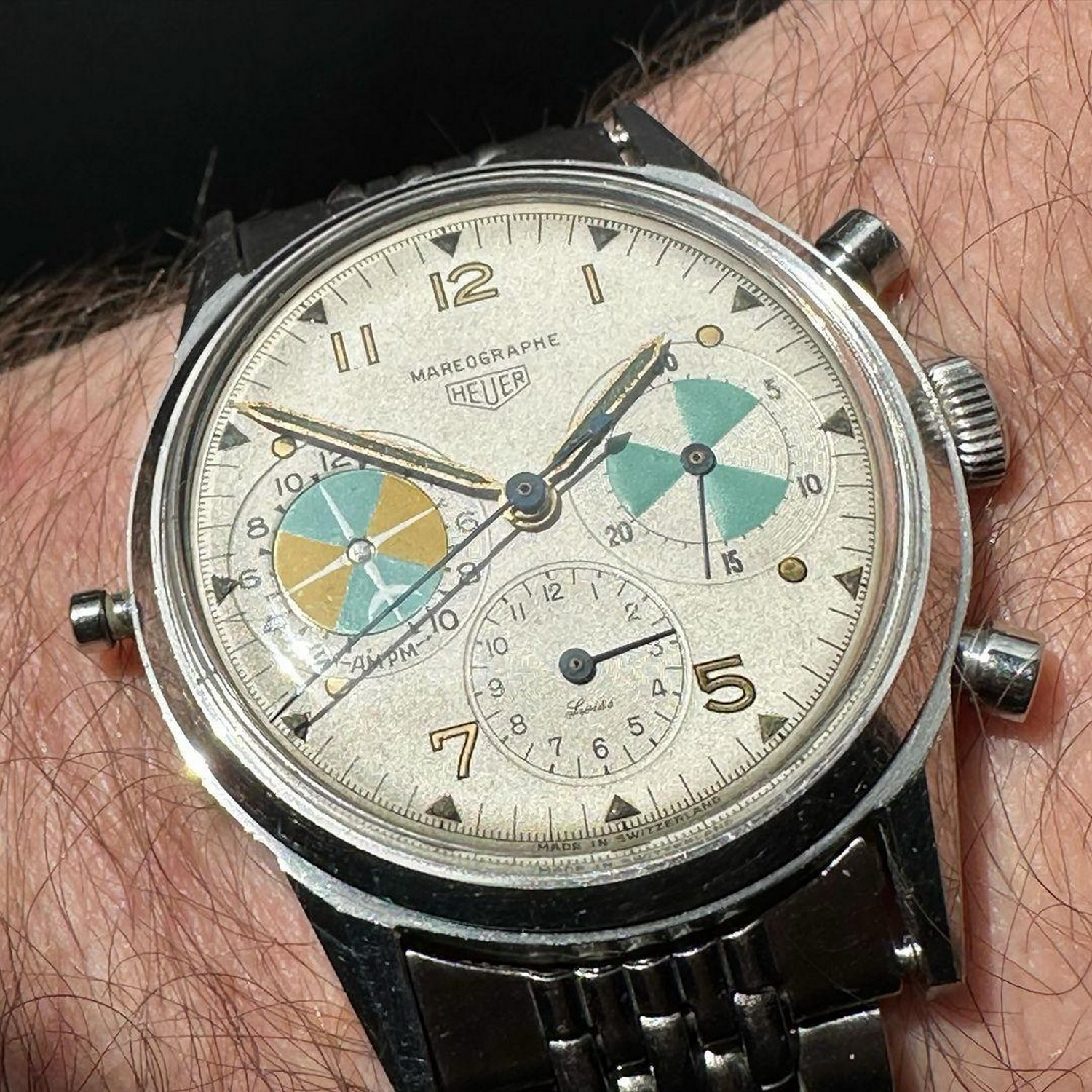
25. Mareographe, reference 2443, second execution — Heuer made the “Seafarer” for Abercrombie & Fitch, but used the “Mareographe” name for the ones sold by Heuer. The second execution of the reference 2443 has gold on numerals, markers and hands.
26. TAG Heuer Carrera, customized by Bamford Watch Department — TAG Heuer introduced the 42 millimeter Carrera in 2020, and it has been a favorite for Bamford customizations.
27. Carrera, reference 2447 “Yachting” — Another special-order version of the Carrera, the minute recorder has alternating blue and white sectors to count down to start of yacht race (regatta).
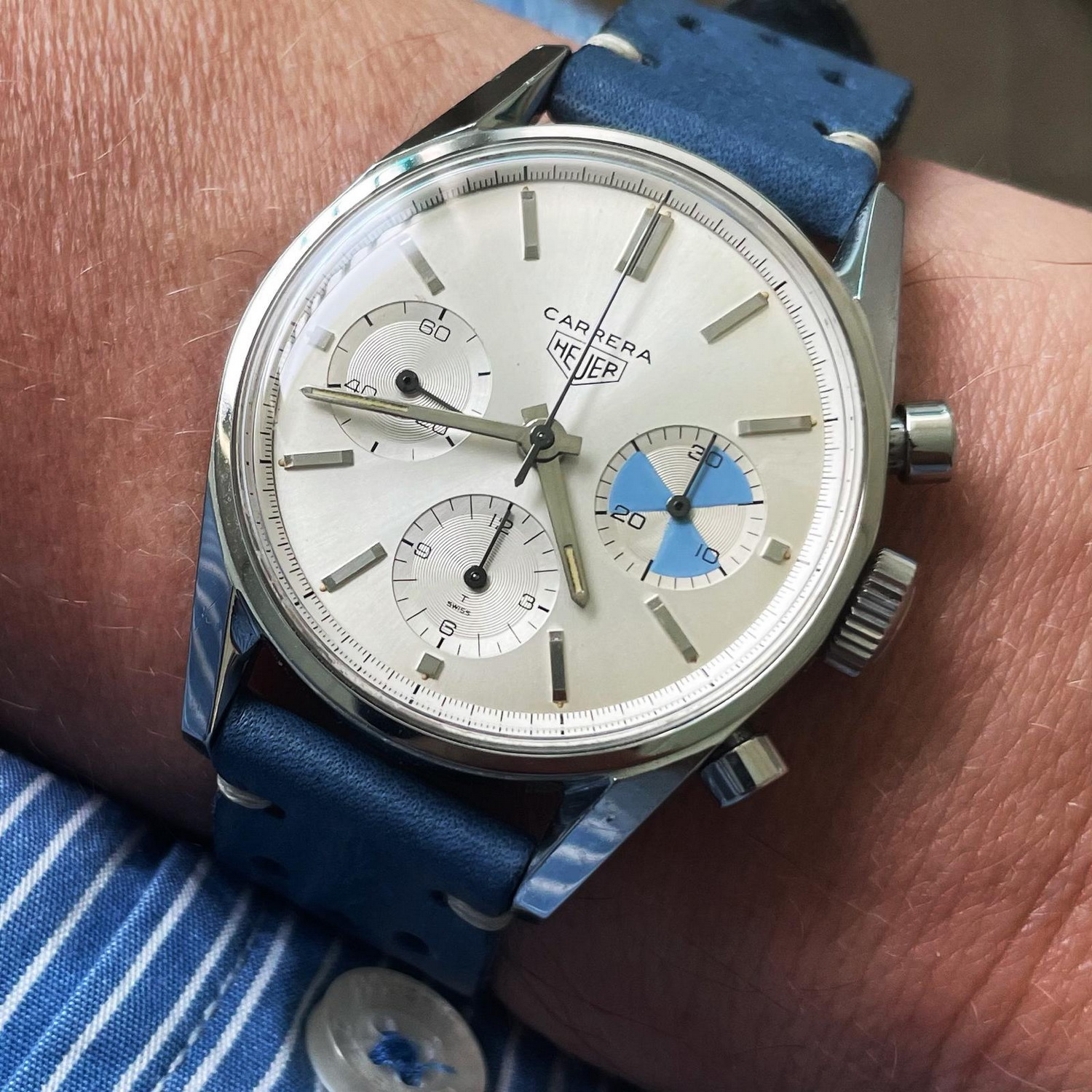
28. Carrera 30, reference 7753 NST (1970) — The Carrera 30 came after the Carrera 45, and was offered with contrasting registers. This “reverse panda” model has a tachymeter scale on dial; nice to see this one, an inch away from its panda (SN) companion.
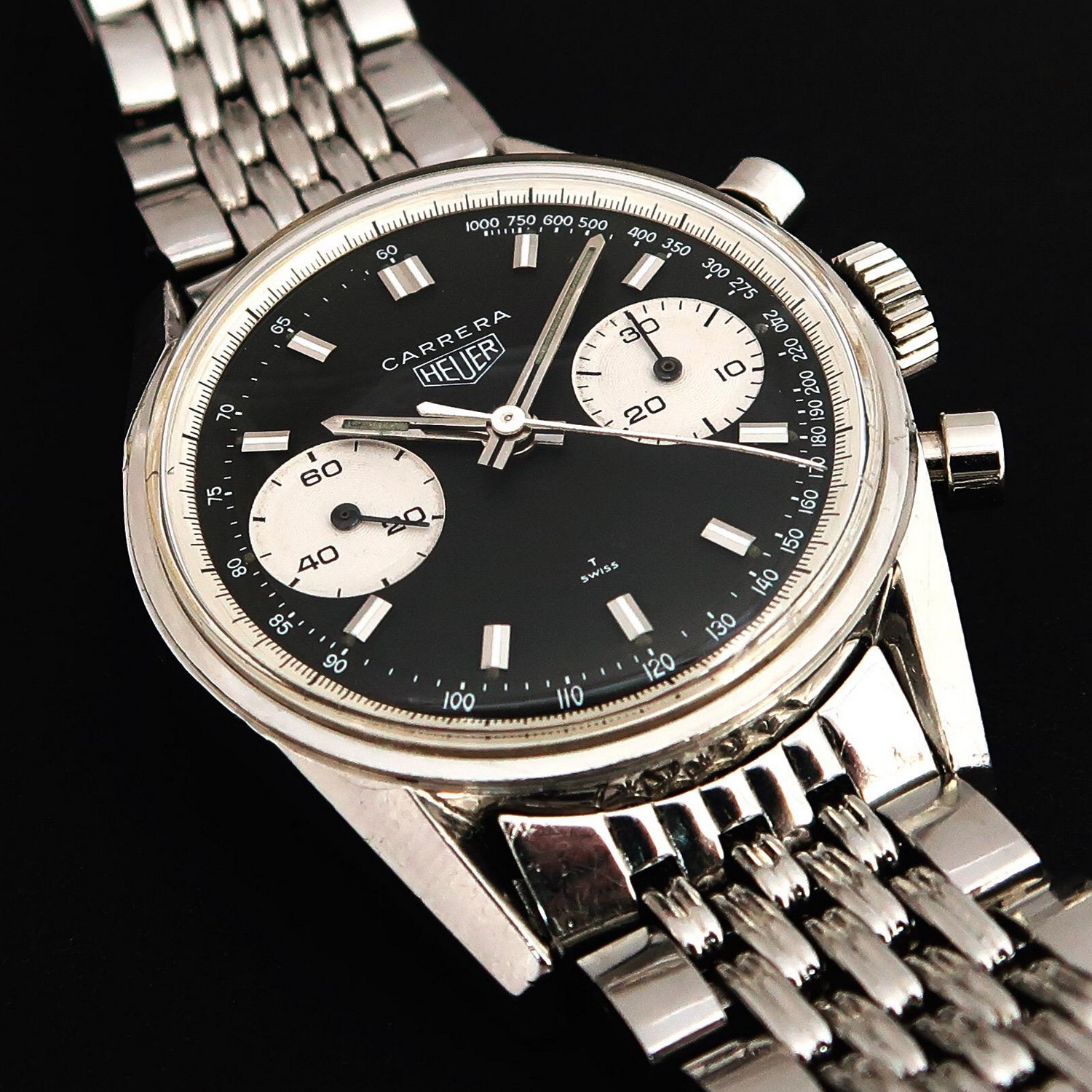
29. Autavia, reference 1163 “Viceroy” (1972) — Offered in a promotion with the Viceroy cigarette brand, this $88 version of the Autavia had brushed steel hands, with red and luminous inserts and red tips; the hour recorder had numerals 1 through 12; the bezel had a Tachymeter scale. So glad that someone thought to bring a “Viceroy” to the Summit; it’s hardly a Heuer gathering without at least one.
30. Carrera 30, reference 7753 SN (1970) — The “panda” version of the Carrera 30, as worn by Matt Damon (as Carroll Shelby) in the movie, Ford vs Ferrari. Since Ford vs Ferrari was released, this has become one of the most pursued Carreras.
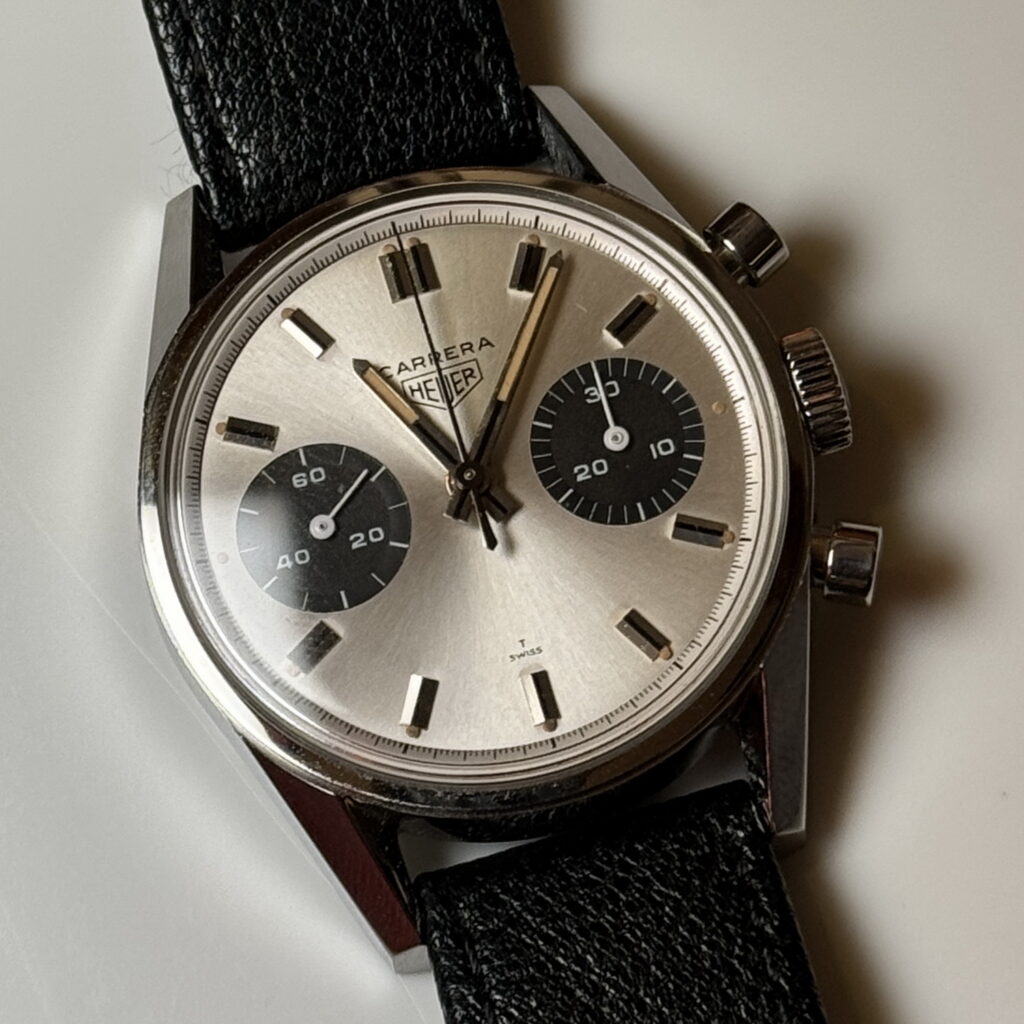
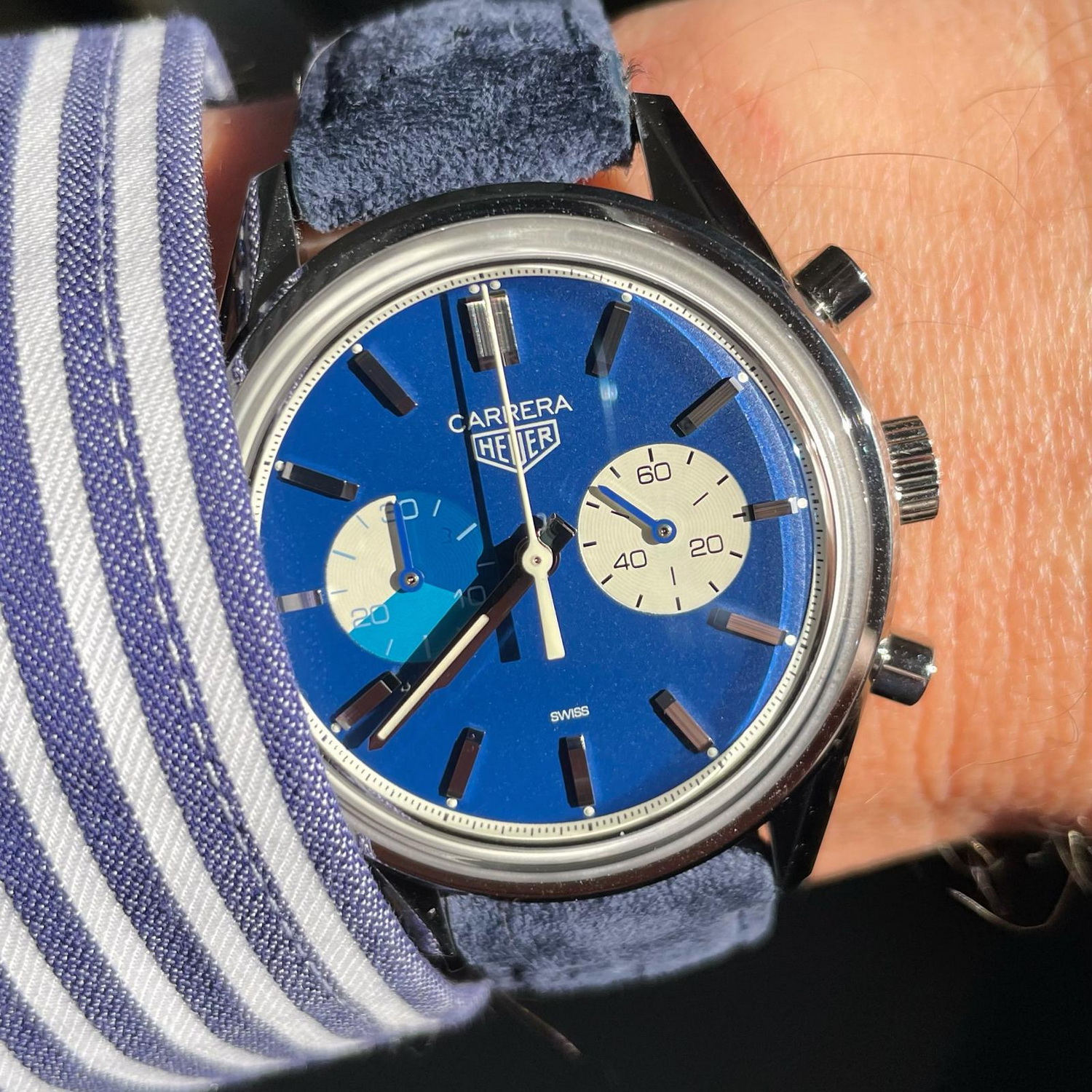
31. TAG Heuer Carrera “Blue Dreamer” Special Edition for Revolution and The Rake (2018) – Collectors began paying attention to the “Glassbox” Carrera in June 2017 when Hodinkee offered its Limited Edition of the Skipper; Revolution / The Rake built on this success with when they incorporated the colors of the Riviera into their “Blue Dreamer” special edition (100 pieces), reference CAR221C, a few months later.
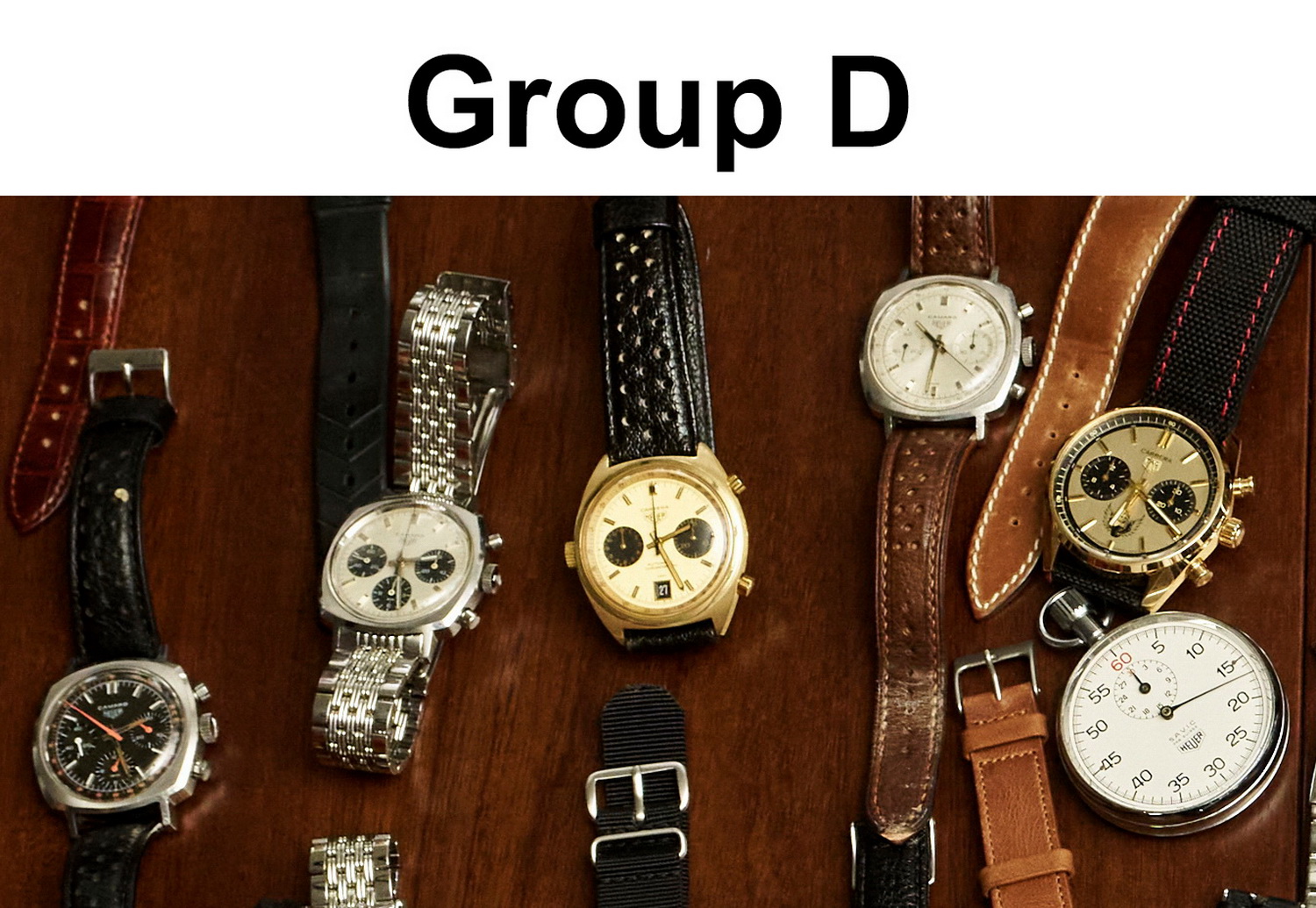
32. Camaro, reference 73643 NT (1972) – With its black dial and registers, and orange Tachymeter scale, this is one of the most coveted of the Camaros.
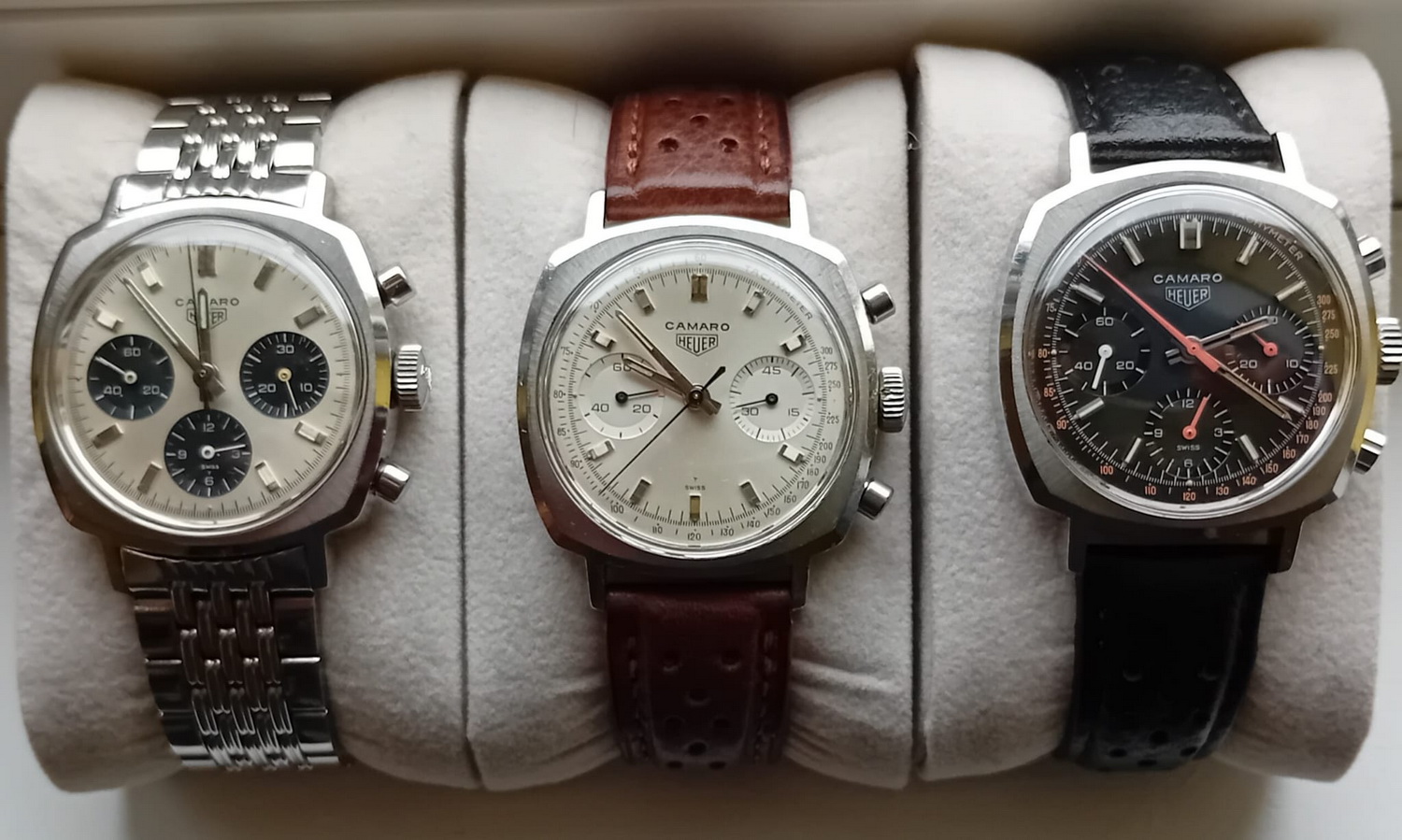
33. Camaro, reference 7220 SN — The three-register “panda” is one of the rarest of the Camaros; the panda Autavias and panda are far more common.
34. Carrera, reference 1158 CHN, first execution (1972) — Let’s work through the numbers and letters: 1158 tells us that this Carrera has an 18 karat gold case; CHN indicates a champagne dial with black registers; first execution means that the date disc will be black. It was nice to have two of the reference 1158 Carreras on the table.
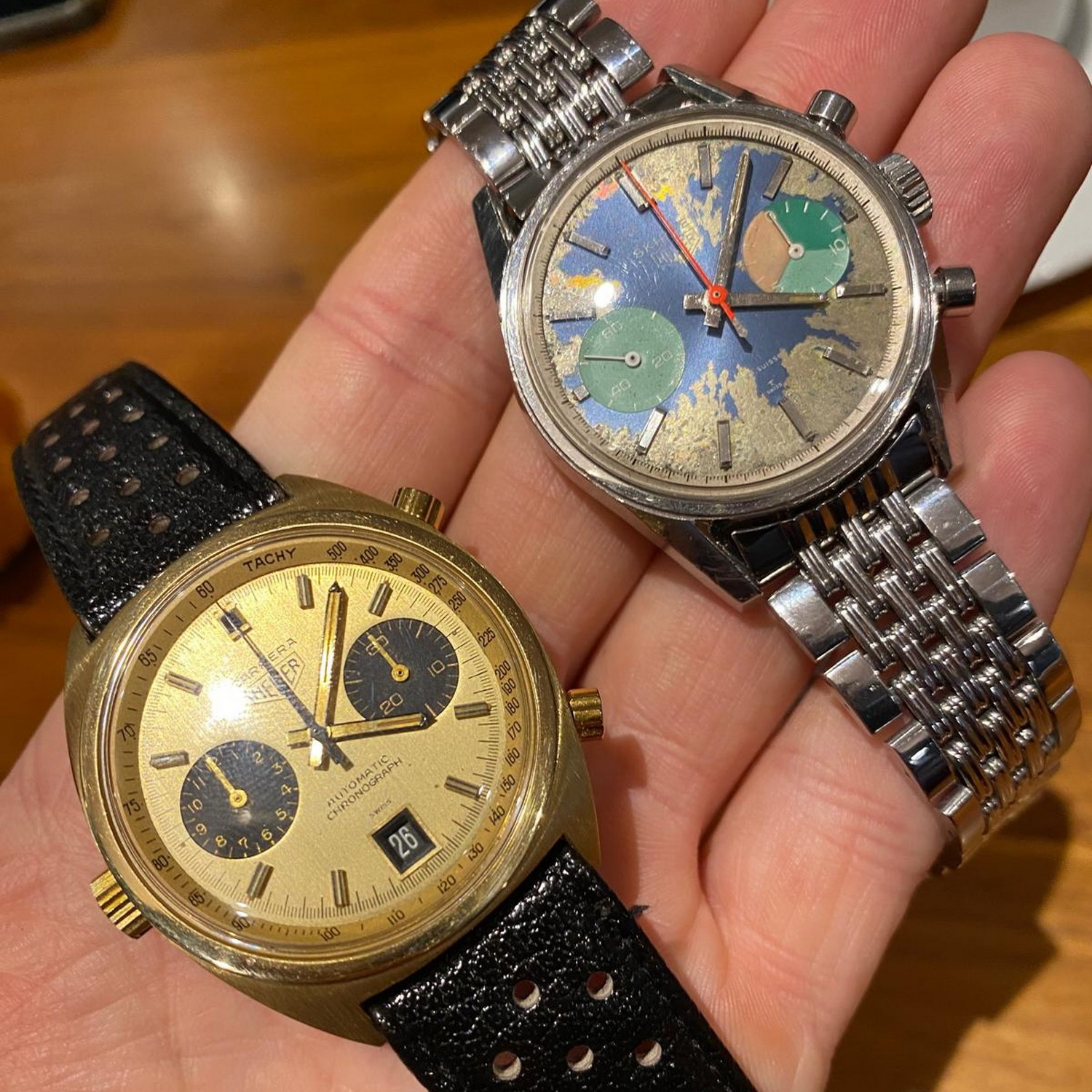
35. Camaro 45, reference 9220 T (1968) — The Camaro 45 uses the Valjoux 92 movement; the “T” version has a white dial and registers, with a tachymeter scale. These are far less common than the later Camaro 30 models.
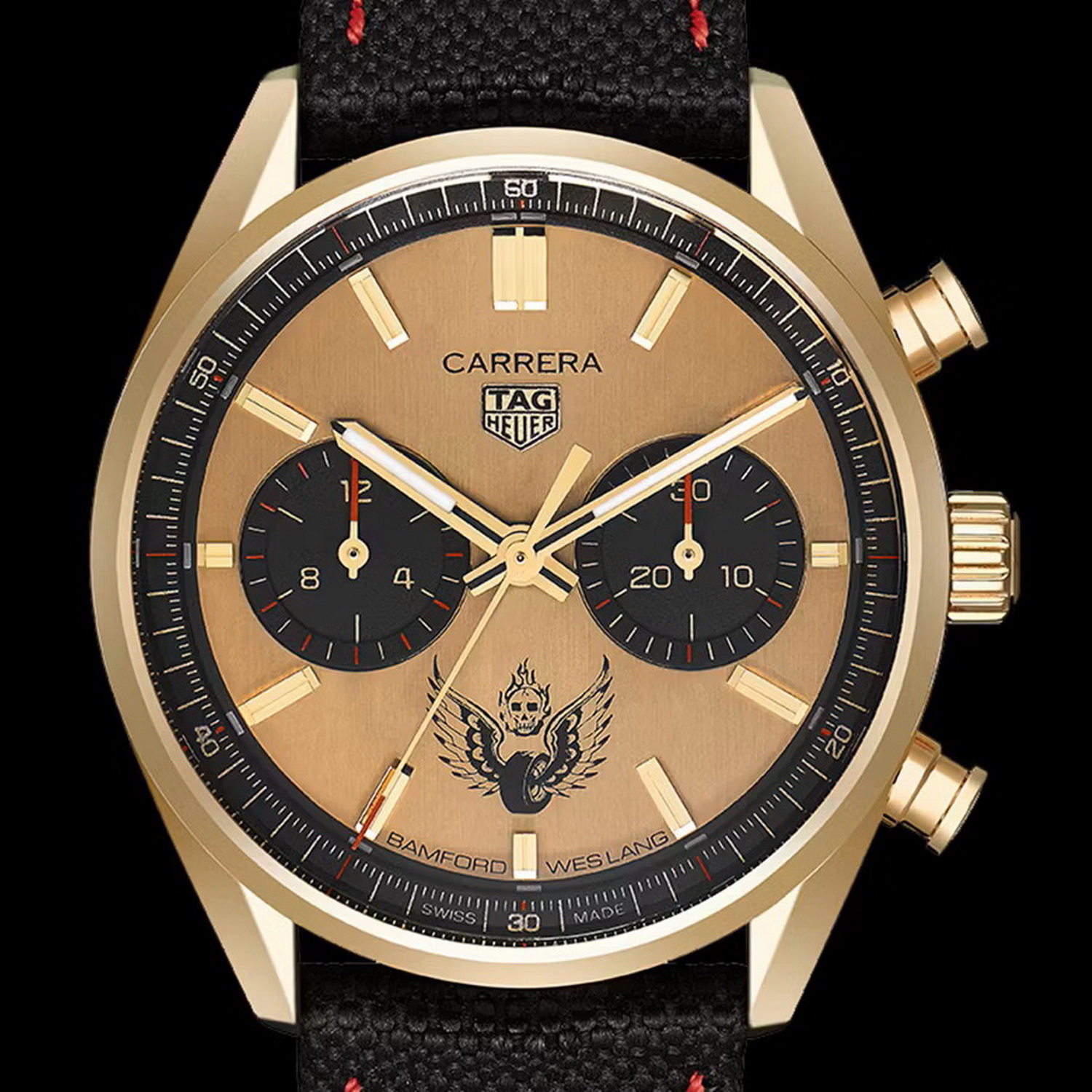
36. TAG Heuer Carrera Bamford x Wes Lang Limited Edition (2023) – The Los Angeles-based artist is fond of skulls, wings and other totems of the American West; yes, the 18 karat gold case of this 15-piece Limited Edition came as a bit of a surprise.
37. Reference 901 stopwatch, co-branded “SAVIC” — Made for Société Anonyme de Vente Industrielle de Compteurs, Heuer’s French importer. There had to be at least one stopwatch on the table, and this one with the SAVIC branding adds a twist.
38. Bundeswehr chronograph, reference 1550 SG (1967) — The “3H” on the dial (indicating tritium) means that this one was military issued. Having two standard “Bunds” on the table, plus the Caliber 12 prototype, seems about right.
39. Autavia, reference 2446, transitional case (1967) — The “Transitional” case came between the first and second execution screw-back cases, and it’s missing the bevel / chamfer between top and side surfaces. Whether it was an error or Heuer testing a different design, collectors seem to love the “Transitional” Autavia.
40. AC Signature Monaco (2023) — Belgian watchmaker Abel Court is one of the pillars of the collecting community, and in 2023, he created a customized Monaco from the reference CS2110 (the first re-edition from 1997). I brought this one, and I’m glad that I did . . . everyone at the Summit loved it!!
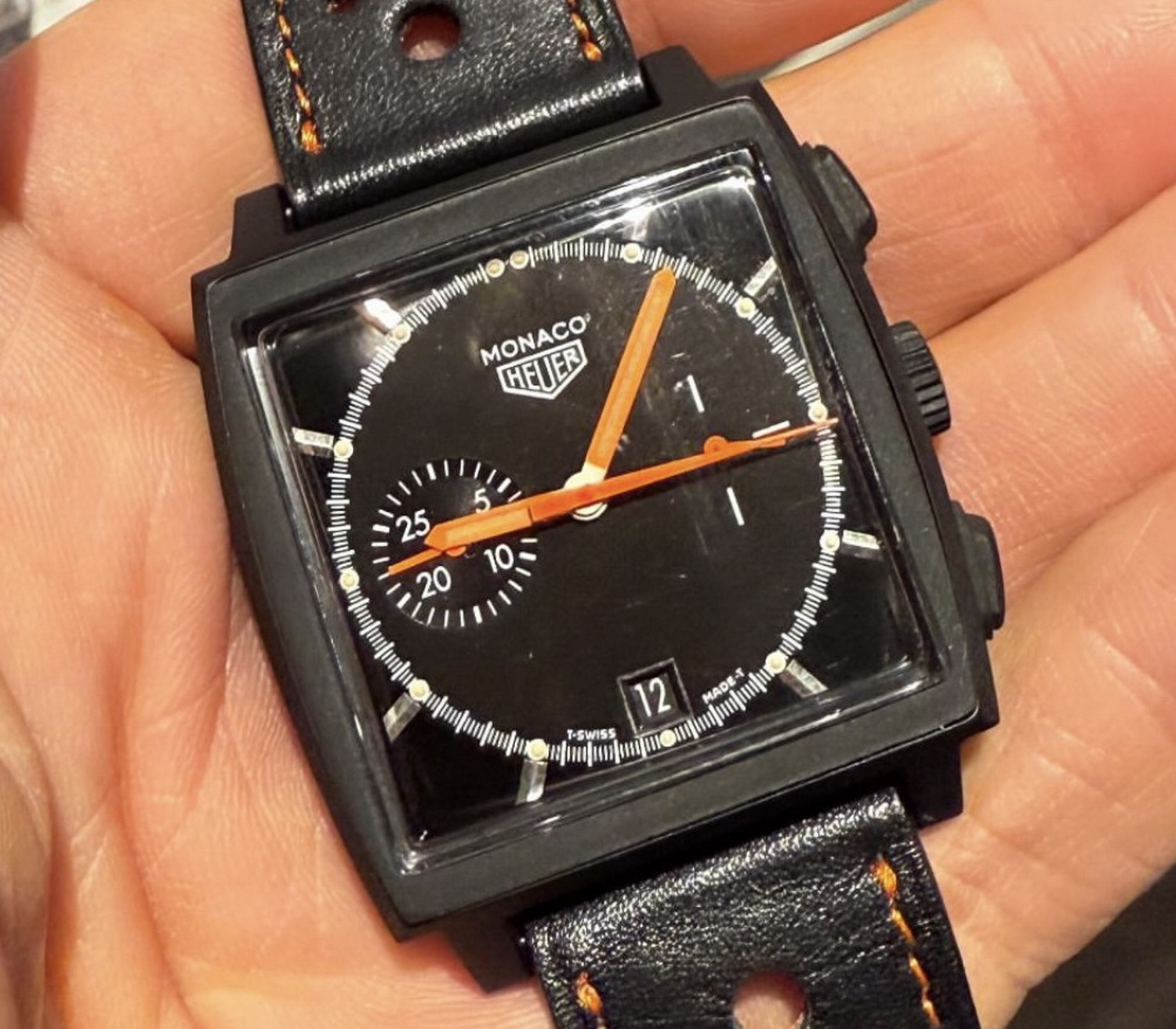
41. Carrera, reference 2447 T (1963) — With the tachymeter scale printed on dial in red, here is another instance in which Heuer got it right the first time.
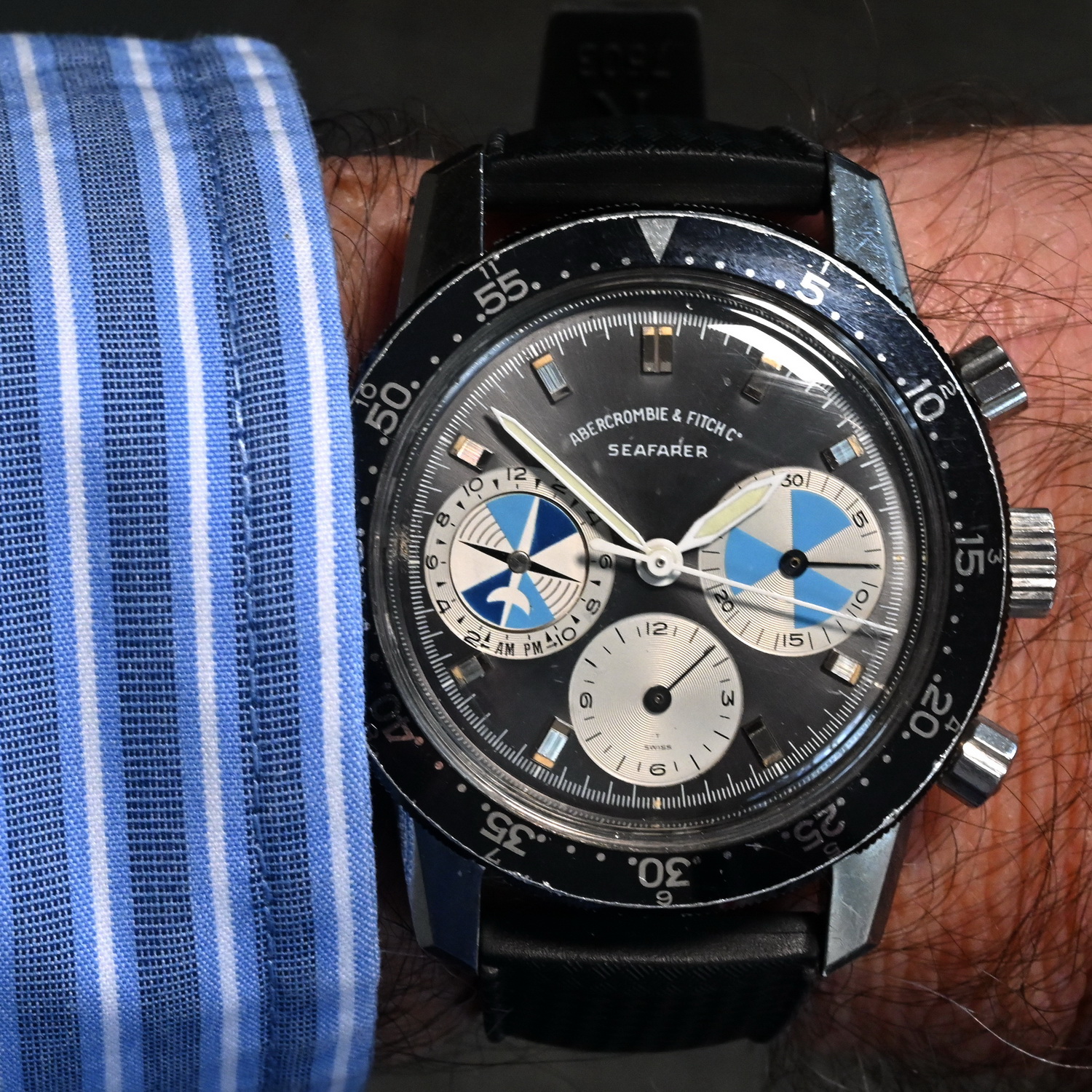
42. Abercrombie & Fitch Seafarer, reference 2446C (1970) — For three decades, Heuer made the Seafarer for Abercrombie & Fitch. Circa 1970, the Seafarer resided in the Autavia’s compressor case; the second execution had white aviator style hands, for maximum legibility.
43. Autavia, reference 2446 M, “Rindt” model (1968) – Probably the people’s choice as an attainable Autavia from the 1960s, it was fitting that we had three of these on the table.
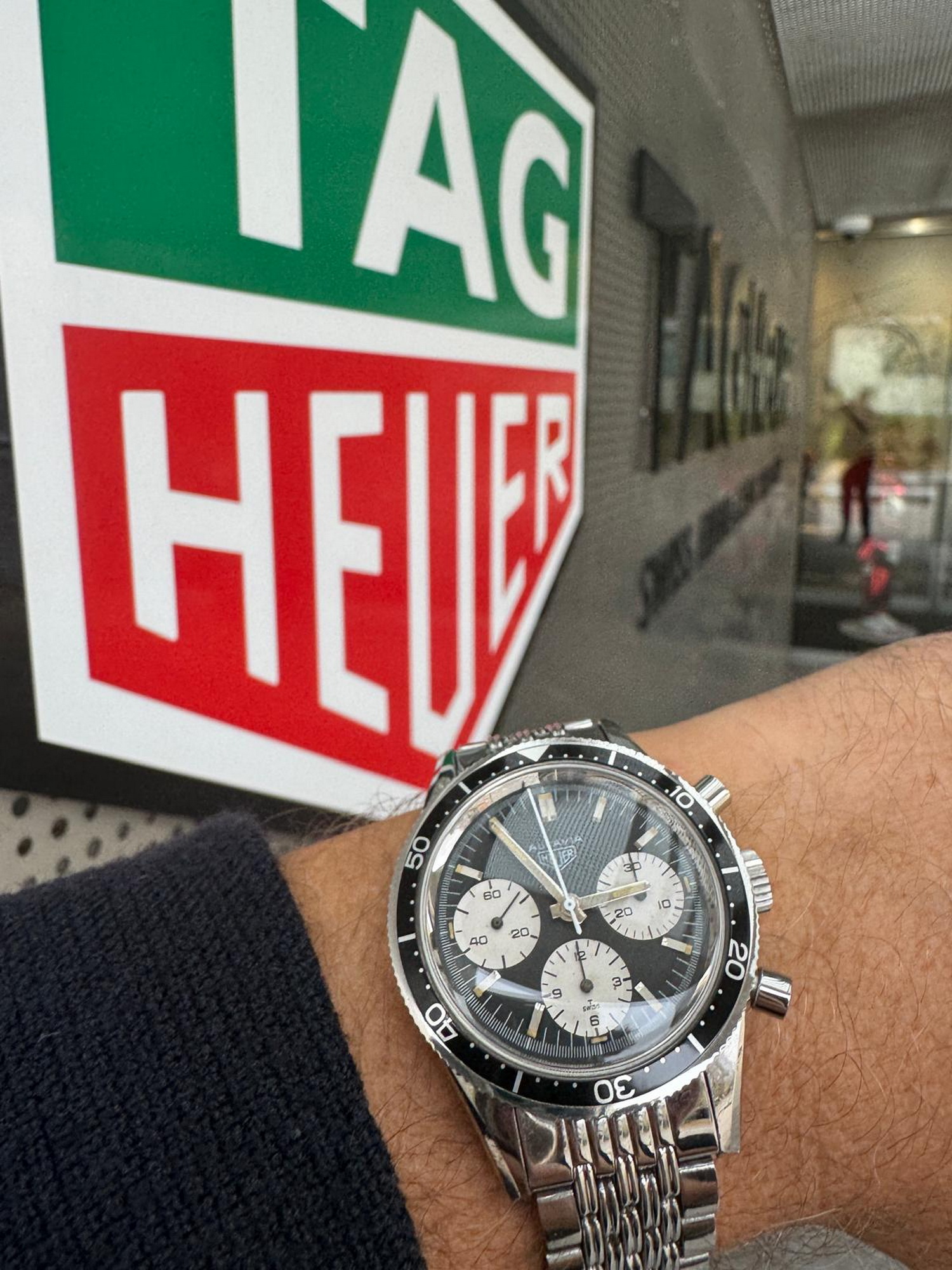
44. TAG Heuer Carrera x Team Ikuzawa by Bamford, reference CBN201F (2023) – Atribute to Tetsu Ikuzawa, the Japanese racer who competed in formula and sports cars, in the 1960s and 70s.
45. Carrera 45 Dato, reference 3147 S, first execution (1966) — The first execution of the Carrera 45 Dato had the date window at twelve o’clock; it would soon move to 9 o’clock, so that you could read the date with the chronograph second hand at zero.
46. Camaro, reference 7220N, first execution (1968) — This version of the Camaro has a charcoal dial and registers, with plain polished steel hands and markers. We had six Camaros on the table, and all of them were awesome.
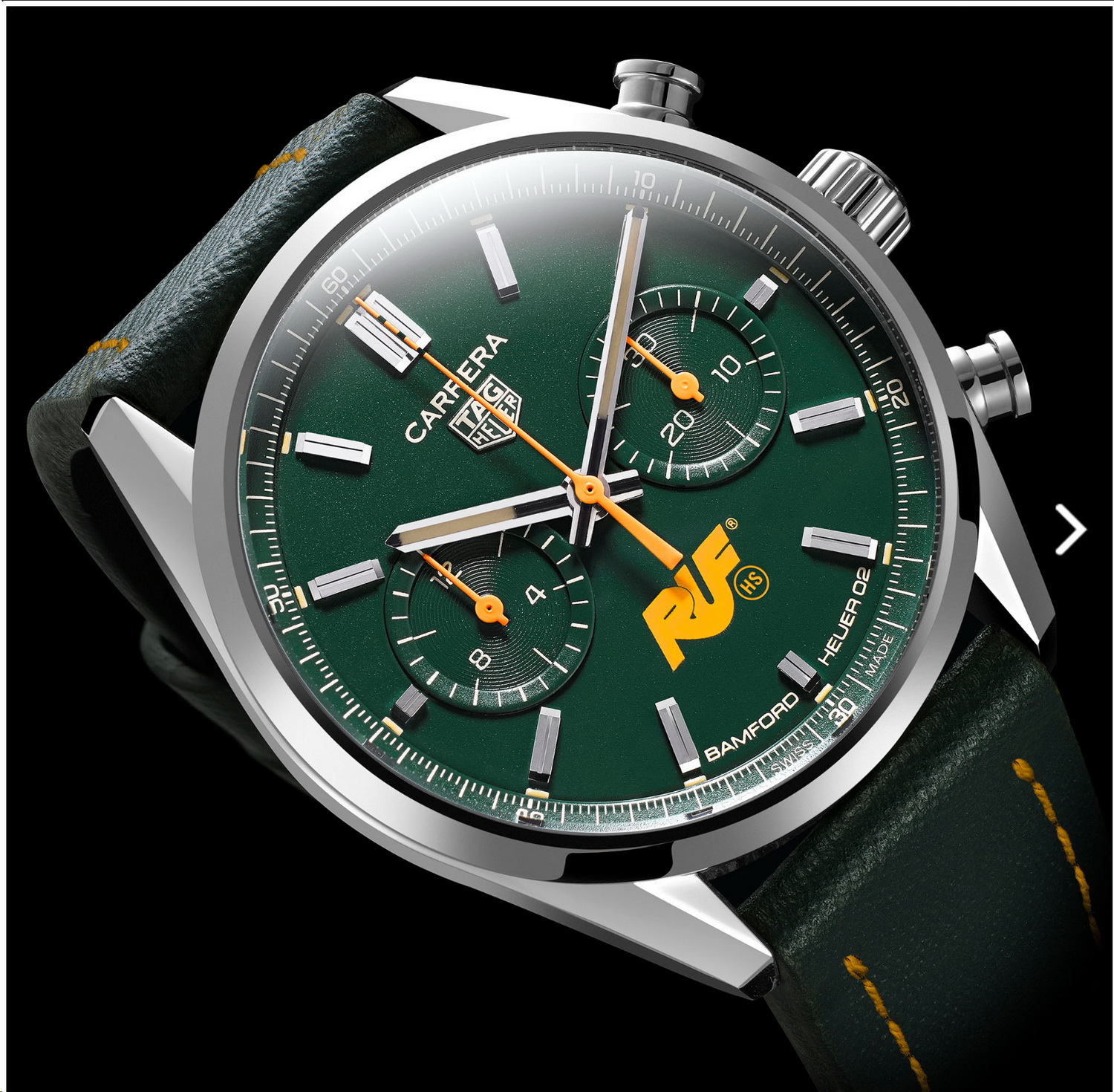
47. TAG Heuer Carrera RUF x Bamford x Highsnobiety Limited Edition (2022) – Using the 42 millimeter Carrera chronograph, this Limited Edition of 100 watches (reference WHF2471) was the natural collaboration between a producer of high-performance Porsches, a global fashion and lifestyle media company, and Bamford Watch Department.
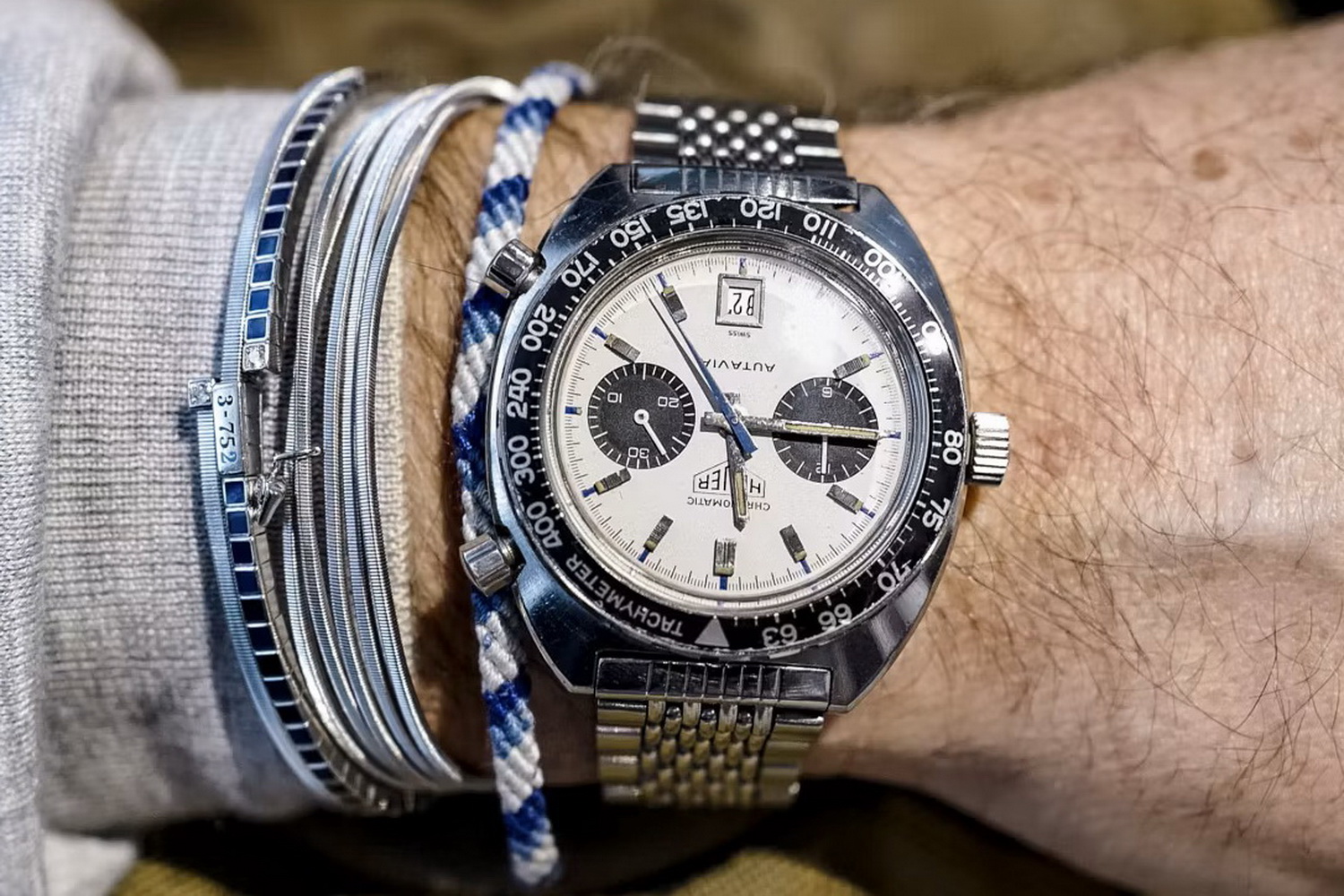
48. Autavia, reference 1163 T “Chronomatic” (1969) — The earliest version of the automatic Autavia was offered in two versions — a black dial with white registers (and red accents) and a white dial with black registers (and blue accents), as worn by Jo Siffert. It was nice to have Chronomatic versions of the Monaco and Autavia on the table.
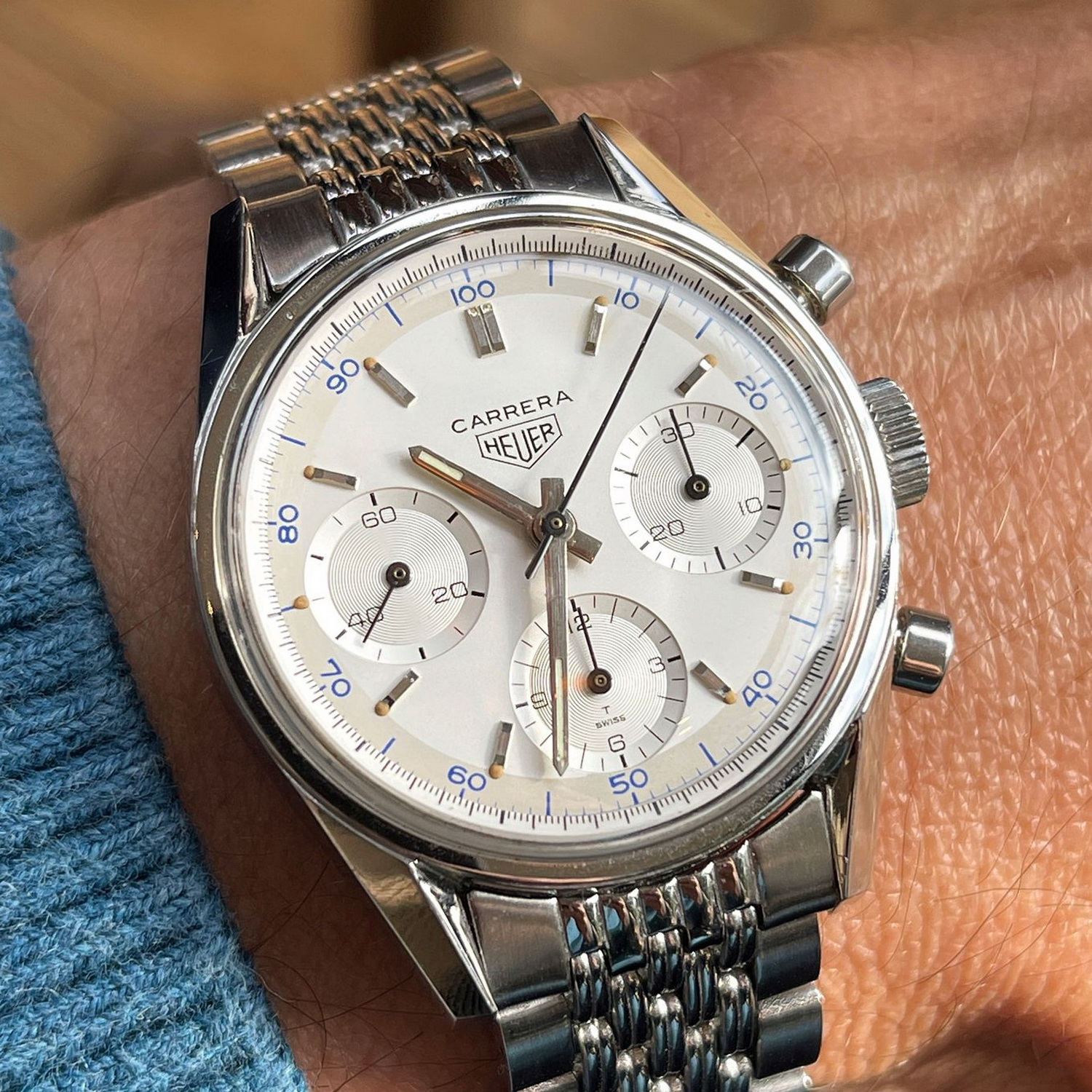
49. Carrera, reference 2447 D, first execution (1963) – The decimal minutes scale shows elapsed time in 1/100s of a minute, rather than seconds. Useful for speed computations and industrial / scientific calculations; also offers a nice symmetry.
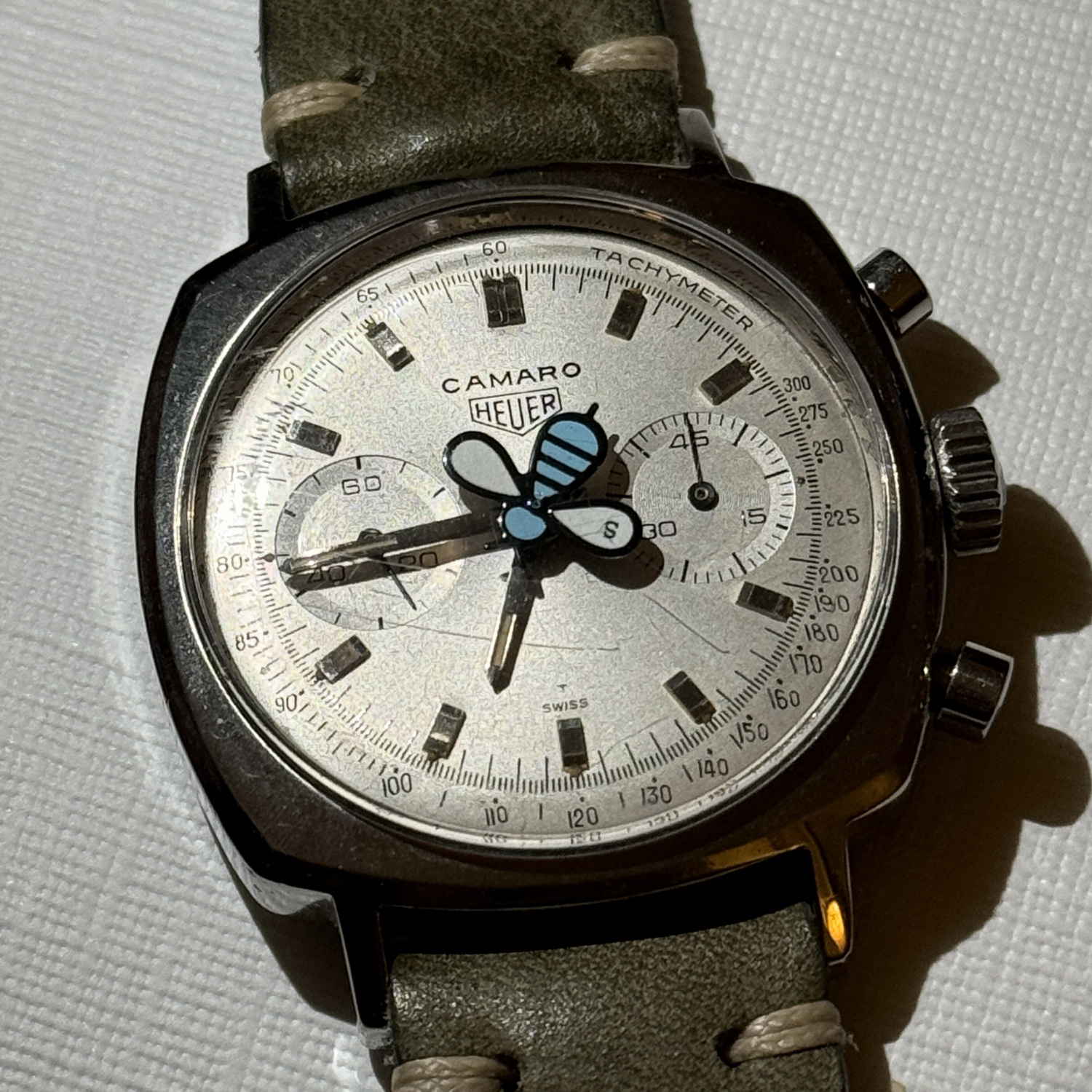
50. Camaro, reference 9220T, customized by Seconde/Seconde (1968) — Sure you can replace the chronograph second hand with a bee . . . why not?
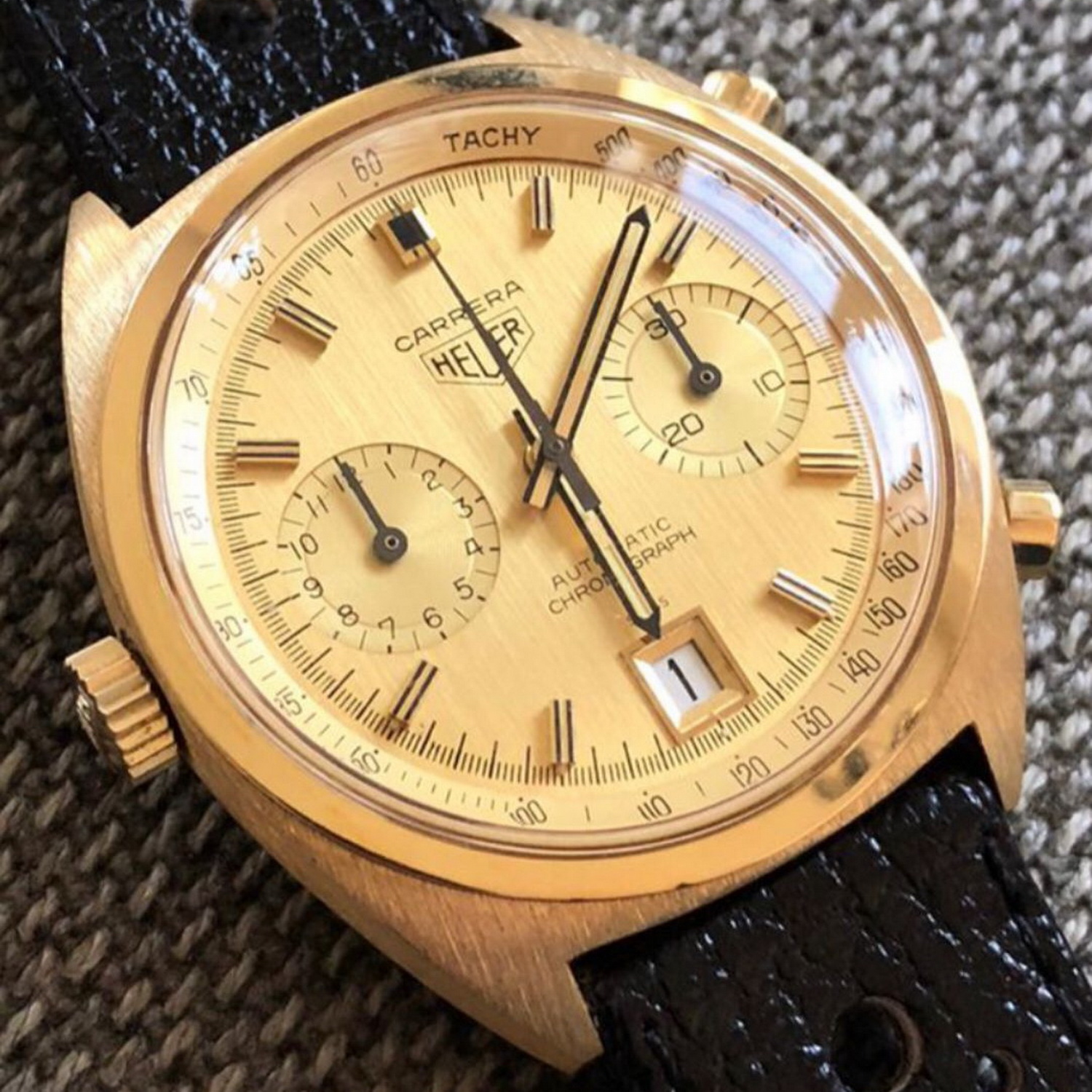
51. Carrera, reference 1158 CH, second execution (1972) — The “CH” tells us that this one has a champagne dial; second execution means that it has numerals 1-through-12 on hour recorder; as worn by Mario Andretti.
52. Bundeswehr chronograph, prototype with Caliber 12 movement – The story goes that Heuer produced prototypes of the “Bund” chronograph that incorporated the Calibre 12 automatic movement. It never went into production, but is one awesome looking chronograph.
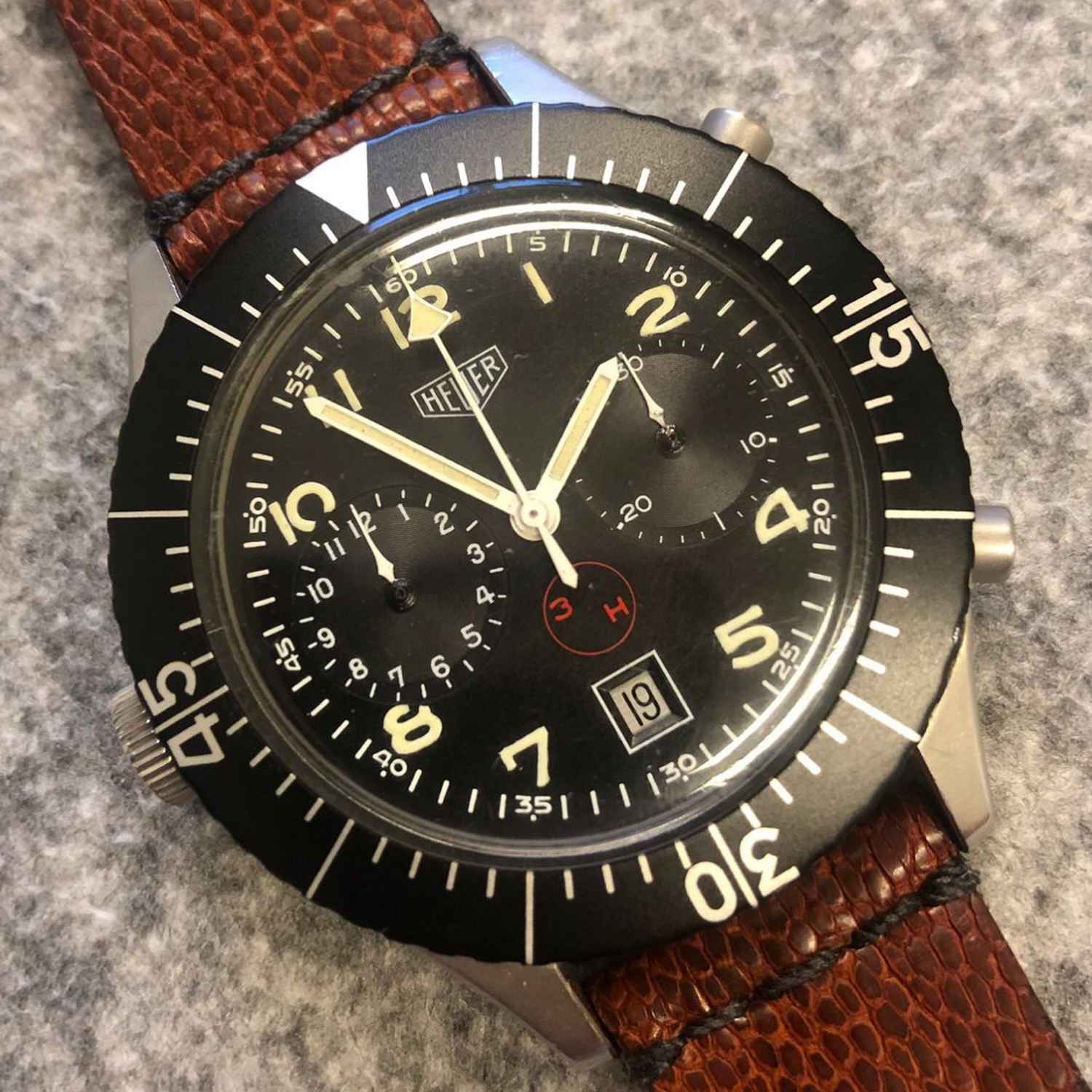
53. Autavia, reference 2446 GMT, first execution (1967) — Above, we see it on a bracelet (see watch 17) and this one is on a leather strap.
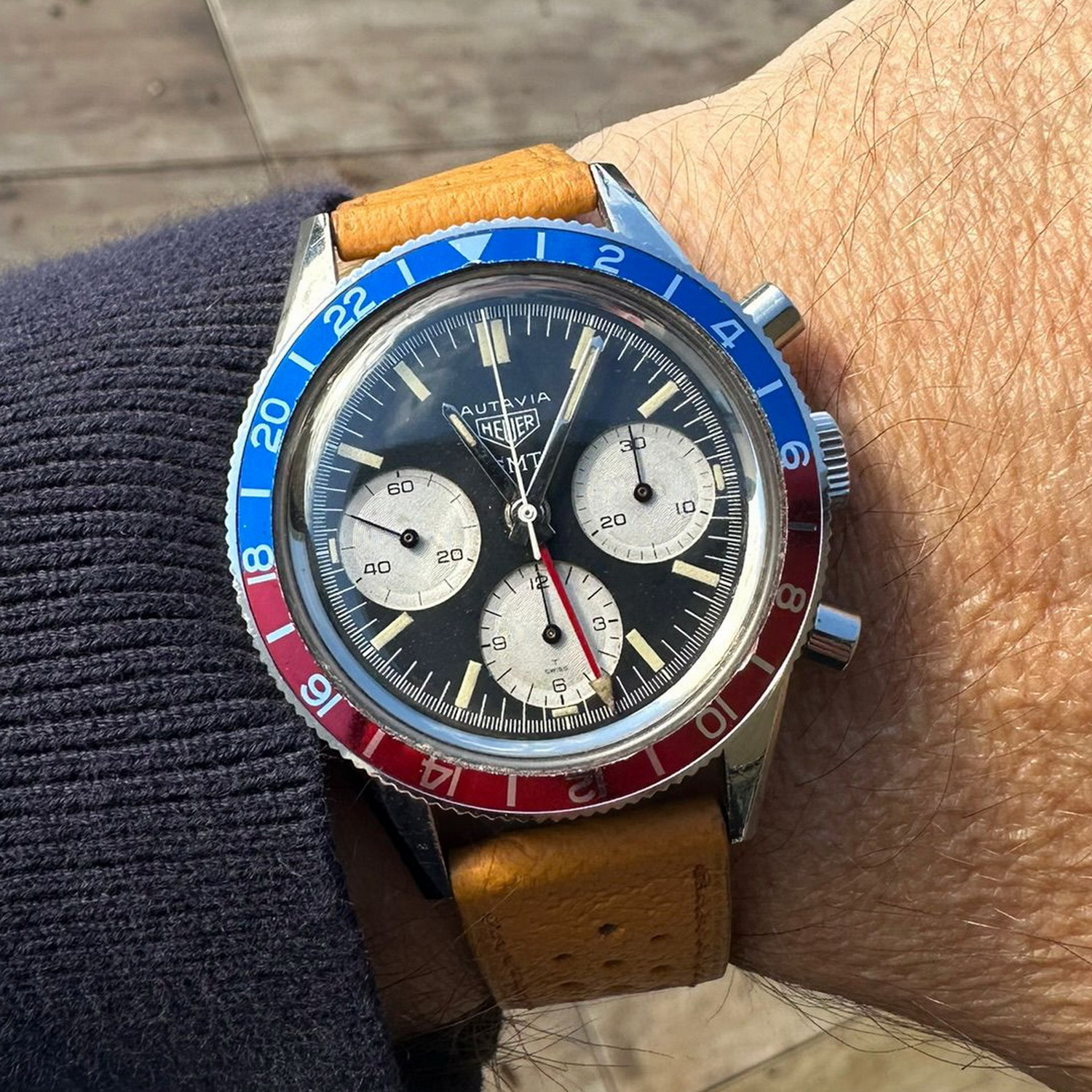
54. Carrera, reference 2447 T, second execution (1970) — With the second execution of the reference 2447 Carrera, we see wider markers and hands (both with black inserts) and a tachymeter scale that goes up to 1000 units per hour.
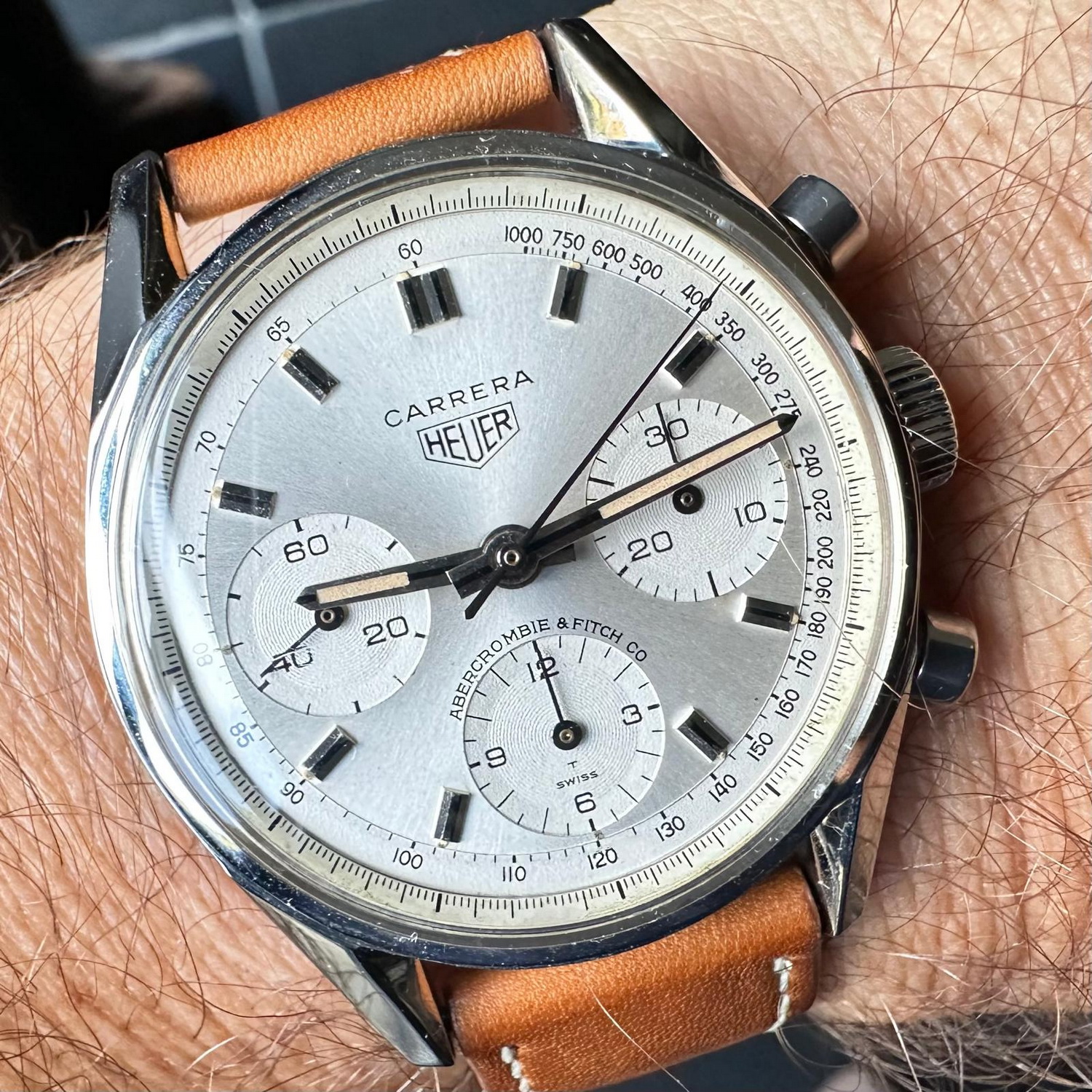
55. Autavia, reference 2446C, second execution (1970) – We had a nice selection of Autavia compressor cases on the table – Skipper, Seafarer and Autavia GMT. This “plain old Autavia” features black inserts in the markers and hands, with red accents.
56. Carrera, reference 73653N, first execution (1970) — The 1970s Carreras with manual movements often don’t get much attention; this charcoal gray dial has aged to capture the look of the Milky Way.
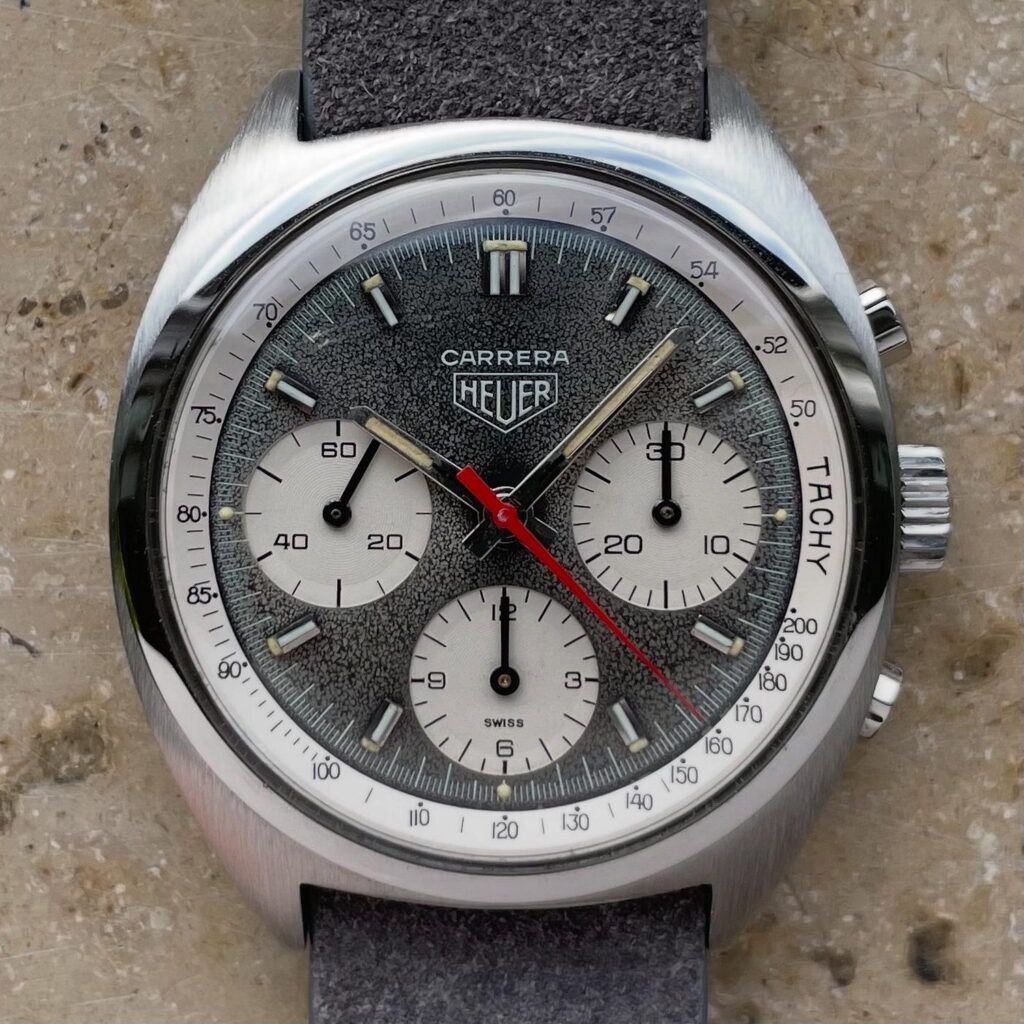
57. Autavia, reference 2446C GMT (1970) — We had Autavia GMT chronographs in all shapes and sizes; this early version features a compressor case, with polished hands.
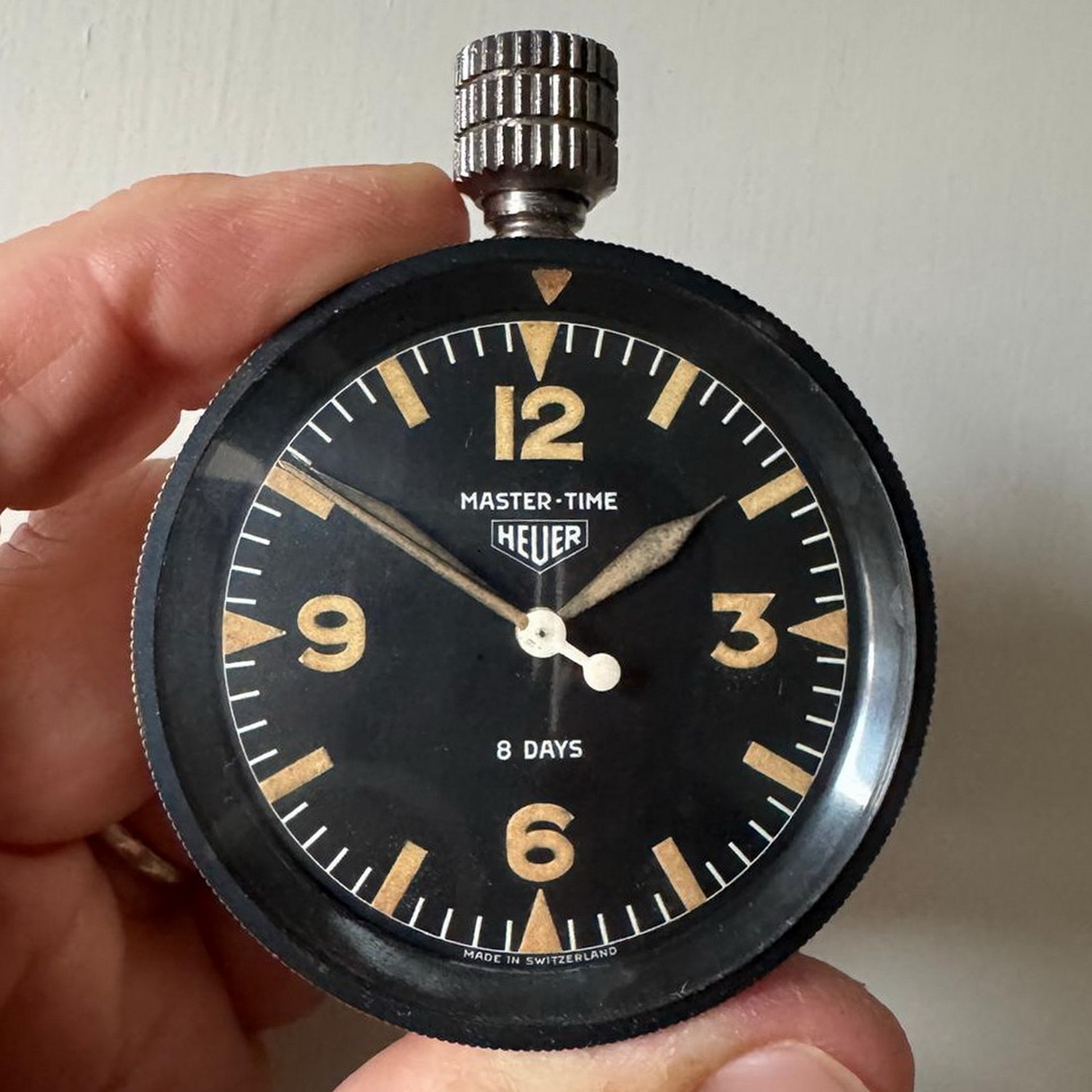
58. Master Time, eight-day dashboard clock (1960) – Heuer made the dashboard timers from the mid-1930s until the late 1970s; nice that this Master Time could represent this group of timepieces.
59. Carrera 12 Dato, reference 2547, first execution (1966) – Heuer made the triple calendar chronographs from the 1940s, and in the mid-1960s began marketing them as part of the Carrera collection. Collectors call this one the “Fat Lugs” model.
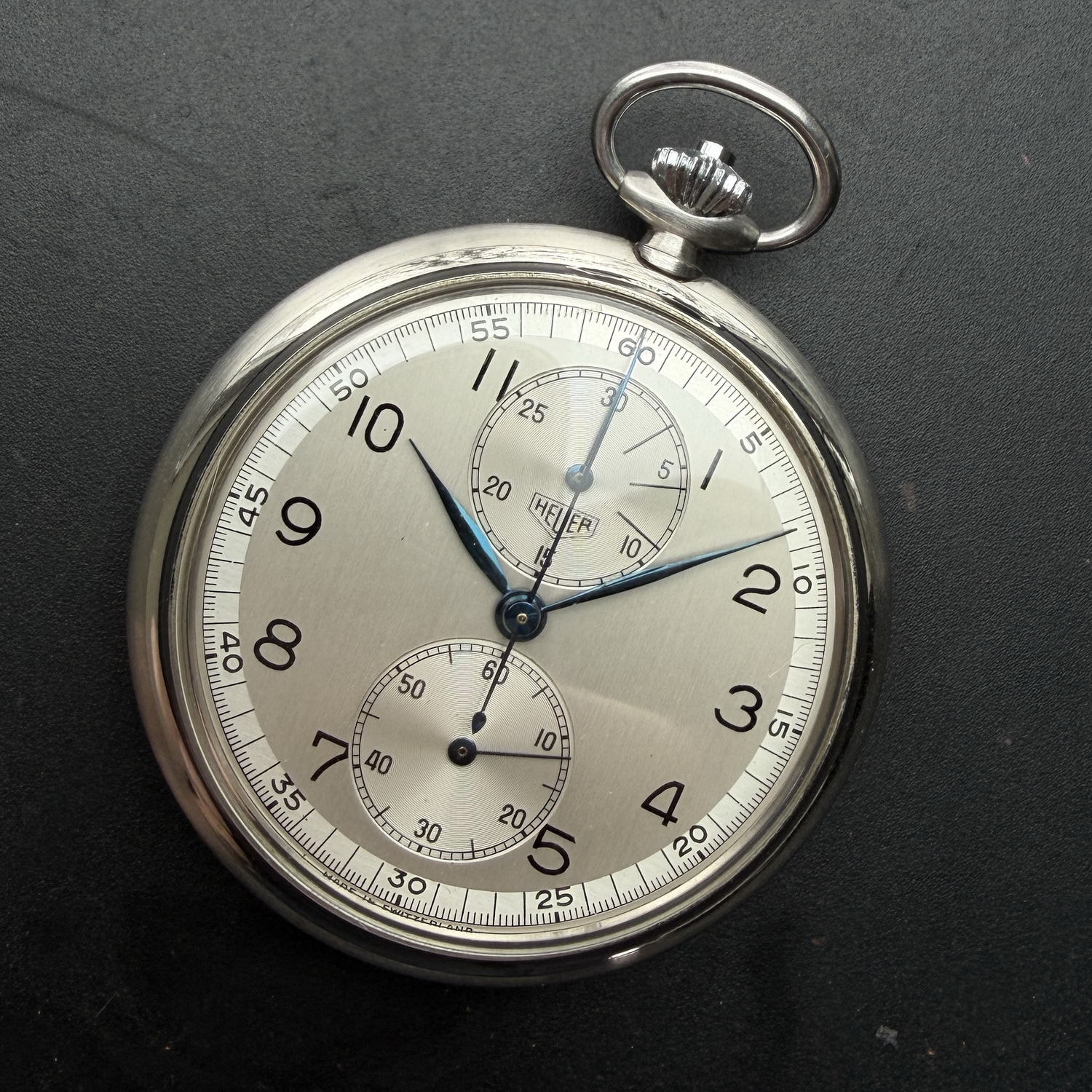
60. Pocket chronograph, Reference 701, from the 1940s — Heuer’s pocket (handheld) chronographs were standard equipment for races and rallies from the 1880s through the 1970s. I’m thrilled that someone brought this one to the Summit, to represent the category. The reference 701 had a long-production history, appearing in Heuer catalogs from 1936 through 1965.
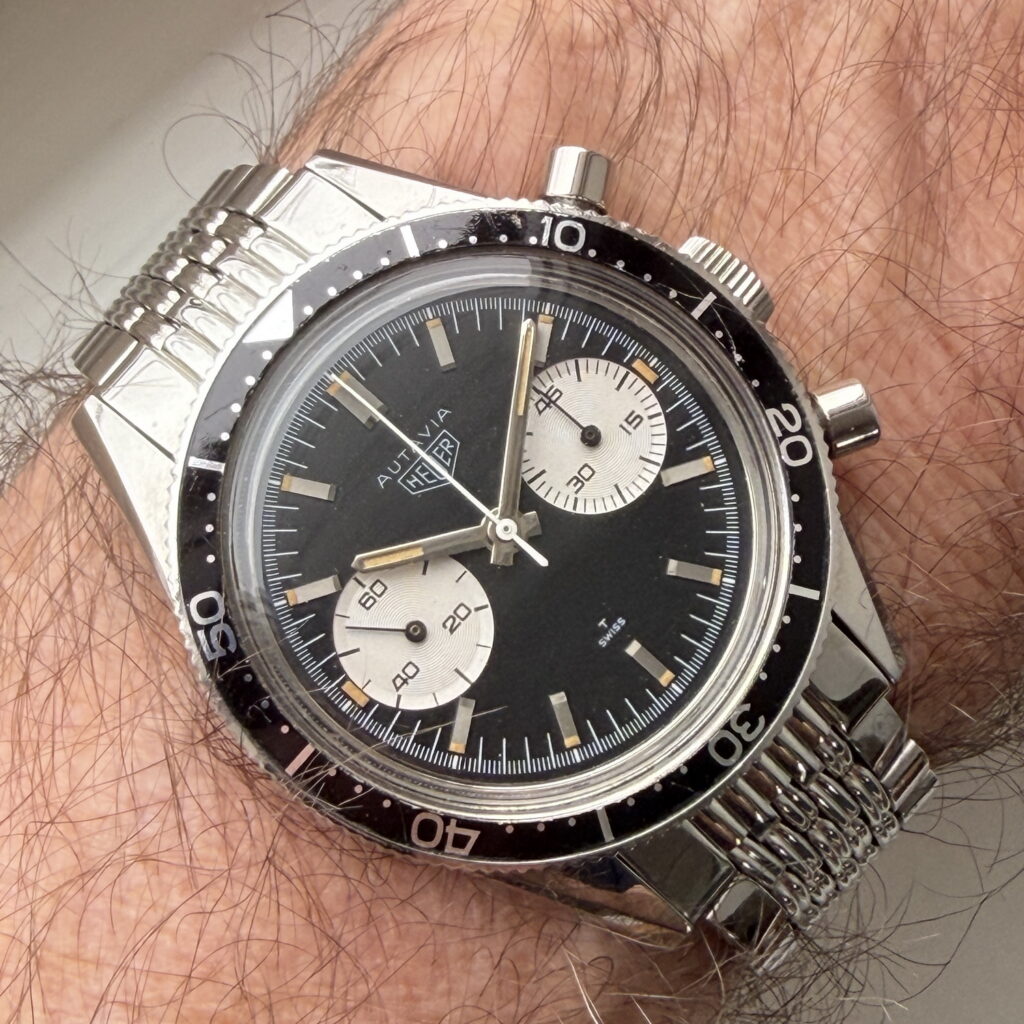
61. Autavia, reference 3646 M (1968) — The second execution case with the third execution dial is the Autavia that Mario Andretti wore; in fact, owned two of these watches, one with an hour bezel and one with a minutes bezel. We had two “Andretti” Autavias on the table; the watch shown here is the version with the minutes bezel. Watch 89 (below) is an Andretti with a tachymeter bezel.
62. Autavia, reference 1163, “White Orange Boy” — This version of the Autavia has cream dial with black registers and orange accents; a nice companion to the far more common black-dialed “Viceroy” reference 1163. The watch shown here has the very rare decimal minutes bezel and also the “German” Heuer bracelet, which has a micro-adjustment.
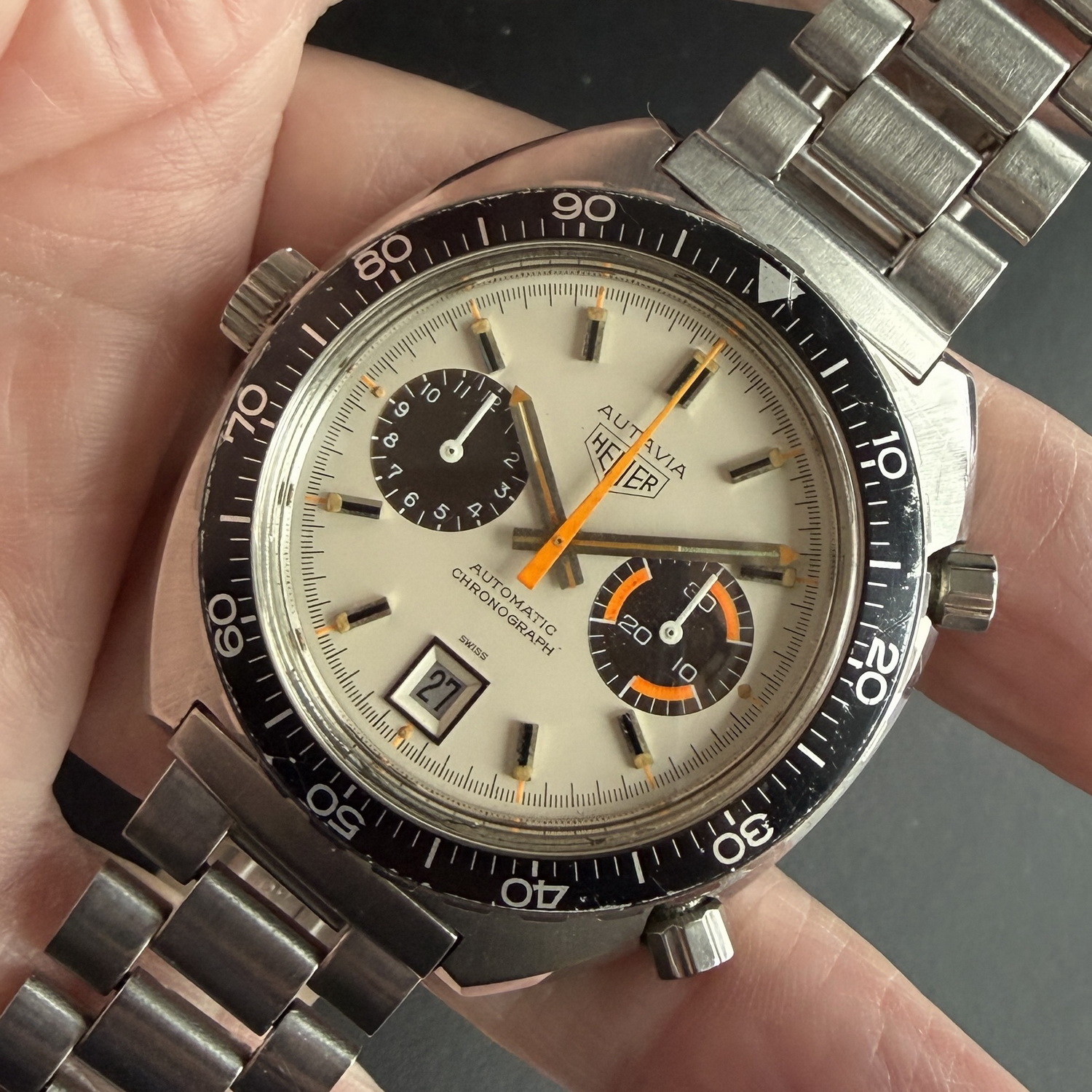
63. Autavia, reference 1163 GMT, second execution (1970) — The “Mark 2” version of the 1163 GMT has even numbers on bezel, brushed steel hands, and red hands on chronograph recorders. Two of these attended the Summit.
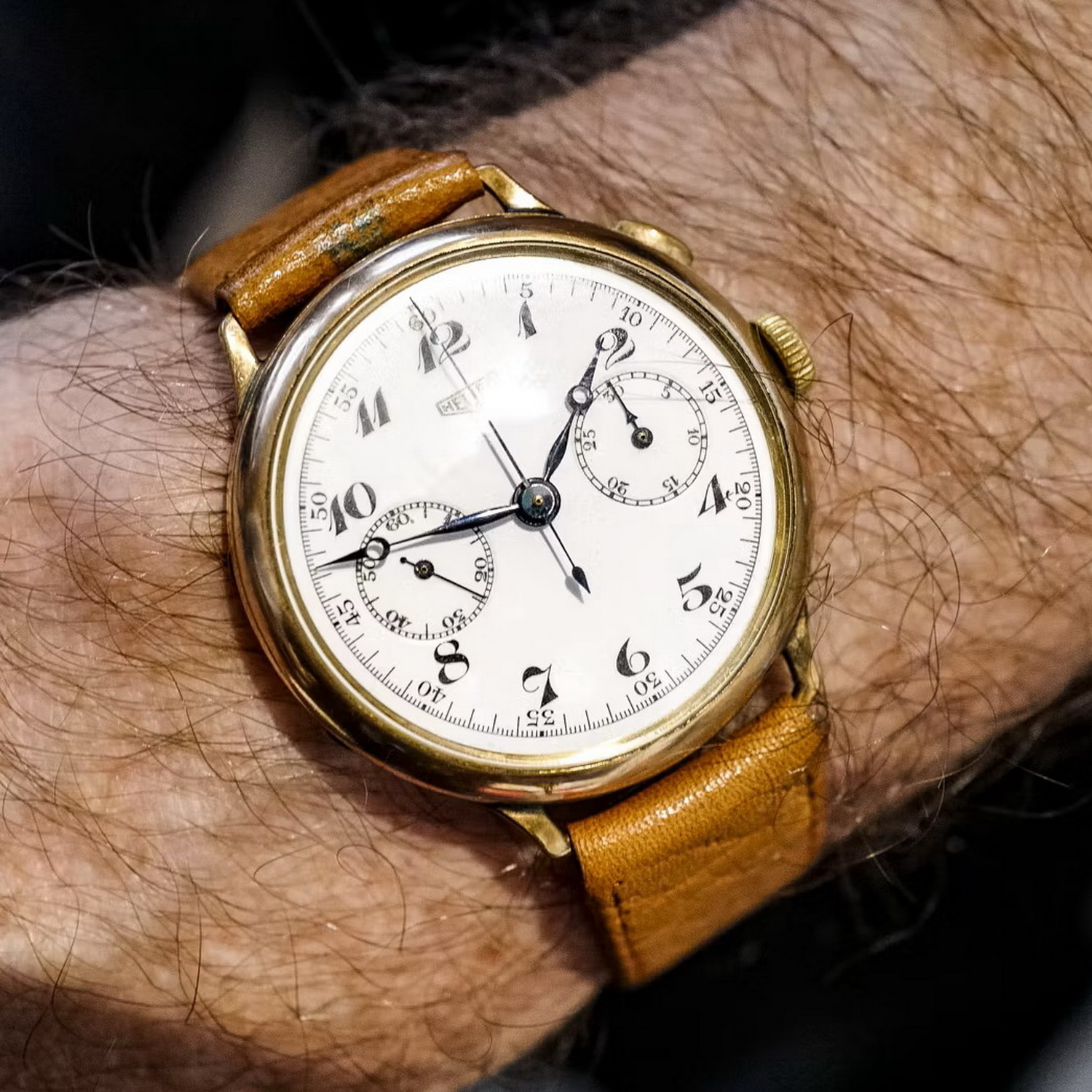
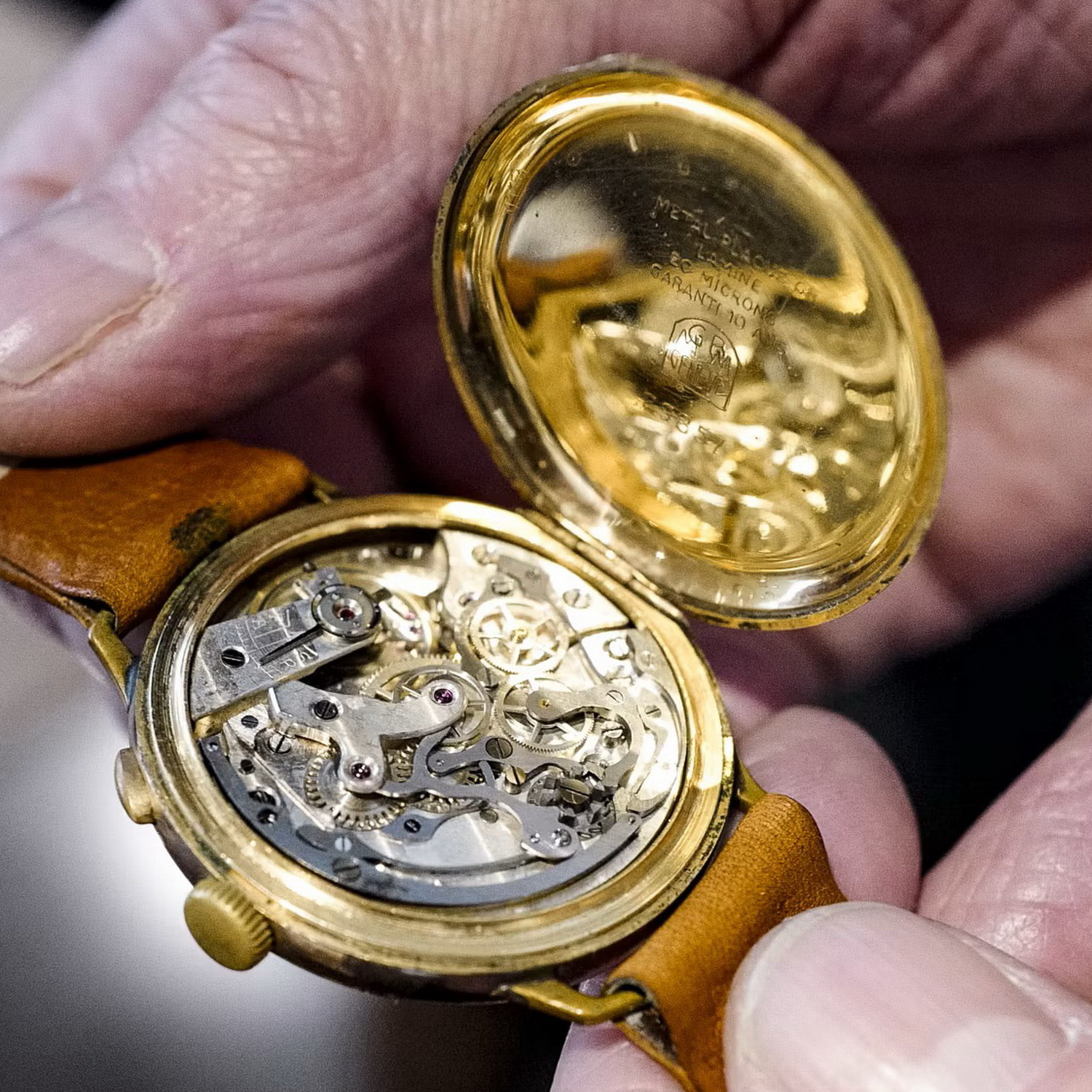
64. Gold-plated chronograph, with Valjoux 22 movement (1935) – This gold-plated model was a fine way to represent the 1930s Heuer chronographs.
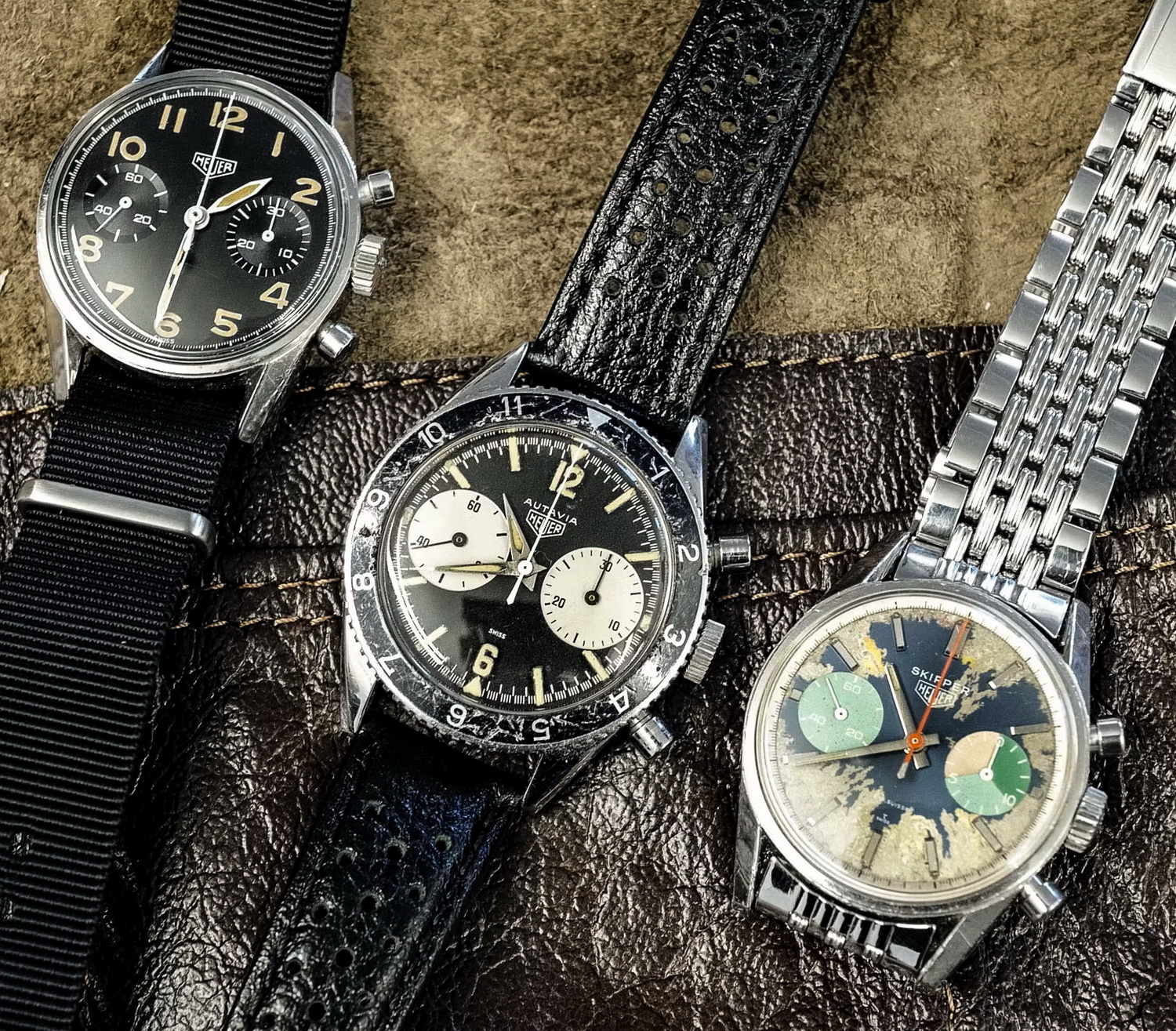
65. Carrera 30, reference 7753, made for the Belgian Air Force (1970) — The unique model that Heuer produced for Force Aérienne Belge had painted Arabic numerals, a black inner bezel and “Bund” style hands); one of the most distinctive (and handsome) of the 1960s Carreras.
66. Autavia, reference 1163, with orange test dial — We had two chronographs with “test dials” on the table, the wild looking Monaco (watch 11, above) and this Autavia with a bright orange dial and white registers. This Autavia also has a high-beat movement (28800 VPH) that Heuer must have been experimenting with, as discussed in this posting. This Autavia, owned by Peter Moller, is another of the community favorites.
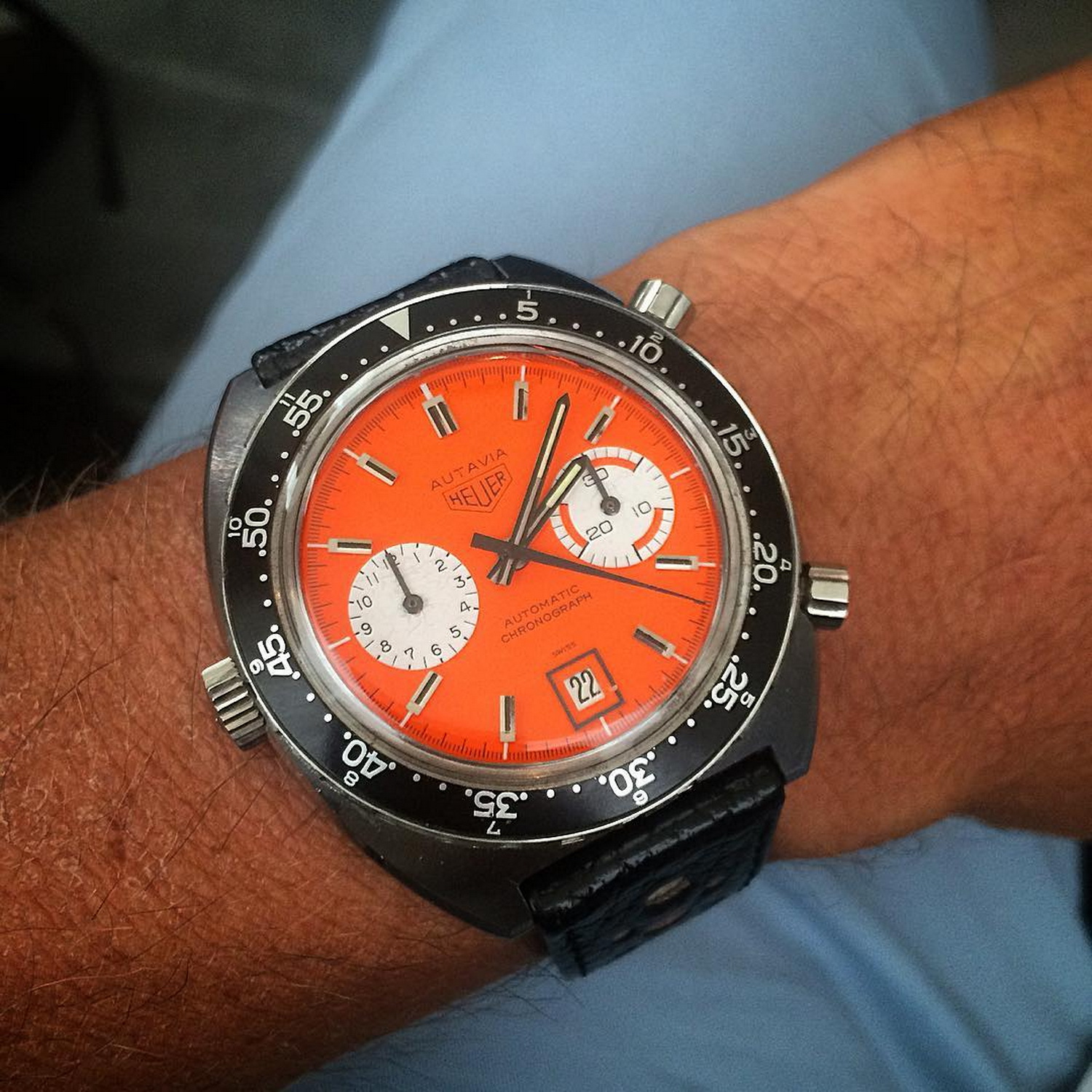
67. Autavia, reference 3646, first execution dial, second execution hands (1962) — With this, we had both the two and three register “Big Subs” Autavias on the table. This one is slightly later than watch 19 (above), which has the first execution (all lume) hands.
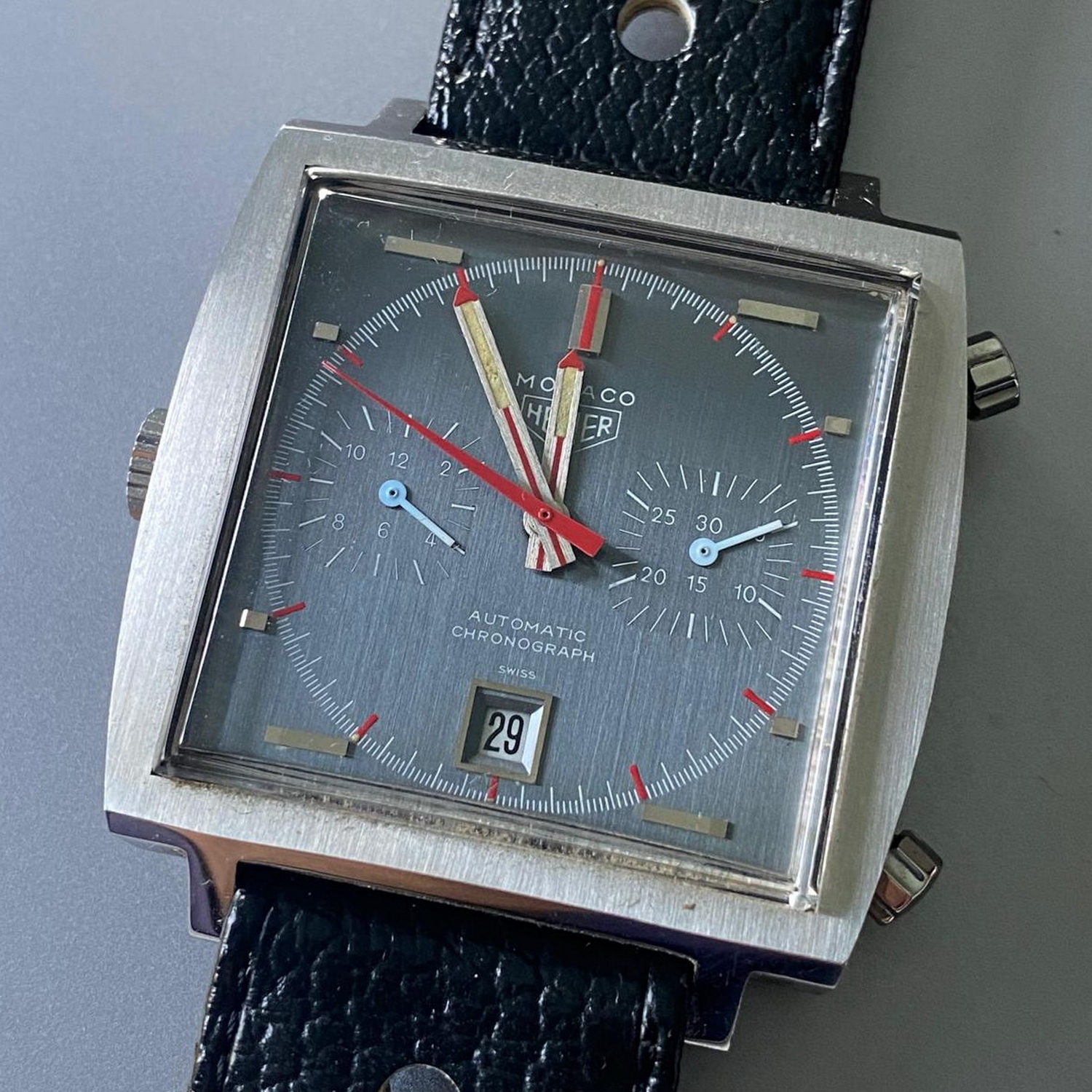
68. Monaco, reference 1133 G, first execution (1972) – On the first execution of the gray automatic Monaco, both the dial and registers are a metallic gray; the second execution would have darker registers.
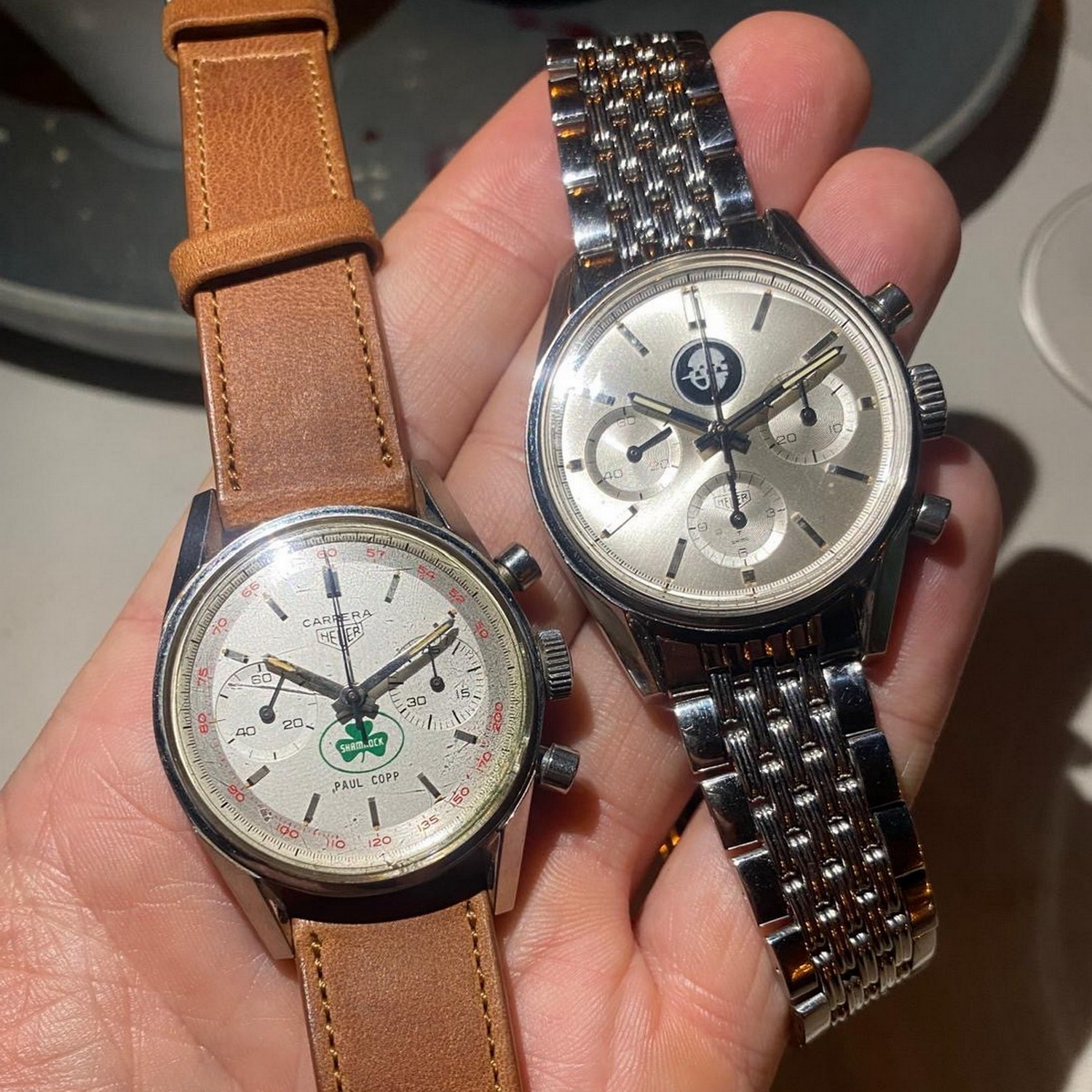
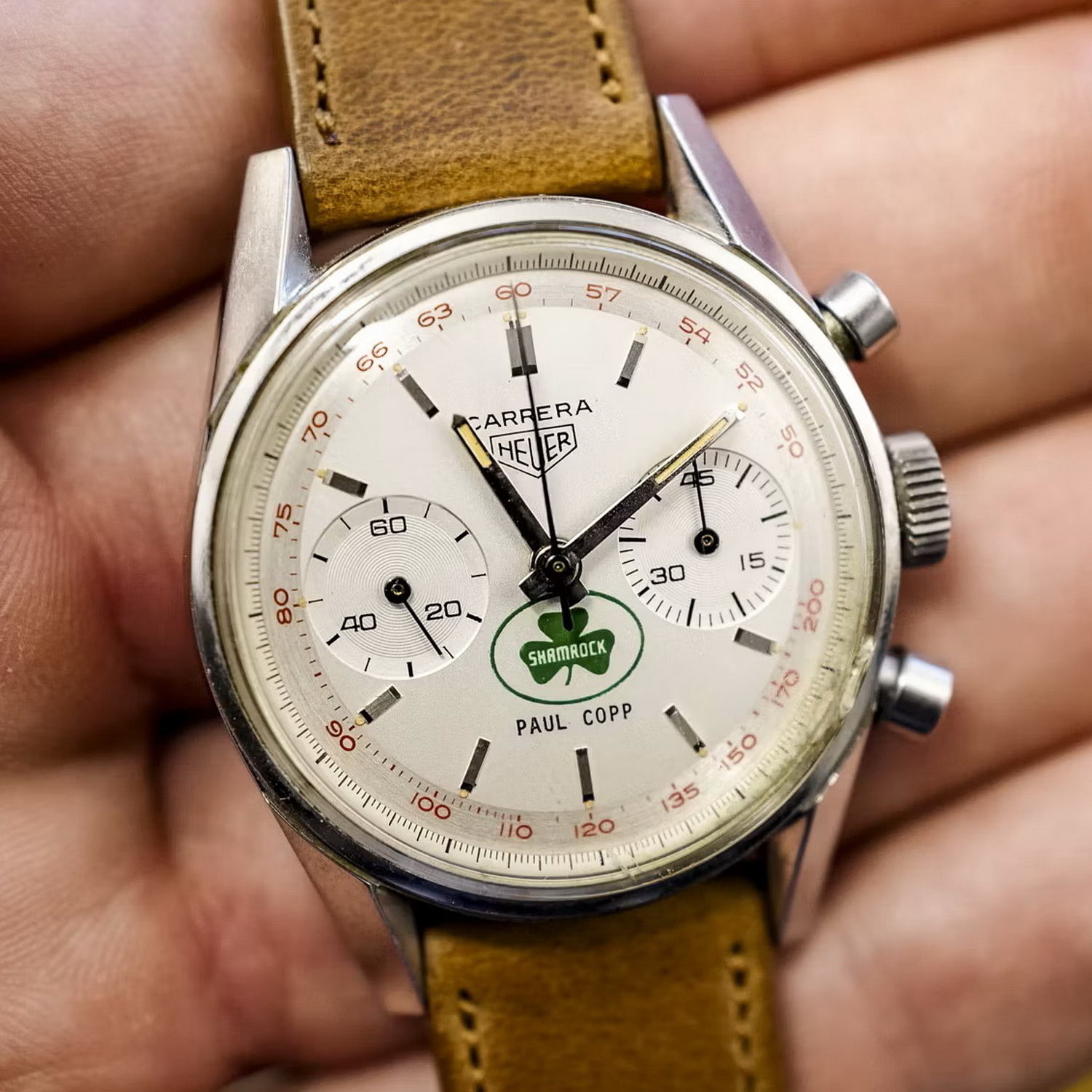
69. Carrera 45, reference 3647T, first execution, with “Shamrock Oil” logo and the name “Paul Copp” printed on the dial (1964) – Vintage Heuer collectors love the mysteries, and the “Shamrock Oil” and “Paul Copp” printed on the dial have yet to be explained. Paul Capps was an executive of Shamrock Oil, but why did they have this dial printed for him. Yes, we love the mysteries!
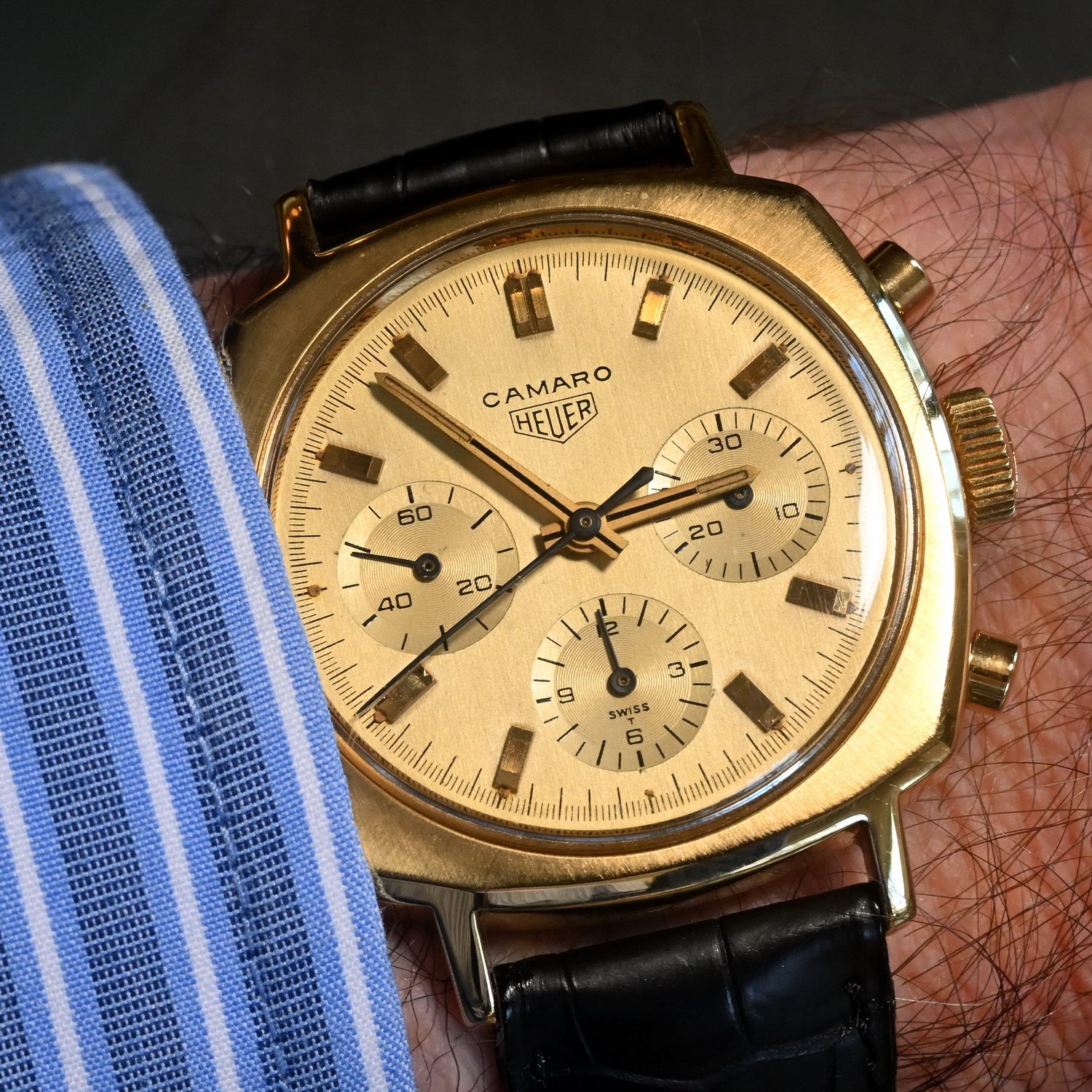
70. Camaro, reference 7228, 18 karat gold case (1968) – Most of the Camaros are stainless steel; a few are gold-plated; and a handful are 18 karat gold. The Camaro looks great with the champagne dial in the gold case.
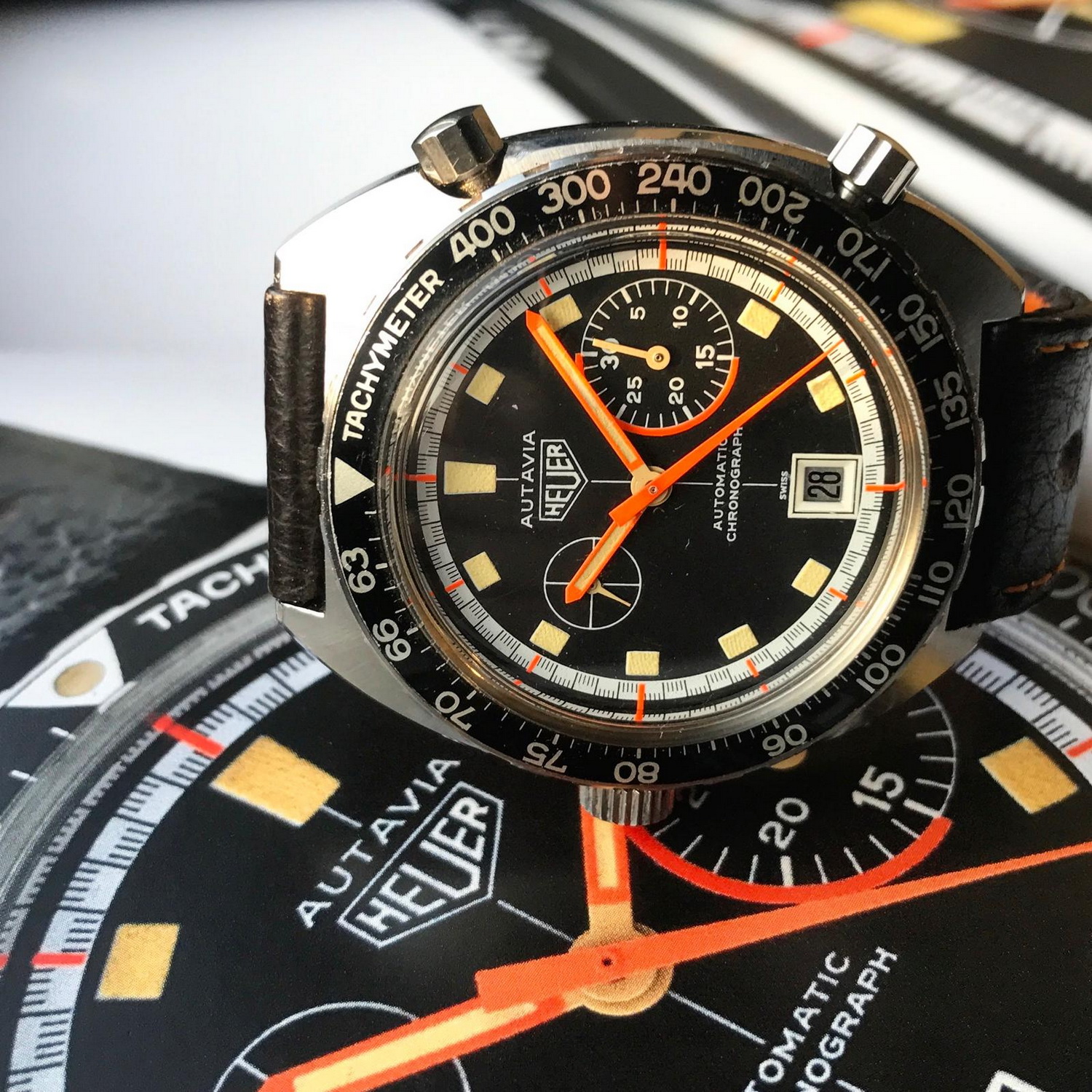
71. Autavia, reference 1563, “Exotic” dial (1972) – There were three on the table; this one looks great on the perforated racing strap.
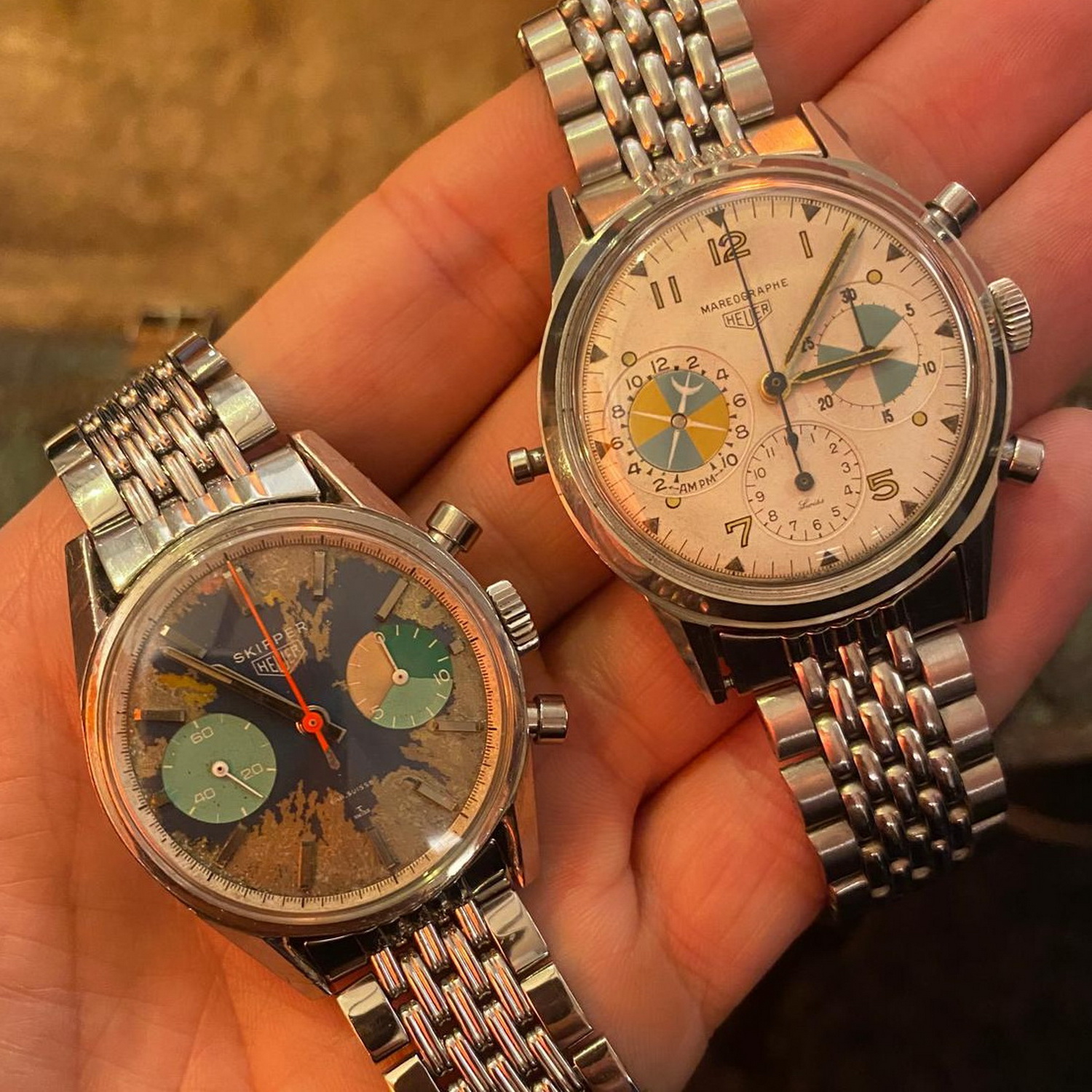
72. Skipper, reference 7754, “Skipperrera” (1968) – Most of the Skipperrreras have some paint loss on the dial; we can describe this watch by saying that some paint remains on the dial . . . but not much.
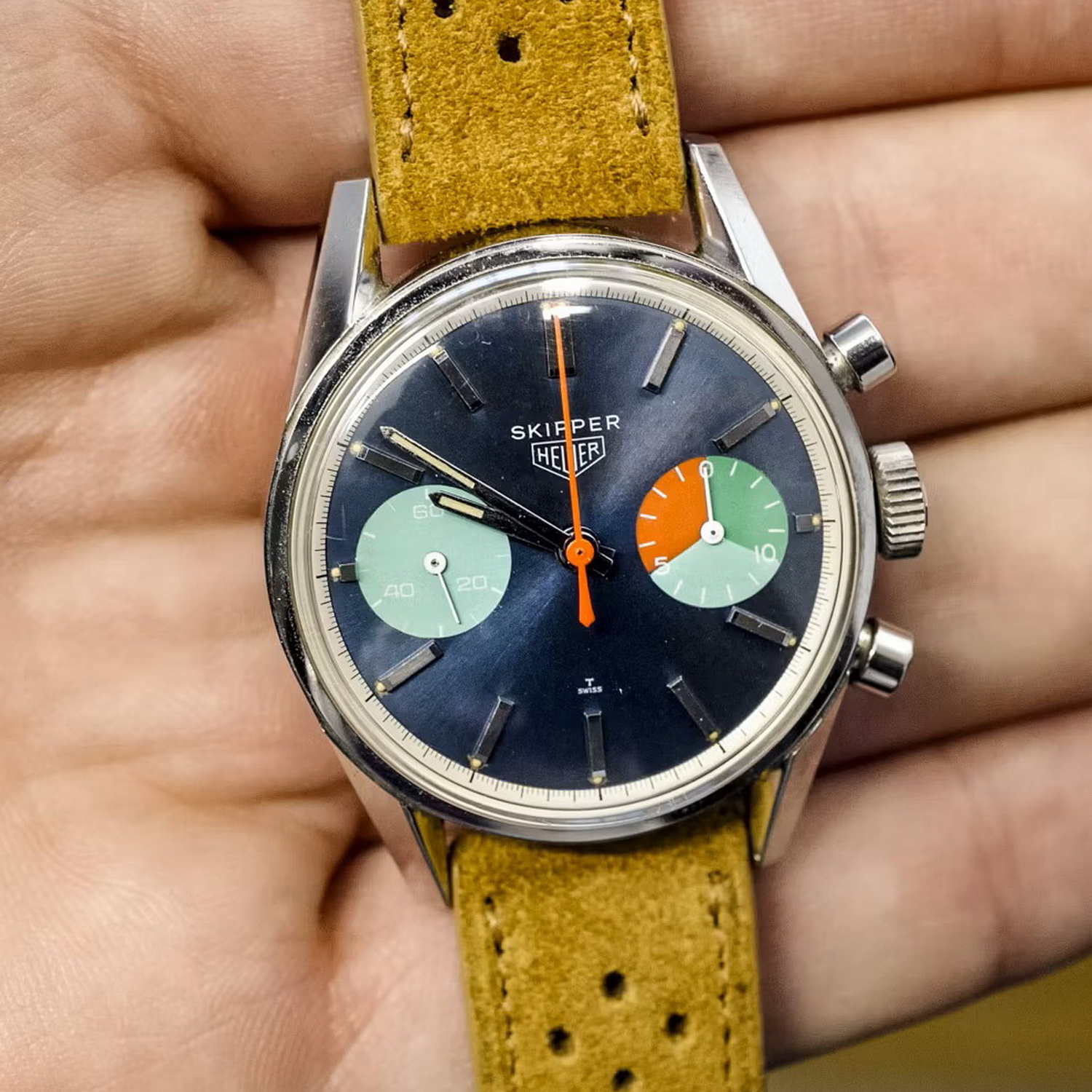
73. Skipper, reference 7754, “Skipperrera” (1968) – This Skipperrera is in better condition, and looks great on the perforated brown strap.
74. Abercrombie & Fitch Seafarer, reference 2447 (1963) – There are over a dozen versions of the Seafarer / Mareographe / Solunagraph, and if you ask vintage Heuer collectors to name a favorite version, this one probably wins. The blue and white colors of the Seafarer dial look perfect in the Carrera case.
75. Autavia, reference 2446C GMT Mark 4 (1968) — The final version of the compressor-cased Autavia GMT has polished steel hands with red inserts and tips.
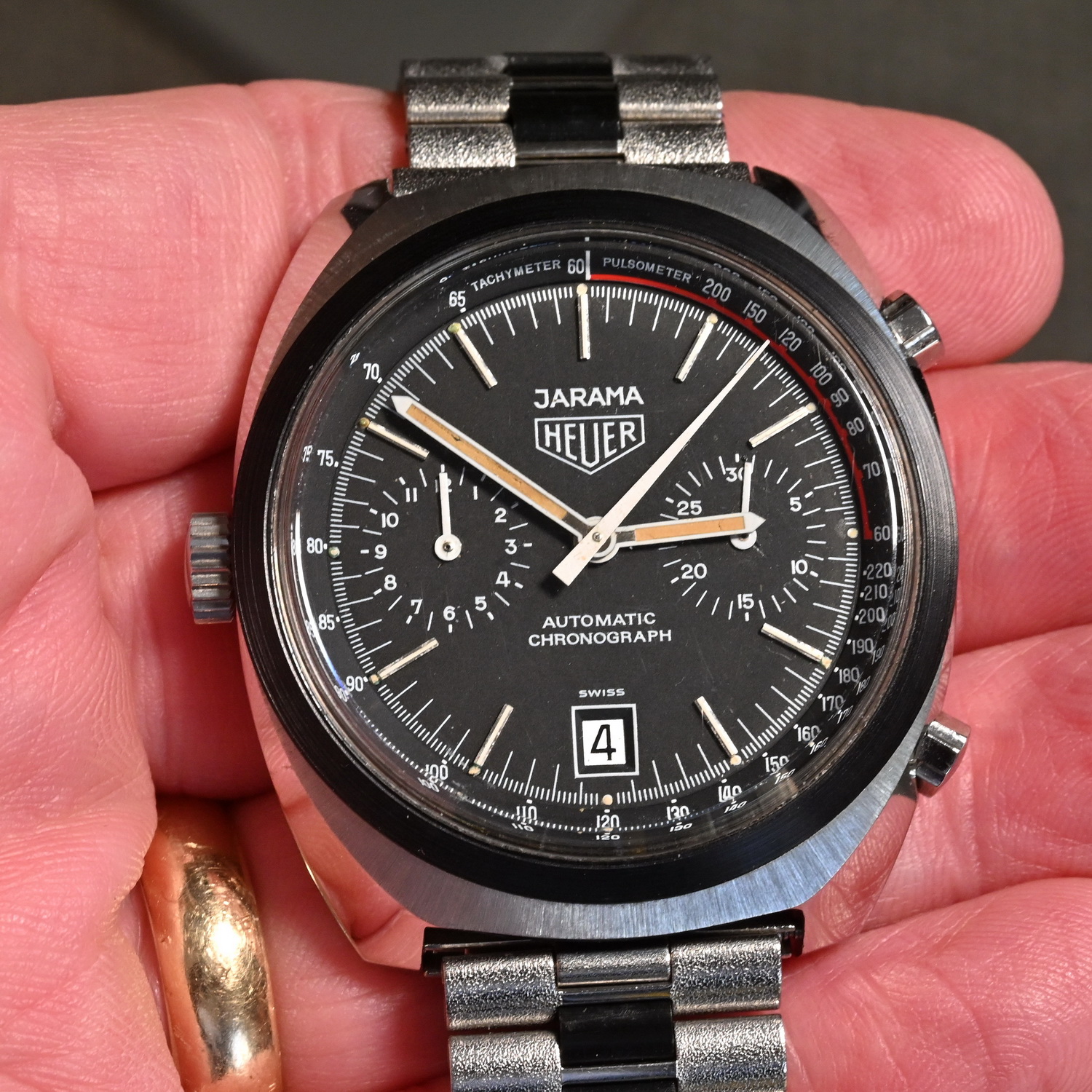
76. Jarama, reference 110.223 (1977) — Most versions of the Jarama are bi-metallic, with fluted yellow-gold bezels on stainless steel cases; this version has a smooth black bezel. This watch is a fine representative of the third generation automatic chronographs of the 1970s, Jarama, Cortina, Verona, etc.
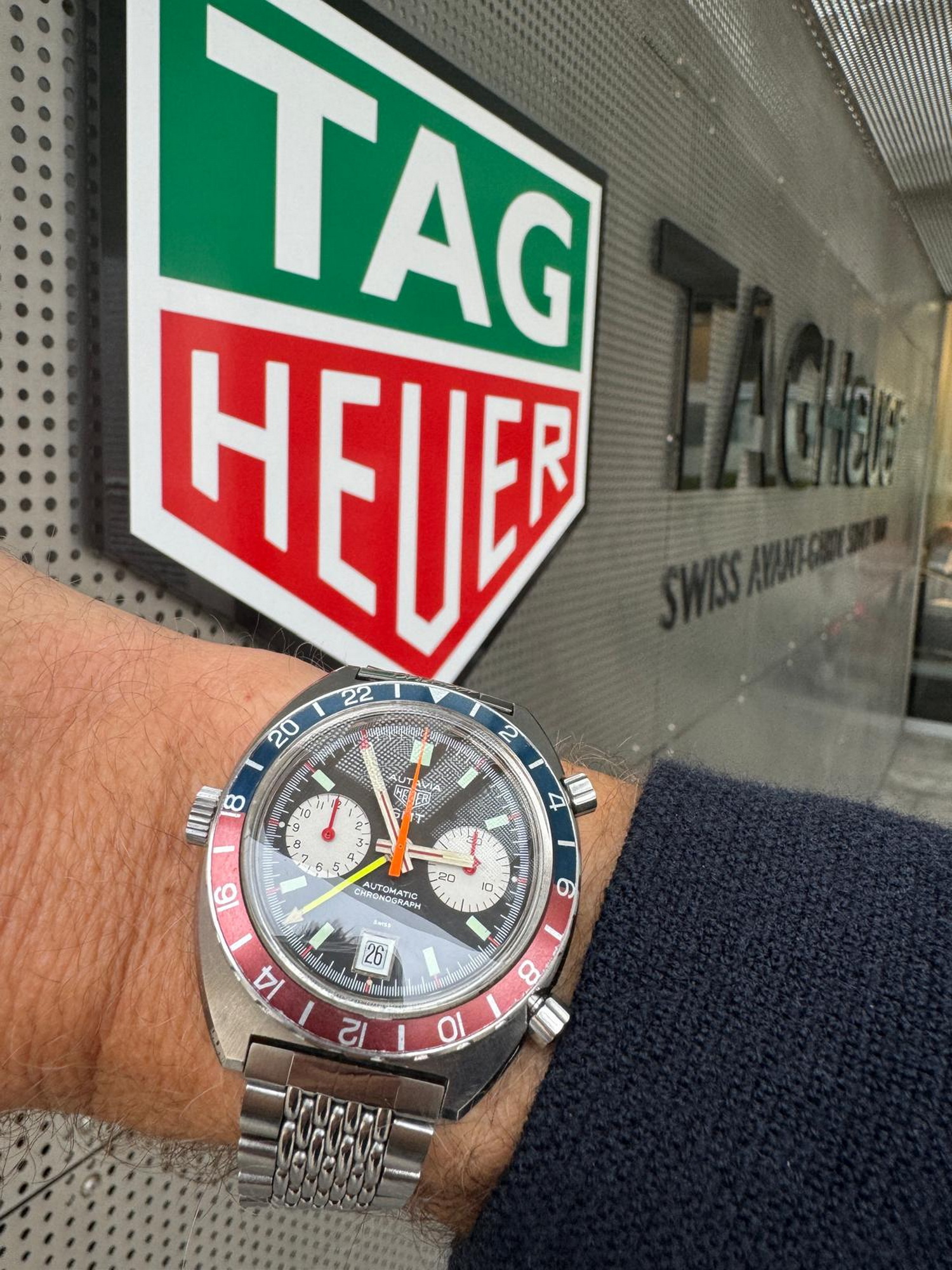
77. Autavia, reference 1163 GMT, second execution (1970) — Our second sample of one of the beloved Autavia GMT chronographs.
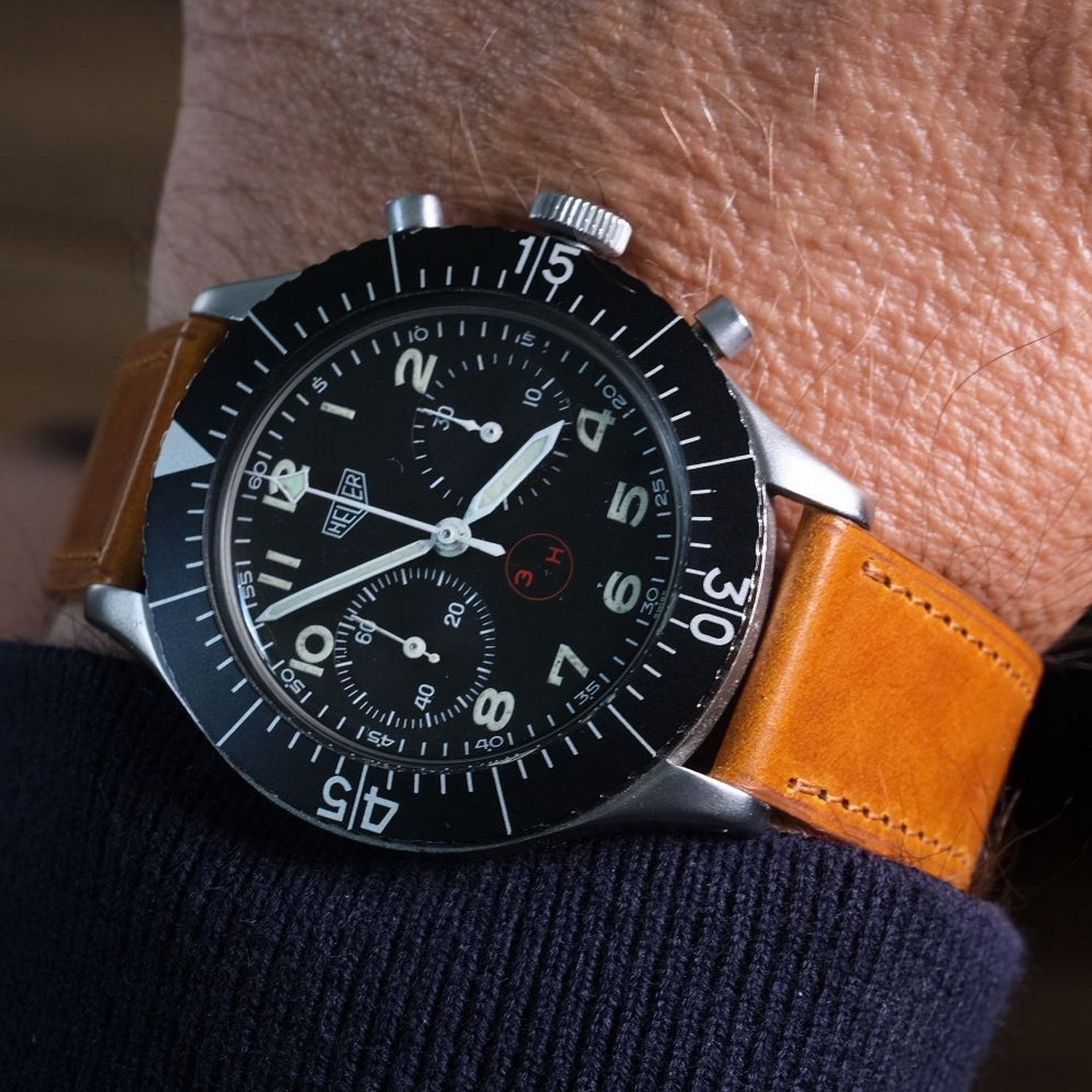
78. Bundeswehr chronograph, reference 1550 SG (1967) — another “issued” Bundeswehr chronograph, as indicated by the “3H” on the dial.
79. Carrera, reference 2447 SN (1970) — The “Panda” version of the Carrera (white dial, with black registers) is one of the grails.
80. Carrera, reference 2447 NST (1970) — Another sample of the Carrera worn by James Hunt, this one on a bracelet. Nice to see the Panda and the Reverse Panda, side-by-side
81. TAG Heuer Carrera, reference CBS2210 (2023) — This is the second generation “Glassbox” Carrera, a reverse Panda model with a black dial and silver registers. It’s the only watch on the table currently being produced by TAG Heuer.
82. Autavia, reference 2446 H, “Rindt” model (1970) — with this, we have three “Rindt” Autavias on the table.
83. Autavia, reference 1163T, “Siffert” model (1969) — Without Jo Siffert, where would we be? The Swiss Formula 1 and endurance racer put the Heuer logo on his car, he put the Heuer patch on his racing suit, and he put the Autavia on his wrist. Steve McQueen saw all this and wanted to look like Siffert when he chose his costume and watch for the movie Le Mans. “Siffert” colors for the Autavia refer to the bright white dial, with black registers and blue accents.
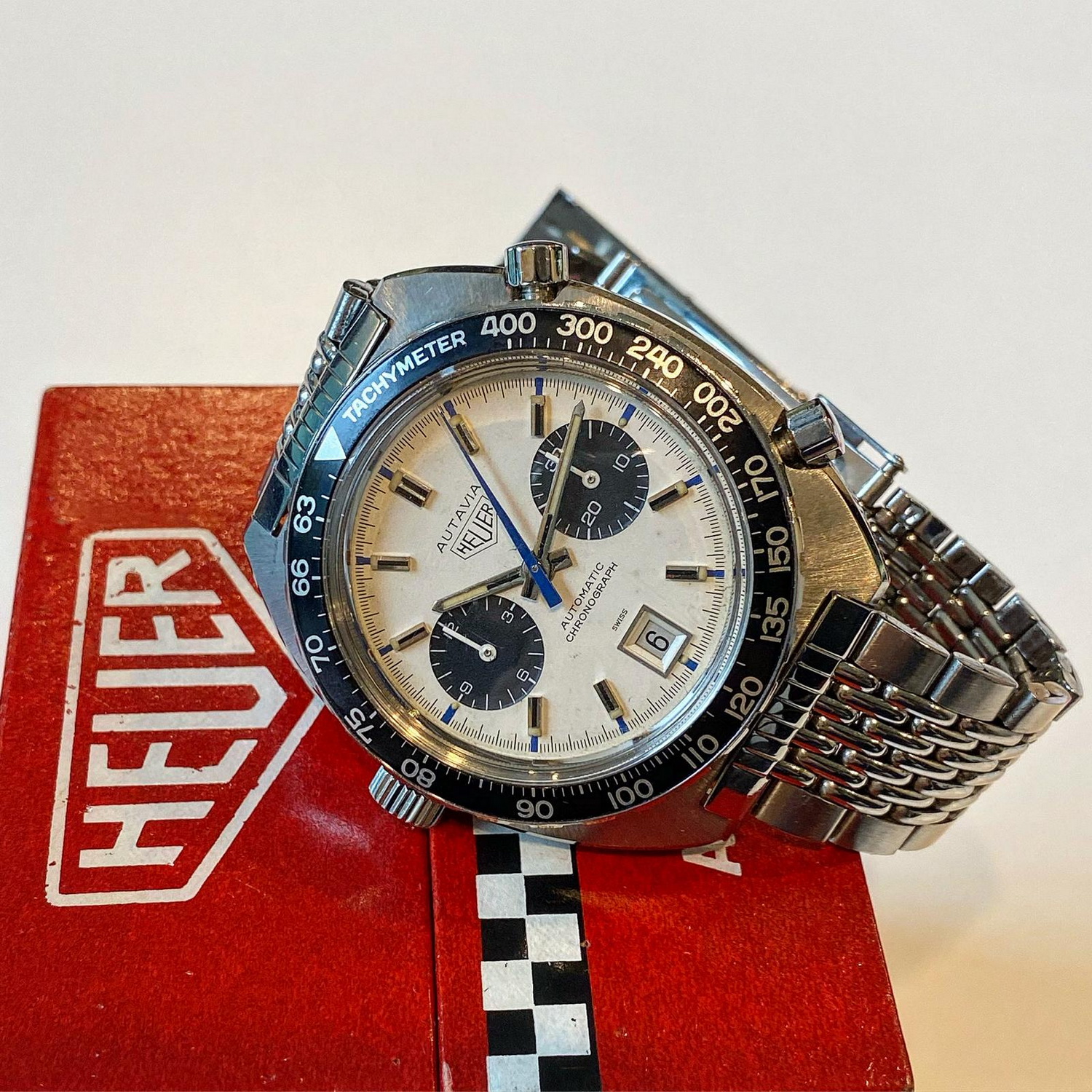
84. Monaco, reference 1533G (1972) — Heuer produced the Calibre 15 Monaco with two different dials, midnight blue, and this one in a silver / gray.
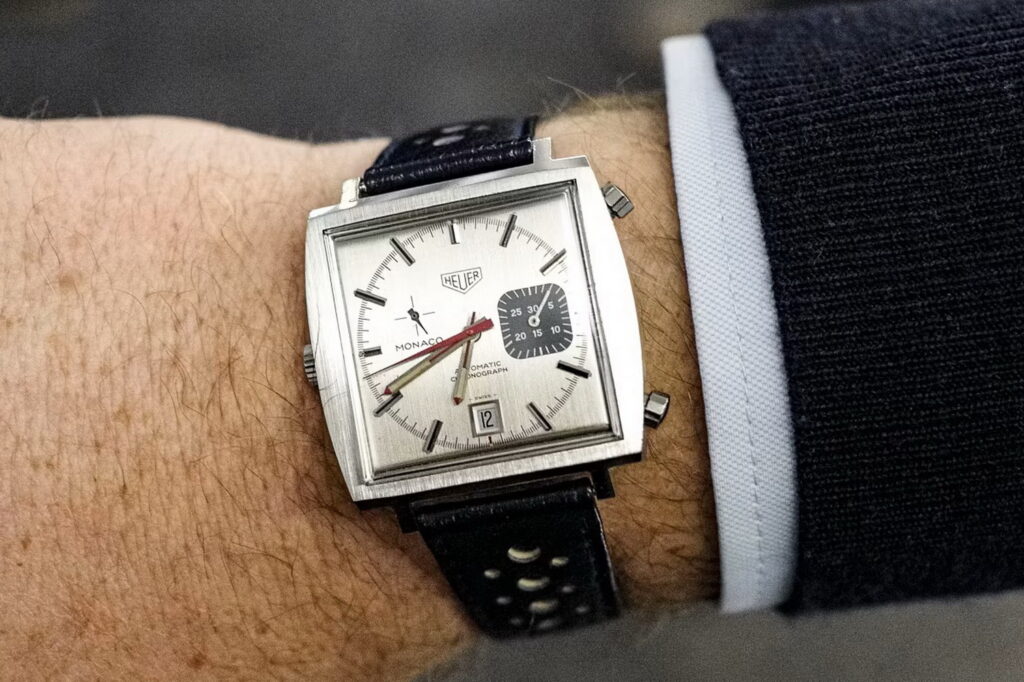
85. AC Signature MC09 Monaco (2024) — With the success of his first customized Monaco in 2023 (on the left), Abel Court offered his encore in 2024. This second version (on the right) was based on the Monaco reference CS2111, from 1998. The same amazing colors, but in a three-register dial configuration.
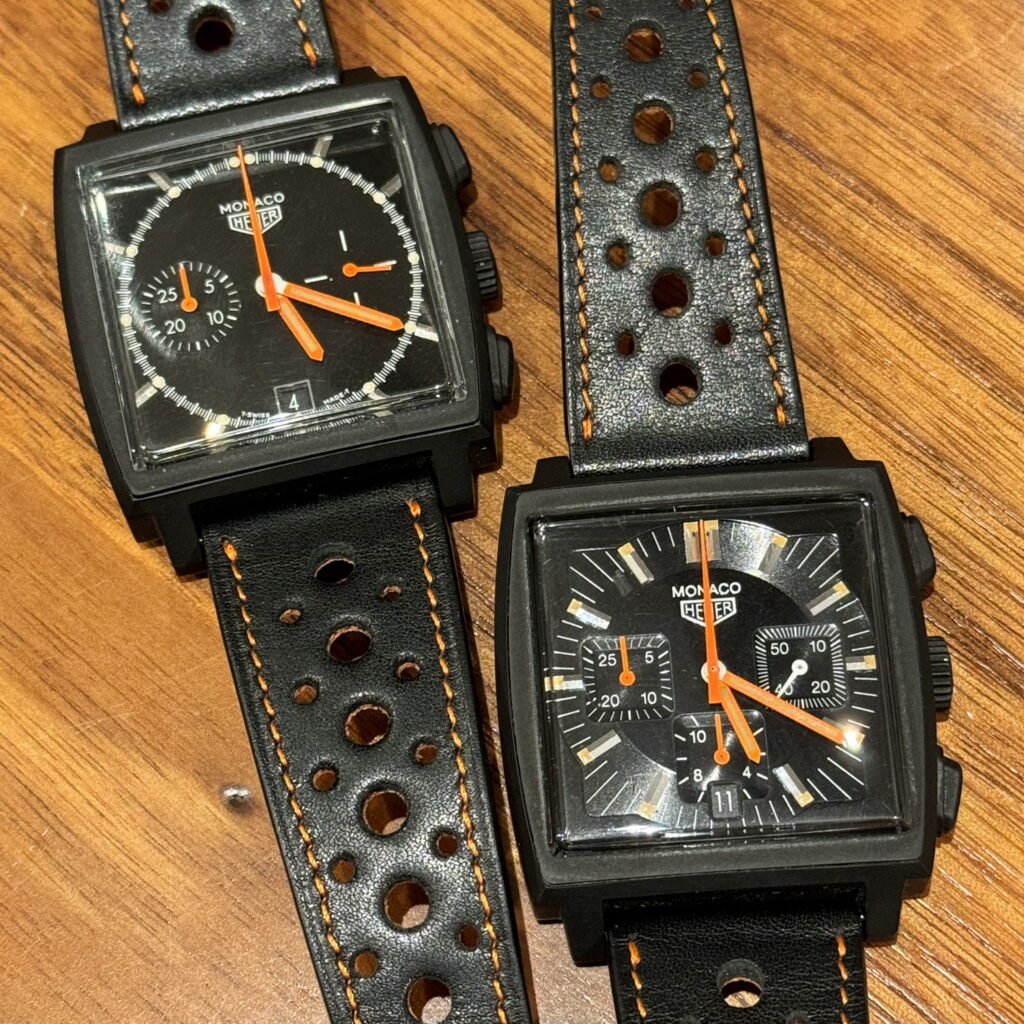
86. Autavia, reference 1563, “Exotic” (1972) – with this, we had three “Exotics” on the table.
87. TAG Heuer Monaco, customized by Bamford Watch Department — With George Bamford attending the Summit, we had a nice variety of customized TAG Heuer chronographs on the table.
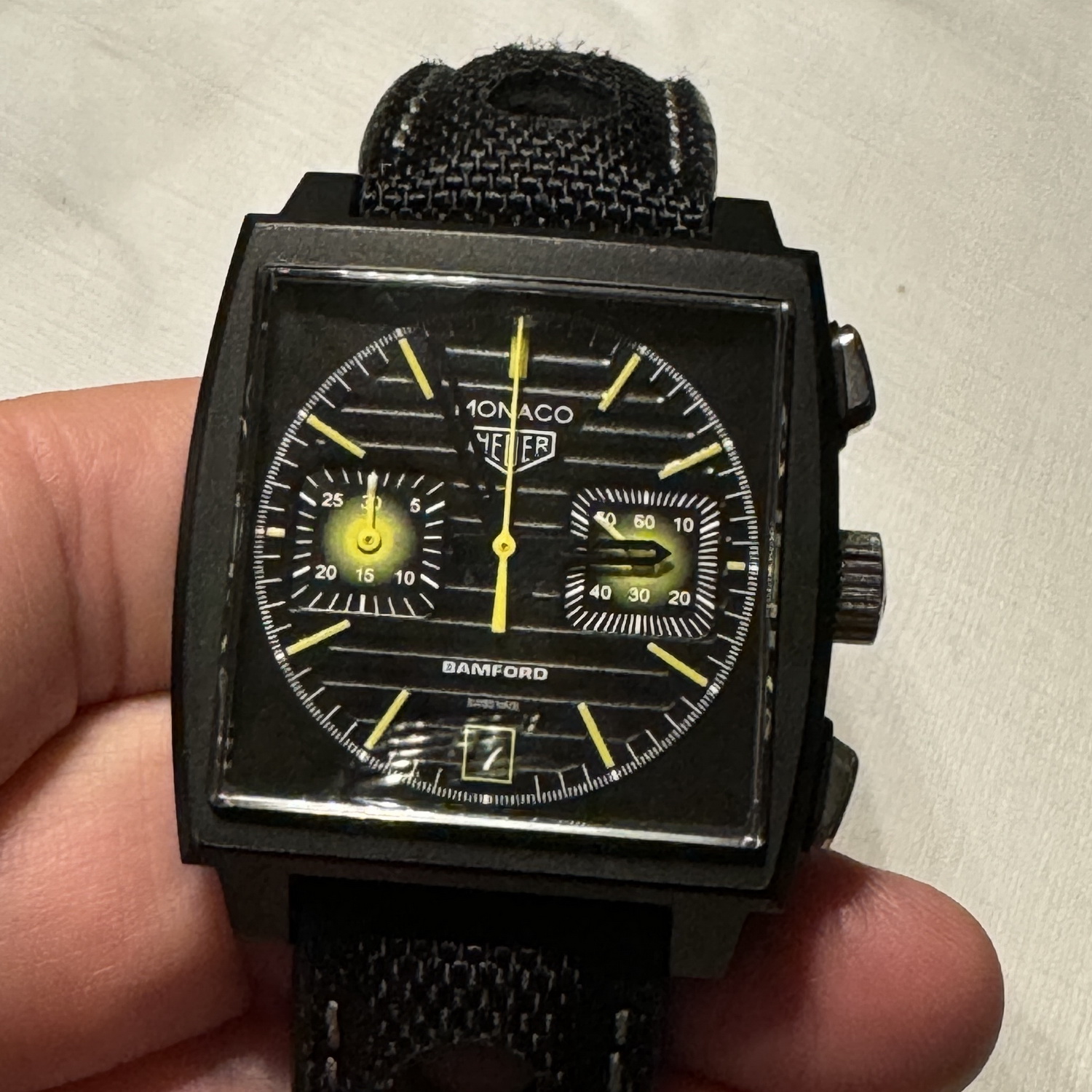
88. Autavia, reference 741603 GMT (1974) – This is the only version of the C-shaped Autavia GMT with a manual-winding movement. We expected the 2446 GMTs, the 2446C GMTs and the 1163 GMTs; the super rare reference 741603 GMT was a pleasant surprise.
89. Autavia, reference 3646 T (1968) — This Autavia, with the second execution case and third execution dial, was one of the ones worn by Formula 1 and Indy 500 champion, Mario Andretti. See also watch 61, above.
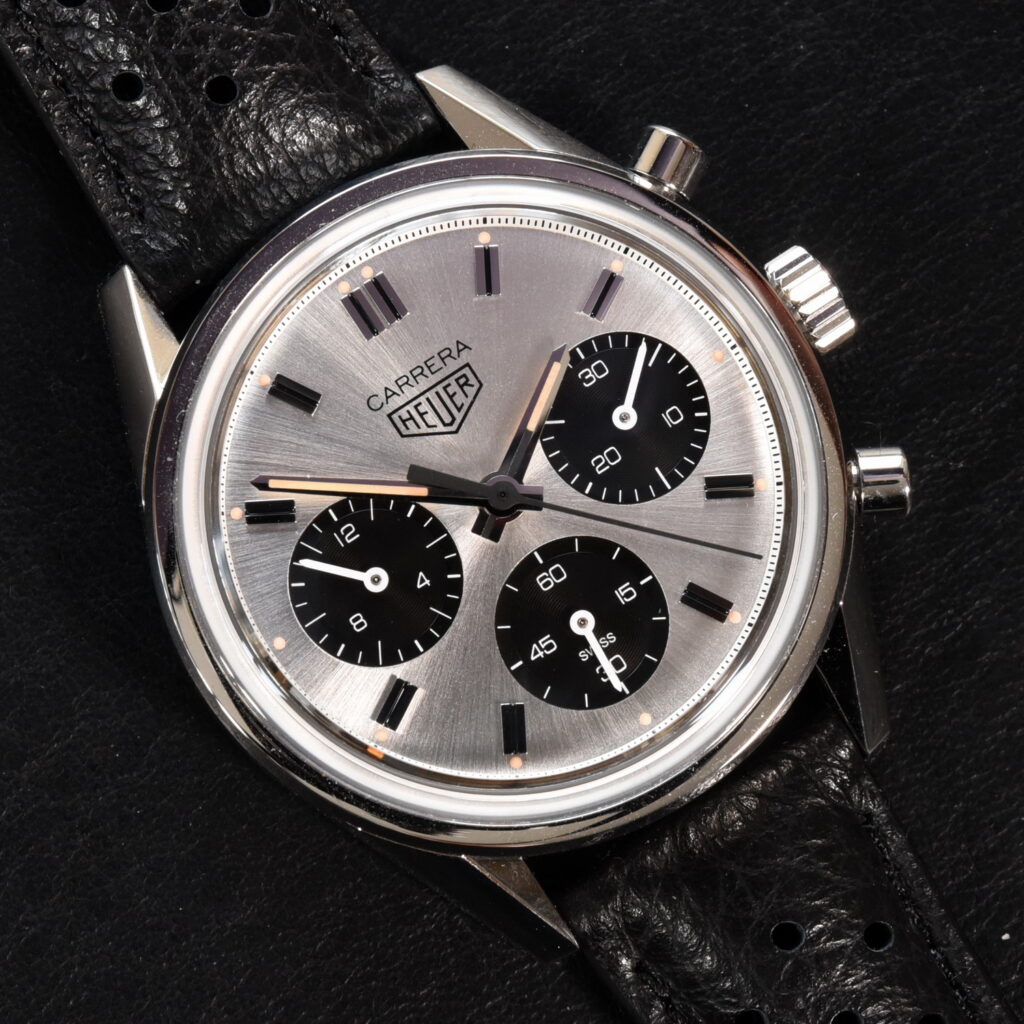
90. TAG Heuer Carrera, 60th Anniversary Limited Edition, (2023) – From 2015 to 2023, TAG Heuer produced 10 models of the “first generation” Glassbox Carrera. Most collectors believe that the company saved the best for the last with this “Panda” model (reference CBK221H), which sold out quickly as a Limited Edition of 600 watches.
Impressions of the 2024 Summit
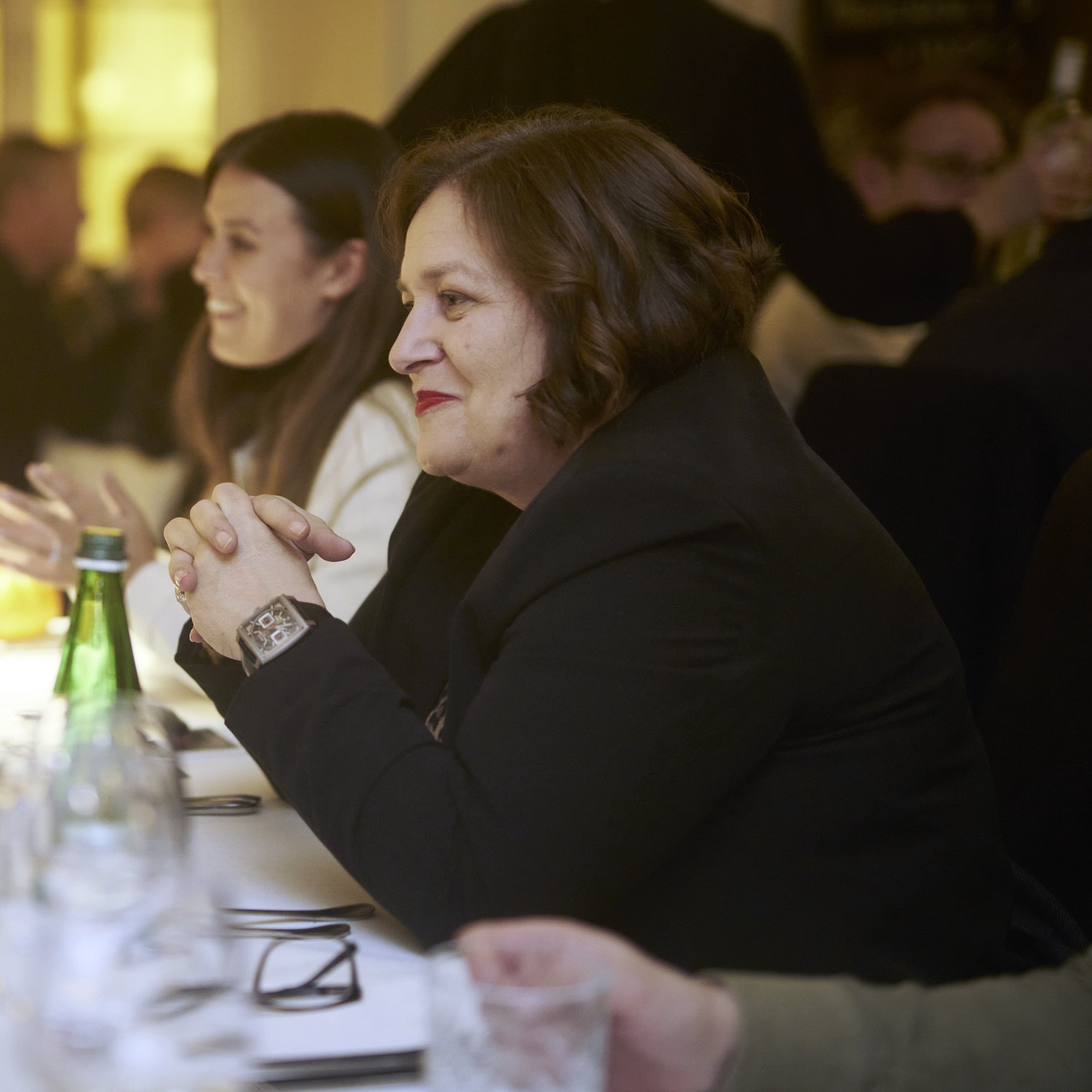
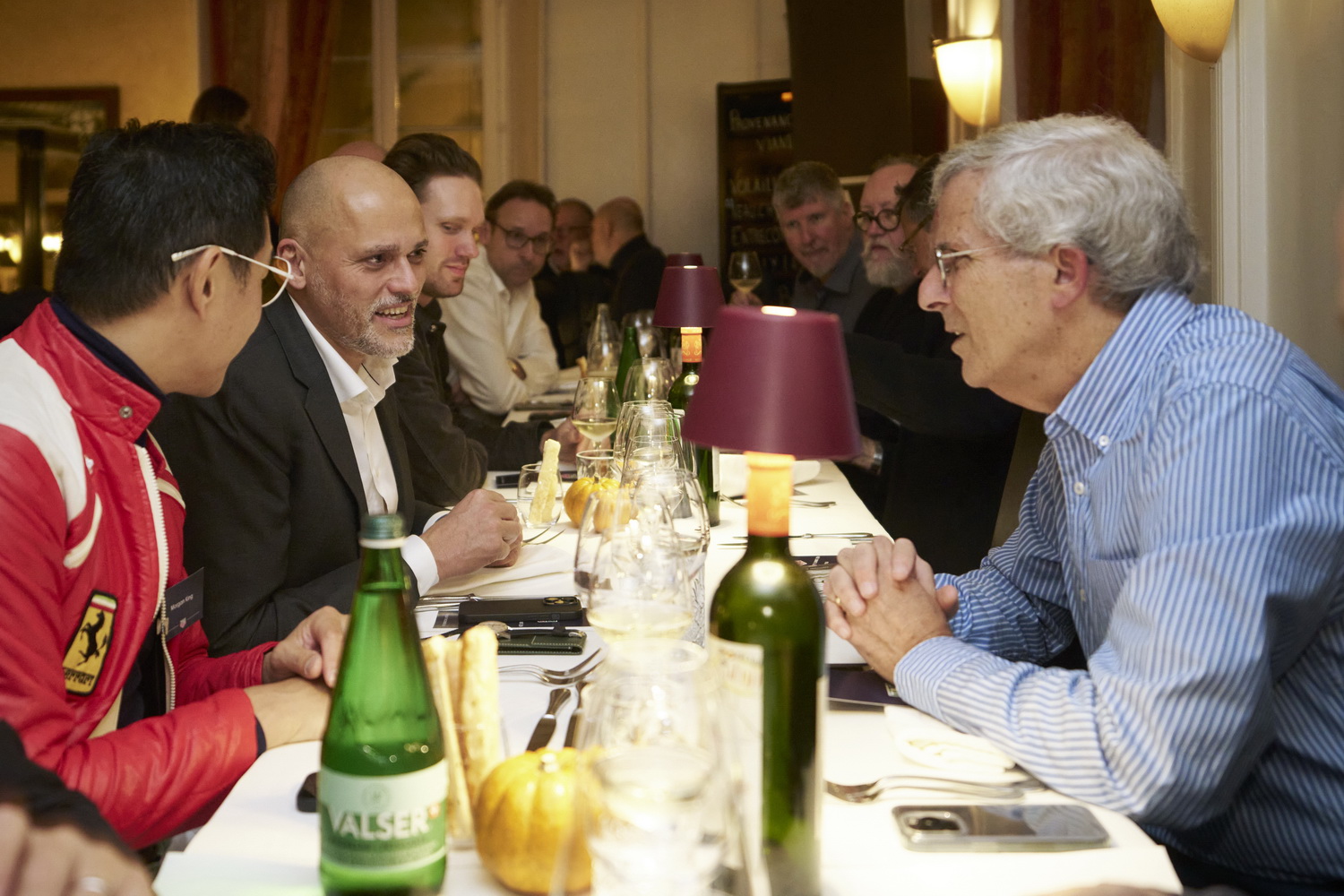
The magic of the Summit came in the collectors spending time with each other and with members of the TAG Heuer team. Collectors spent a lot of time together, sharing their passion for the brand and swapping stories of their collecting adventures.
The event organizers at TAG Heuer suggested that the collectors bring only a very limited number of watches to the Summit, so most of the collectors were “traveling light”, bringing only a handful of watches. Still, it’s fair to say that while the collectors brought a limited number of watches, the watches that they selected to share with their fellow collectors were exceptional. We saw many interesting models, in exceptionally good condition, and many came with interesting back stories – how they were produced by Heuer, the lives they had lived, how they came to be acquired.
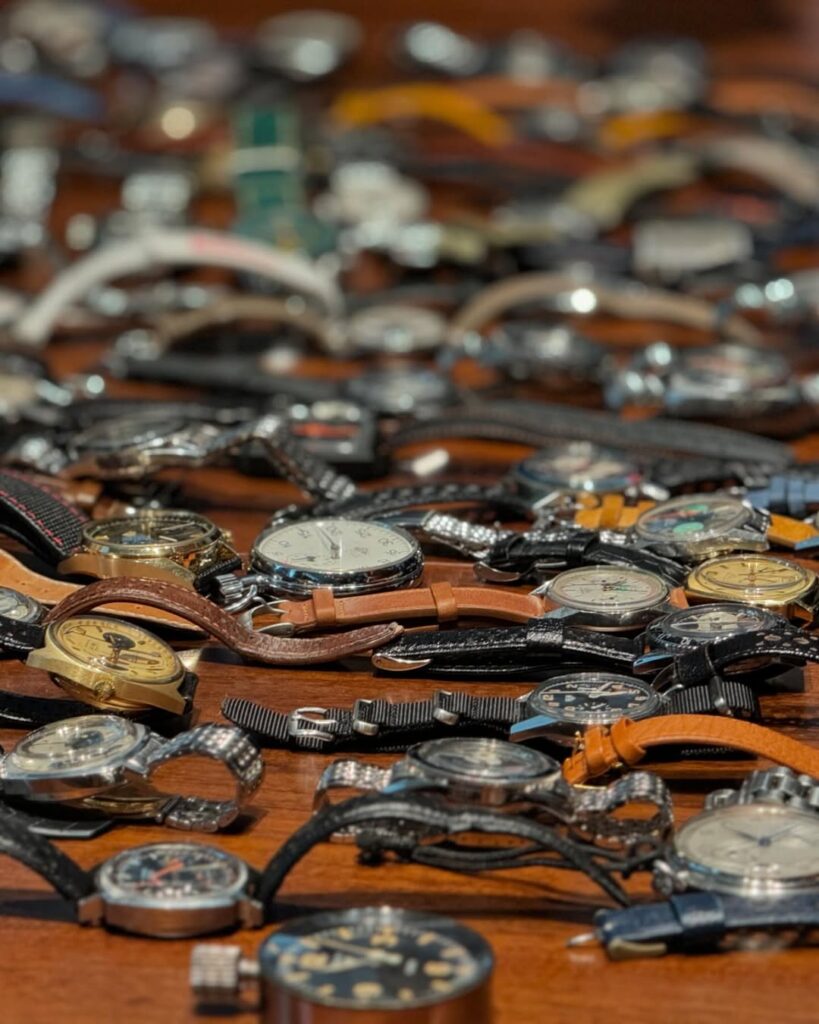
All this explains the magic of the Table Shot from the Summit. With no advance planning and no attention to how the watches were arranged, this photo captures the energy and variety of the vintage Heuer community, its collectors and their watches — Heuer and TAG Heuer; steel and gold; for the wrist, the pocket and the dashboard; some fully documented and others cloaked in mystery; watches from eight different decades. 90 watches from 30 collectors, all rallying around our beloved brand and celebrating its heritage – we shared our watches, we told our stories, and we enjoyed three magical days with our friends.
Our Most Task-Repetitive Posting
So there we have it, folks. I opened this posting with a confession regarding my (occasional) enjoyment of repetitive tasks, and after writing blurbs covering all the watches that were on the table and incorporating almost 100 photos, we have one of the longest postings in the 23 year history of OnTheDash . . . just over 5,300 words. And, yes, every one of those tasks was a thrill!!
The content management system that powers this site tells me that this posting has gone through 124 revisions and that it will take the average reader 28 minutes to get through it. (Mercifully, the CMS does not tell me how many hours I worked on it, from start to finish.) Here’s hoping that the biggest table shot in the 166 years of the Heuer brand will bring back some good memories for the collectors who attended the Summit and that it will inspire other collectors to pursue their passion for these fantastic watches.
Thank You
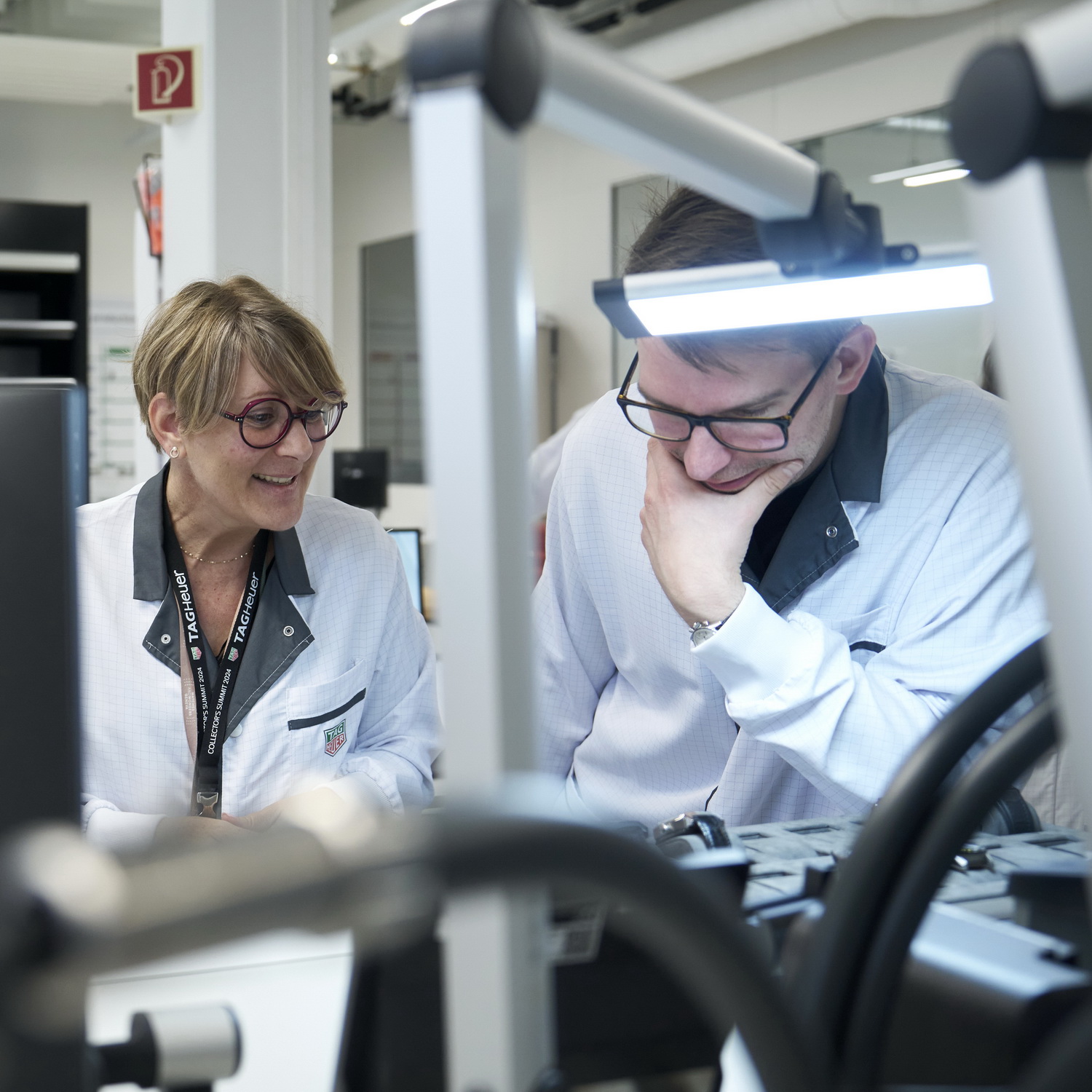
Thanks to our wonderful hosts at TAG Heuer — we appreciate your tremendous hospitality and your passion for our old watches and the Heuer heritage, and we are super excited about the new ones that you are creating!!



Thanks to all the collectors who participated in the Summit, and especially those who provided the information and photos that we included in this posting.
Thanks also for your patience as I prepared this posting . . . it’s been 455 days since the 2024 Summit, but with each passing day, we are getting closer to the 2026 Summit! Think of this posting as the “pre-game” pump-up for the next Summit.
Jeff Stein
February 11, 2026